TL;DR
- Compare cost per resolved call, not cost per minute. A failed AI call that ends with a human costs you twice.
- An AI call center on ElevenLabs has run costs (agent minutes, language model, telephony), one-time build costs and ongoing ownership costs. Budget for all three.
- AI pays off fastest against onshore teams, after-hours gaps and high-volume simple calls. Against a cheap offshore team, it only wins if it resolves enough calls on its own.
- Use the formula in this post with your own numbers before you sign anything.
Your vendor quoted a per-minute rate. Your CFO wants to know what a resolved call costs, and the two numbers don't connect.
That gap is where most AI call center business cases fall apart. A per-minute price tells you what the AI costs while it's talking. It says nothing about the calls it can't finish, the human who picks them up, or the people you need to keep the agent accurate. This post walks through the real cost of an AI call center against a traditional one, with the cost structure of an ElevenLabs deployment laid out the way you'd budget it.
Compare Cost per Resolved Call, Not Cost per Minute
Cost per resolved call is the only number that tells you whether an AI call center saves money. It adds up everything spent to fully resolve a customer's issue, including the AI minutes spent on calls that end up with a human anyway.
Per-minute and per-interaction figures hide two things:
- Failed calls cost twice. If the AI talks for two minutes and then transfers, you pay for those two minutes and for the full human call that follows.
- "Contained" isn't the same as resolved. A call that ends without a transfer still fails if the customer calls back tomorrow about the same problem.
The input that drives everything is containment rate: the share of calls the AI resolves without a human. Measure it per call reason, and count a repeat call within seven days as a failure.
What a Traditional Call Center Really Costs
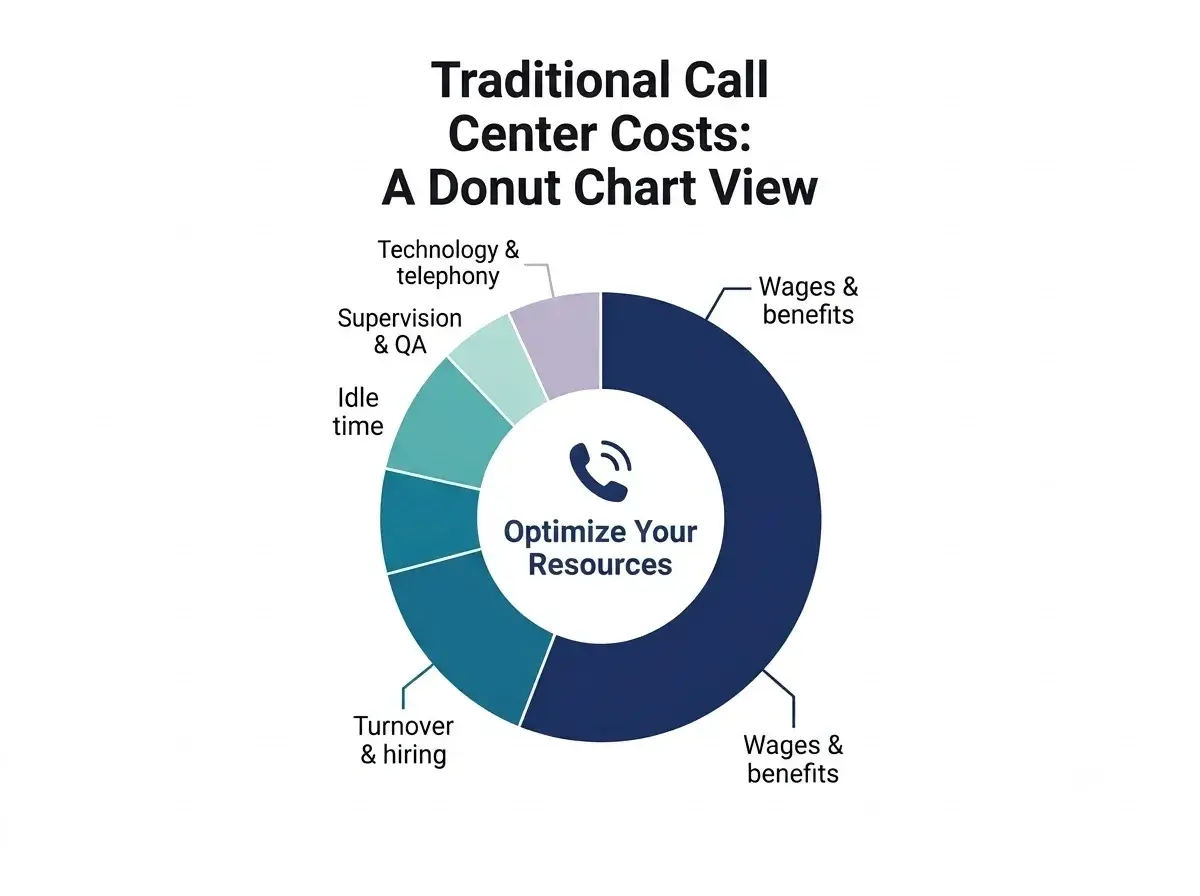
Most teams know their salary bill. Fewer know their fully loaded cost per call. Build it from these lines:
| Cost line | What to include |
|---|---|
| Wages and on-costs | Base pay, benefits, payroll taxes, bonuses |
| Shift premiums | Night, weekend and holiday rates for 24/7 coverage |
| Turnover | Recruiting, background checks, lost productivity while seats are empty |
| Training and ramp | Classroom time plus the weeks before a new agent reaches full speed |
| Idle capacity | Paid time between calls, especially when you staff for peaks |
| Supervision and QA | Team leads, quality reviewers, workforce management |
| Technology | Contact center seat licenses, telephony, call recording, CRM seats |
| Facilities | Office space and equipment, or home-working allowances for remote agents |
Divide the total by the number of calls your team resolves in the same period. That's your baseline cost per resolved call.
Two things usually surprise people. First, idle capacity: you pay for agents during the quiet hours so you have enough for the busy ones. Second, turnover, which you pay for repeatedly as new hires ramp up. Annual agent turnover in call centers typically runs at 30% to 45%, and high-stress or outsourced operations often see higher rates. At those levels, you're rehiring and retraining a third or more of your team every year.
If you outsource, use the rate you actually pay, including minimum volume commitments.
What an AI Call Center Costs on ElevenLabs
An AI call center built on ElevenLabs has three kinds of cost. Budget for each one separately, because they behave differently as you scale.
Run costs
These scale with call volume:
- Agent minutes. ElevenAgents plans include a monthly allowance of call minutes, with overage charges beyond it and a cap on concurrent calls by plan. Current plans and rates are on the ElevenAgents pricing page.
- Language model. The model you choose for reasoning has its own cost. Larger models handle complex calls better and cost more per turn.
- Telephony. Check how your phone numbers and carrier minutes are billed for your setup, whether through Twilio, SIP trunking or another provider.
- Concurrency headroom. Size your plan for your busiest hour, not your average. A plan that caps concurrent calls below your peak forces overflow to humans or a queue.
One-time costs
These come before the first live call:
- Conversation design: prompts, workflows, escalation rules and the handover summary
- Integrations with your CRM, order system or booking system, so the agent can resolve calls rather than only answer questions
- Testing against real call recordings, accents and noisy audio
- Compliance review for disclosure, recording and data retention
- Phone number setup or porting
Our guide to ElevenAgents implementation covers what each phase involves and how long it usually takes.
Ongoing ownership costs
This is the line most AI business cases leave out. Someone has to own the agent after launch:
- Keeping the knowledge base accurate as policies, prices and products change
- Reviewing transcripts every week, especially transferred and repeat calls
- Updating prompts and workflows, then re-running tests before each change goes live
- Monitoring latency, failure rates and costs
Whether that's part of one person's week or a full team, it belongs in the budget.
How model choice changes cost
Your voice model affects both cost and caller experience. ElevenLabs' models documentation lists Eleven v4 Turbo at around 100ms of latency for real-time use. Flash is the lower-cost real-time option, with lower model latency still. A more natural voice can keep more callers engaged instead of asking for a human, which pushes containment up. A cheaper model lowers the cost per minute. Test both on your own scripts and compare cost per resolved call, not price per minute.
If you're new to the platform, start with what ElevenLabs is and what it includes.
AI Call Center vs Traditional Call Center: Side-by-Side
| Traditional call center | AI call center | |
|---|---|---|
| Main cost driver | Headcount and hours | Minutes, model usage and ownership time |
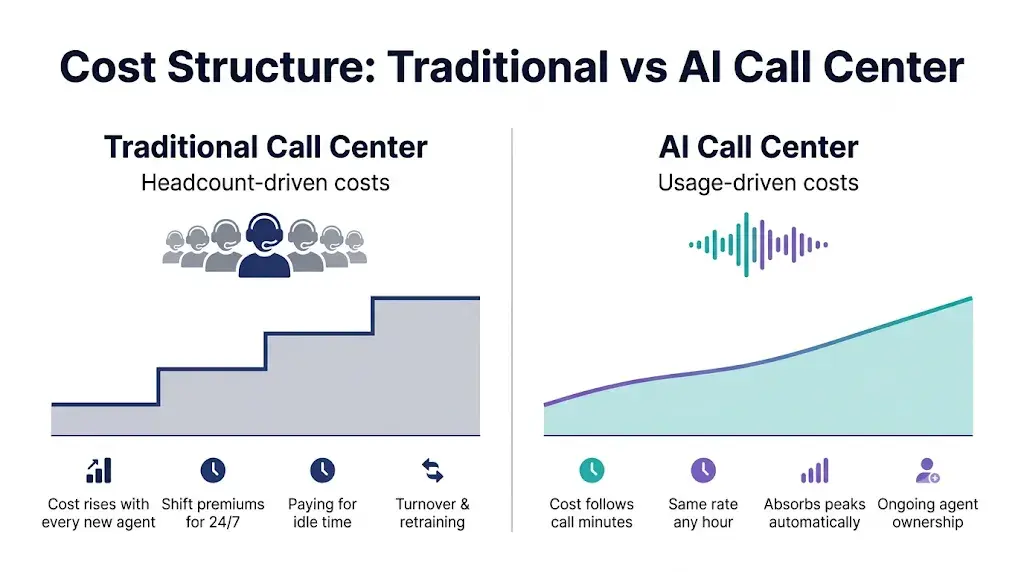
| How cost scales | In steps: each new agent is a full salary | Gradually, with usage, up to plan concurrency limits |
| After-hours coverage | Shift premiums or a second team | Same cost per minute at any hour |
| Peak handling | Staff for the peak, pay for idle time | Absorbs peaks up to concurrency limits |
| Complex or emotional calls | Strong | Weak; needs a handover to a person |
| Consistency | Varies by agent and by day | Consistent, including consistent mistakes until fixed |
| Time to change a process | Retraining across the team | Update the prompt or knowledge base, then retest |
| Biggest risk | Turnover and hiring lag | Low containment, so you pay for both AI and humans |
Build Your Business Case: The Cost-per-Resolved-Call Formula
You need six inputs from your own data:
| Input | Symbol | Where to get it |
|---|---|---|
| AI cost per minute, all-in | A | Your ElevenAgents plan plus model and telephony costs |
| Average AI minutes on a call it resolves | M1 | Pilot data or test calls |
| Average AI minutes before a failed call transfers | M2 | Pilot data or test calls |
| Containment rate | C | Pilot data, per call reason |
| Human cost per minute, fully loaded | H | Your baseline from the traditional cost section |
| Average human minutes on a transferred call | M3 | Your current handle time, adjusted upward for harder calls |
Then work through it in order:
- AI cost per call = C × M1 × A + (1 − C) × M2 × A
- Human cost per call = (1 − C) × M3 × H
- Cost per resolved call with AI = step 1 + step 2
- Cost per resolved call today = your current handle time × H
- Break-even containment is the value of C where step 3 equals step 4. Below it, AI makes each call more expensive.
Run it at three containment rates: a pessimistic, an expected and an optimistic case. If you use both onshore and offshore agents, run it once against each cost. Comparing the three results tells you how sensitive your business case is to the one number you control least, which is how many calls the agent actually resolves.
Against an expensive onshore team, break-even containment is usually low, so even a modest agent saves money. Against a low-cost offshore team, break-even is much higher, and a weak agent can raise your costs.
Gartner adds a longer-term warning. It predicts that by 2030, generative AI's cost per resolution in customer service will exceed $3, higher than many offshore human agents. Re-run your model with a higher AI cost per minute to see how much headroom your case has.
Hidden Costs on Both Sides
On the AI side:
- Paying twice for failed calls. Every transfer costs AI minutes plus human minutes.
- Model and platform price changes. Language model prices change, and your contract may not lock them. Build a buffer into the business case.
- Knowledge debt. An out-of-date knowledge base quietly lowers containment, and you only find out when repeat calls rise.
- Testing and monitoring tools. You need a way to test changes before they reach callers and to watch quality afterward.
- Legal and compliance review, especially for outbound calls. Our guide to AI outbound calling covers the consent rules.
On the traditional side:
- Ramp time for every new hire, during which you pay full salary for partial output
- Idle time built into staffing for peaks
The Value Side: Missed Calls and Shorter Human Calls
Calls you currently miss. If calls after hours or during peaks go to voicemail or get abandoned, an AI agent that answers them is recovering value from a baseline of zero. Count those calls in your current data, estimate how many the agent could resolve, and attach the value of each one: a saved order, a kept customer, a booked appointment.
Shorter human calls. When the AI verifies the caller and passes a summary before the transfer, your agents skip the first minutes of every call. Measure handle time on transferred calls during the pilot and compare it with your current average.
Keep these separate from the cost savings in your business case. Finance teams trust a case more when cost reduction and new value aren't blended together.
What Happens to Your Team
Expect to cut fewer seats than your containment rate suggests. The AI removes the shortest, simplest calls first, so the calls left for people take longer on average. Half the calls going away doesn't mean half the agents do.
Most service leaders are planning for this. A Gartner survey of 321 service and support leaders found 85% are expanding human agent responsibilities as AI reduces contact volume, and only 31% had made or planned AI-driven layoffs through early 2027.
In practice, the AI takes status checks, bookings, after-hours triage and identity checks, while people take complaints, disputes, vulnerable callers and complex problems. The handover between them needs to carry a summary so the customer doesn't repeat themselves.
For more on how AI fits alongside human agents, see our guide to AI in call centres.
Verdict: When an AI Call Center Pays Off and When It Doesn't
An AI call center pays off quickly when:
- Your team is onshore or otherwise expensive per minute
- A large share of calls follow a few simple, repeatable patterns
- You lose calls after hours or during peaks today
- Your systems have APIs the agent can use to complete tasks
Wait or start small when:
- Call volume is low, so the one-time costs take too long to recover
- Most calls are complex, emotional or involve several problems at once
- You already use a low-cost offshore team and your expected containment is below break-even
- The conversations are heavily regulated and you haven't completed a compliance review
For most organizations, the answer isn't AI or people. It's an AI call center front door for the simple calls, with people behind it for everything else. If you want to understand the agent side in more depth first, read what an AI voice agent is and how it works, and our view on why voice AI is becoming the main interface for customer support.
Frequently Asked Questions
Is an AI call center cheaper than a traditional call center?
Usually, but not always. An AI call center is cheaper when it resolves enough calls on its own to cover the cost of failed calls that still reach a human. Against expensive onshore teams, that threshold is low. Against low-cost offshore teams, it's much higher. Calculate cost per resolved call with your own containment rate before assuming savings.
How does ElevenLabs charge for AI call center agents?
ElevenLabs charges for ElevenAgents through subscription plans that include a monthly allowance of call minutes, with overage charges and a cap on concurrent calls that rises with each plan. Enterprise plans are priced separately. Check the current ElevenAgents pricing page, and add your language model and telephony costs to get an all-in cost per minute.
What containment rate does an AI call center need to save money?
It needs a containment rate above your own break-even point, which depends on your AI cost per minute and your human cost per minute. Break-even is lower when human agents are expensive and higher against offshore teams. Measure containment per call reason, and count any repeat call within seven days as a failed call.
What hidden costs do AI call centers have?
The biggest hidden cost is paying twice for failed calls: AI minutes plus the human call that follows. Others include keeping the knowledge base current, testing and monitoring tools, weekly transcript reviews, legal review for outbound calling, and model price changes over the contract term. Budget for an owner of the agent, not only the platform.
Can an AI call center replace human agents completely?
No. An AI call center handles high-volume, repeatable calls such as status checks and bookings well, but complaints, disputes, vulnerable callers and complex problems still need people. Most organizations run a hybrid model, with the AI answering first and transferring calls it can't resolve, along with a summary, to a human agent.
Next Step: Model Your Own Numbers
Pull one month of call data, group it by call reason, and calculate today's cost per resolved call. Then pick the highest-volume, lowest-risk reason and run a short ElevenLabs pilot to measure real containment, AI minutes and handover time. Those numbers turn the formula above into an AI call center business case your finance team can check.
If you'd like help scoping that pilot, our checklist for choosing an ElevenLabs implementation partner covers what to ask, or you can book a call with our team.