TL;DR
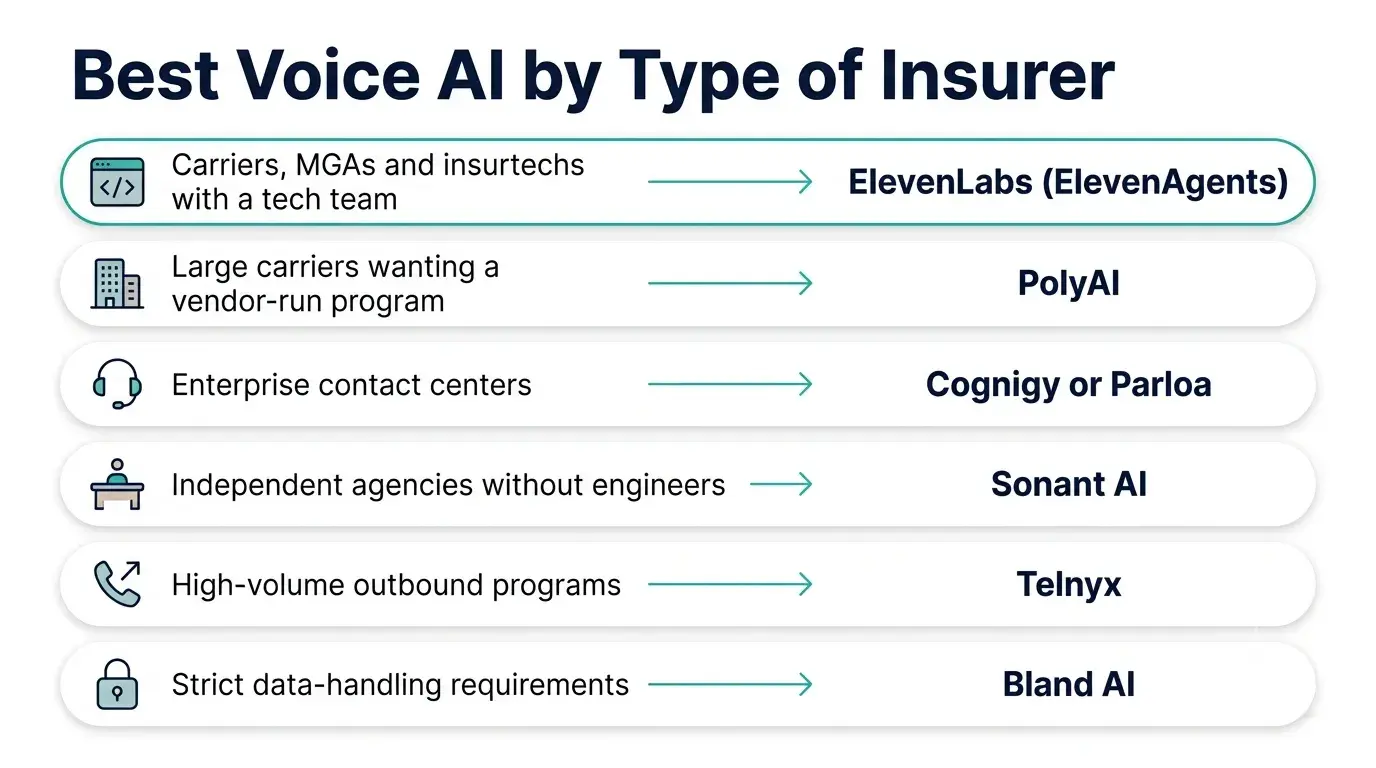
- For most insurers that want the best voice quality and full control over how the agent works, our pick is ElevenLabs (ElevenAgents).
- Large carriers that want a vendor to run the program, independent agencies without engineers, and teams with strict data-handling rules may be better served by the other five picks below.
- Whichever platform you choose, test it on your own recorded calls, including a call spike and a stressed caller, before you sign.
Every vendor says its voice AI is the best choice for insurance, and most "best of" lists are written by those same vendors, with their own product at the top.
That leaves you without a clear answer when you have to defend the choice to a CTO, a compliance team and a claims director. Below, we pick the best voice AI for each type of insurance company, explain where each one falls short, and finish with a test plan you can run on your own calls.
The Short Answer
ElevenLabs (ElevenAgents) is the best voice AI for most insurance companies that have an AI or engineering team, or an implementation partner. It leads independent voice-quality rankings, responds fast enough for live calls, covers more than 90 languages, and lets you design exactly how the agent verifies callers and hands over to people.
It isn't the right pick for everyone. If you want a vendor to build and run the whole program, or you're a small agency with no technical staff, one of the other five picks below will suit you better.
Disclosure: Haass is an ElevenLabs implementation partner. Facts about the other platforms come from their own websites, checked in October 2026.
How We Chose These Voice AI Picks
We used six criteria. Several come from questions insurance buyers raise when they compare platforms.
| Criterion | What we looked for |
|---|---|
| Voice quality | Natural speech that holds up when the caller is upset or confused |
| Reliability under load | How the platform behaves when a storm doubles call volume overnight |
| Integration effort | How much work it takes to connect policy, claims and billing systems |
| Compliance controls | Certifications, data retention, payment handling, audit trails |
| Handover quality | Whether the human agent gets the caller's details and a summary |
| Support model | Self-serve, partner-led or vendor-run, and what that means for you |
We didn't run a lab benchmark across all six. Treat these picks as a shortlist, then test.
6 Best Voice AI Picks for Insurance Companies
1. Best overall for voice quality and control: ElevenLabs (ElevenAgents)
What it is. ElevenAgents is ElevenLabs' platform for building voice agents. It combines speech recognition, the language model you choose and ElevenLabs voices, with workflows, knowledge bases, tool calls to your systems, Twilio and SIP telephony, batch outbound calling and automated testing.
Insurance example. A carrier builds a first notice of loss (FNOL) agent. The workflow verifies the policyholder before anything else, records what happened, when and where, checks basic policy details through a lookup, books an inspection and transfers to an adjuster with a written summary.
Why it stands out. When we checked the Artificial Analysis Speech Arena in October 2026, ElevenLabs' Eleven v4 Turbo and Eleven v4 held the top two places. Listeners vote on clips there without knowing which model made them. ElevenLabs' models documentation lists v4 Turbo at around 100ms of latency and its models at more than 90 languages. On security, ElevenLabs lists SOC 2 Type 2, ISO 27001, PCI DSS Level 1, HIPAA and GDPR on its Trust Center.
Limitation. It's a general platform, so you or a partner design the conversations, connect your systems and own the testing.
Best for. Carriers, MGAs and insurtechs that want the most natural-sounding voice and full control over the agent's design. Read more about what ElevenLabs is and what it includes.
2. Best for large carriers that want a vendor-run program: PolyAI
What it is. PolyAI builds enterprise voice agents on its own dialog models, configured through its Dialog Studio and deployed across voice, SMS and web chat, according to its website.
Insurance example. A large insurer gives PolyAI's team its billing and policy-change call flows, and PolyAI configures and runs the agents.
Benefit. You get a managed rollout instead of building in-house. PolyAI says its agents resolve over 90% of calls without escalation. Treat that as a vendor figure and test it against your own call mix.
Limitation. Your internal team has less direct control over day-to-day changes to the agent.
Best for. Large carriers with high call volumes that prefer a managed partnership.
3. Best for enterprise contact centers with existing infrastructure: Cognigy or Parloa
What they are. NiCE Cognigy provides voice and chat AI agents for enterprise contact centers as part of NiCE. Parloa describes itself as an AI agent management platform for building, testing and scaling voice and chat agents in enterprise customer service.
Insurance example. An insurer already running NiCE contact center software adds Cognigy agents for identity checks and routine policy questions before routing to people. A carrier with a large contact center uses Parloa's tools to build and monitor claims intake agents over time.
Benefit. Both fit established enterprise contact centers, with tools aimed at managing agents after launch.
Limitation. Enterprise implementation effort and procurement cycles. Cognigy's value is highest if you're already in the NiCE ecosystem.
Best for. Large insurers adding voice AI to an existing enterprise contact center operation.
4. Best for independent agencies without engineers: Sonant AI
What it is. Sonant is an AI receptionist built for insurance agencies, with native agency management system integrations, quote intake, appointment scheduling and 24/7 answering, according to its website.
Insurance example. A property and casualty agency uses Sonant to answer after-hours calls, take quote details and book appointments with producers.
Benefit. It's insurance-specific out of the box, with little build work.
Limitation. It's built for agency front-desk calls, so it fits custom carrier workflows such as complex claims intake less well.
Best for. Independent agencies that want working call coverage quickly.
5. Best for telephony-heavy outbound programs: Telnyx
What it is. Telnyx offers voice AI agents on its own carrier-grade network, with sub-200ms response times, 80+ languages, SOC 2 Type II and A-level STIR/SHAKEN call attestation, according to its website.
Insurance example. A carrier running large renewal and payment-reminder campaigns uses Telnyx for both phone numbers and voice agents.
Benefit. Telephony and voice AI from one provider, which matters for outbound call reputation and reliability.
Limitation. It's infrastructure-led, so expect more engineering work on conversation design.
Best for. Engineering-led teams running high-volume outbound calls.
6. Best for strict data-handling requirements: Bland AI
What it is. Bland offers an enterprise voice AI platform for regulated calls, including insurance, built on its own self-hosted models and supporting 40+ languages, according to its website.
Insurance example. An insurer that won't send call audio to third-party model providers runs outbound policy reminders on Bland.
Benefit. Less reliance on outside model providers, which can simplify some security reviews.
Limitation. Compare voice quality on your own scripts, and expect to own much of the conversation design.
Best for. Teams whose security policies restrict third-party model processing.
For a wider comparison of platforms, including how each handles claims, servicing and renewals, see our list of the 8 best AI voice agents for insurance.
What to Watch For With Any Insurance Voice AI
These rules apply whichever voice AI you pick. This is general information, not legal advice.
Licensing. Selling, soliciting and giving coverage advice are generally limited to licensed insurance producers. Have the agent collect details and answer factual questions, then hand advice and sales conversations to licensed staff. Check the rules in each state or country you operate in.
Card payments. If the agent takes payments, the PCI Security Standards Council's PCI DSS requirements apply. Sending a secure payment link by text keeps card numbers out of the conversation and out of your recordings.
Outbound consent. In the US, the FCC's February 2024 Declaratory Ruling confirmed that AI-generated voices count as artificial voices under the Telephone Consumer Protection Act, so outbound AI calls need prior express consent. Our guide to AI outbound calling covers the rules for the US, EU and India.
AI disclosure. Article 50 of the EU AI Act requires telling people they're interacting with an AI system, from August 2, 2026. Doing it everywhere is good practice.
Cost. Compare platforms on cost per resolved call, not price per minute. A cheaper platform that fails more calls costs you twice, once for the AI and again for the human who finishes the job. Our AI call center cost comparison shows how to model it.
How to Test Before You Choose
Shortlist two platforms, then run the same test on both.
Take 20 to 30 real recorded calls from one call type, such as claim status or certificate requests. Include a caller who is upset, one with a strong accent or background noise, and one who asks something the agent should refuse. Then:
- Check voice quality and accuracy. Did the agent understand the caller, and did it capture the right policy number, date and details?
- Simulate a spike. Run many test calls at once and watch response delay and failures.
- Test the handover. Does the human agent receive the caller's details and a summary, or start from scratch?
- Test support. Raise a technical question with each vendor during the trial and note how fast and how well they respond.
- Have the right people listen. A claims handler and a compliance reviewer should hear the recordings alongside the project team.
If you're new to how these systems work, start with what an AI voice agent is. If you plan to build on ElevenLabs, our guide to ElevenAgents implementation walks through the phases.
Frequently Asked Questions
Which voice AI is best for insurance companies?
ElevenLabs (ElevenAgents) is the best voice AI for most insurance companies that want top voice quality and control over how the agent works. Large carriers that want a vendor-run program may prefer PolyAI, enterprise contact centers may prefer Cognigy or Parloa, and independent agencies without engineers often choose a ready-made product such as Sonant AI.
Is ElevenLabs good for insurance companies?
Yes. ElevenLabs suits insurers that want natural-sounding voice agents for claims intake, policy servicing and outbound reminders. Its models lead independent blind-listening rankings, cover more than 90 languages, and its Trust Center lists SOC 2 Type 2, PCI DSS Level 1 and HIPAA. You or a partner build the workflows, so plan for design and testing time.
What should insurers look for in a voice AI platform?
Insurers should look for natural voice quality, reliability during call spikes, straightforward integration with policy and claims systems, and strong compliance controls. Check how the platform handles card payments, data retention and audit trails. Test the handover to human agents, and judge vendor support by how quickly they respond during the trial.
Can voice AI handle insurance claims calls?
Yes, for the intake and status stages. Voice AI can verify the policyholder, record first notice of loss details, give claim status updates and book inspections. Coverage decisions, disputed claims and emotional conversations should go to an adjuster, with a summary passed over so the caller doesn't have to repeat anything.
How do you test a voice AI platform before choosing it?
Test a voice AI platform by running the same 20 to 30 real recorded calls on two shortlisted options. Include difficult callers, a simulated call spike and a request the agent should refuse. Measure accuracy of captured details, response delay, handover quality and vendor support response. Have claims and compliance staff review the recordings.
Next Step: Pilot ElevenAgents on One Insurance Call Type
The fastest way to find the best voice AI for your insurance company is to test it. Pick one call type, such as claim status, pull 20 to 30 recorded calls and pilot an agent on ElevenAgents against them. You'll hear the voice quality, see the handover and check the accuracy of captured details on your own calls before committing to a rollout.
If you'd like help planning that pilot, our checklist for choosing an ElevenLabs implementation partner covers what to look for, or you can book a call with our team.