TL;DR
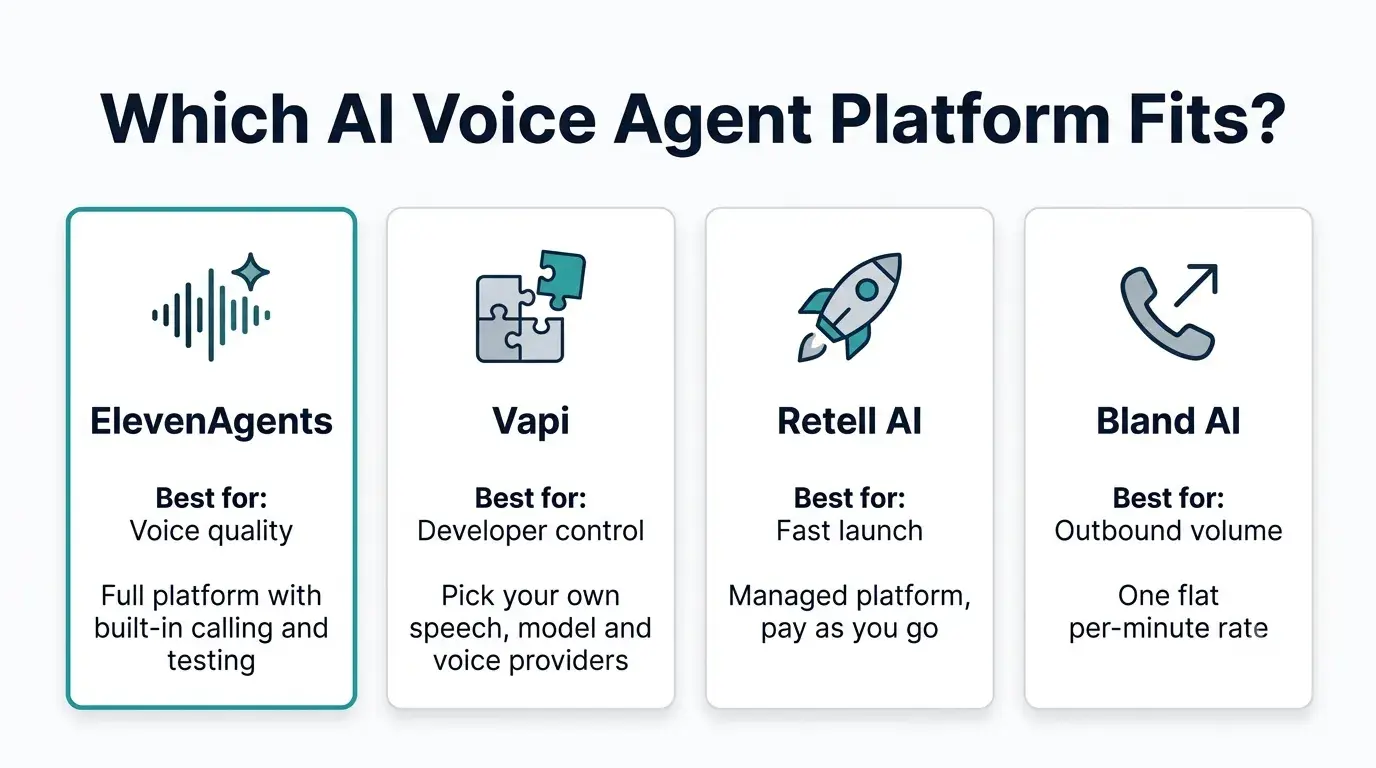
- ElevenAgents (ElevenLabs): the strongest voice quality and a full agent platform, with built-in phone calling, workflows and testing. Best when the voice itself affects results.
- Vapi: an orchestration layer where you pick your own speech-to-text, language model and voice providers. Best for developers who want control over every component.
- Retell AI: a managed, pay-as-you-go platform with HIPAA and SOC 2 listed. Best for teams that want to launch quickly.
- Bland AI: one flat per-minute rate covering the language model and speech, with self-hosted models. Best for high-volume outbound calling.
- The deciding factor is usually what you control versus what you hand over: voice, models, telephony or compliance.
The demo sounded great. Then the first production call went live, the agent paused for two seconds, the customer said "hello?", and the agent talked straight over them.
The gap between demo and production is where the real differences between AI voice agent platforms show up. ElevenAgents, Vapi, Retell AI and Bland AI all make good demos. They differ in how much of the call you control, how they bill you, and how they hold up when real callers interrupt, mumble or call in their hundreds at once. This comparison covers those differences with facts from each vendor's own site, checked in October 2026.
Quick Verdict
| Platform | Best for | Main trade-off |
|---|---|---|
| ElevenAgents (ElevenLabs) | Teams where voice quality drives results, such as support, sales and branded experiences | More platform features to learn than a single-purpose tool |
| Vapi | Developers who want to choose and swap every component | You assemble and tune the stack yourself |
| Retell AI | Teams that want a managed platform and a quick start | Less control over the underlying components |
| Bland AI | High-volume outbound calling with predictable per-minute costs | Less choice of models and voices |
Disclosure: Haass is an ElevenLabs implementation partner. Facts about Vapi, Retell AI and Bland AI come from their own websites and documentation.
How We Compared These AI Voice Agent Platforms
We used seven criteria:
| Criterion | What we checked |
|---|---|
| Voice quality | Independent evidence where it exists, not vendor claims |
| Latency | What each vendor says it measures, and how |
| Telephony and SIP | Built-in phone numbers, Twilio, SIP trunking, outbound batch calling |
| LLM choice | Can you pick or bring your own language model? |
| Compliance | HIPAA and SOC 2, and whether HIPAA costs extra |
| Testing tools | Built-in ways to test agents before and after launch |
| Pricing model | How you're billed, not the headline rate, which changes often |
We didn't run our own lab benchmark across all four platforms. Use these criteria to narrow your shortlist, then test with your own calls.
The Four Platforms
ElevenAgents (ElevenLabs)
What it is. ElevenAgents, previously known as ElevenLabs Conversational AI, is ElevenLabs' platform for building voice agents. It combines speech recognition, a language model you choose and ElevenLabs voices with turn-taking, knowledge bases, tool calls to your systems, workflows and procedures for structured conversations, and automated testing.
Strengths. Voice quality is where ElevenLabs leads. On the Artificial Analysis Speech Arena, a blind listening leaderboard, Eleven v4 Turbo and Eleven v4 held the top two places when we checked in October 2026. ElevenLabs' models documentation lists v4 Turbo at around 100ms of latency and its models at more than 90 languages.
Several comparisons online still say ElevenLabs needs extra work to handle phone calls. That's out of date. ElevenAgents connects to phone numbers through a native Twilio integration and SIP trunking, runs batch outbound calls, and also works on WhatsApp, the web and mobile apps.
On compliance, ElevenLabs lists SOC 2 Type 2, ISO 27001, PCI DSS Level 1, HIPAA and GDPR on its Trust Center, with Business Associate Agreements on Enterprise plans. Deployment options include the cloud API, private cloud (VPC) on AWS SageMaker and GCP Vertex, and on-premises speech models for enterprises, which were still in early access when we checked.
Limitations. There's a lot of platform to learn, from workflows to testing to telephony settings. Each plan caps how many calls can run at once, so check concurrency against your busiest hour.
Best for. Customer support, sales and any use case where callers judge you by how the agent sounds. If you're new to the platform, read what ElevenLabs is.
Vapi
What it is. According to its documentation, Vapi is an orchestration layer for three components: the transcriber (speech-to-text), the model (the LLM) and the voice (text-to-speech). You can replace each one with a provider of your choice, and Vapi handles latency, scaling and conversation flow between them. Its docs describe aiming for roughly 500 to 700ms of response time.
Strengths. Control. If you want a specific speech recognition provider, a particular LLM and a voice from yet another company, Vapi is built for that, and it suits engineering teams that like to tune every part of the call.
Limitations. More choices means more work. You own the decisions about which providers to combine, and each one adds its own cost. Vapi's pricing page lists HIPAA compliance as available for an extra fee, and its plans set different limits on concurrent calls and data retention.
Best for. Developer teams who want full control over the voice stack and are comfortable assembling it. If you're looking for the best voice API for developers who want to mix providers, Vapi voice AI is built around that idea.
Retell AI
What it is. Retell is a platform for building and deploying voice agents for inbound and outbound calls. It lists HIPAA and SOC 2 compliance on its site.
Strengths. It's quick to start. Retell runs on pay-as-you-go pricing with free starting credits, and its pricing page lists agent templates, call analytics and simulation testing. Enterprise plans add higher concurrency limits and dedicated support.
Limitations. Your per-minute rate depends on the voice and language model you pick, so the cost of a call changes with your configuration. You also have less control over the underlying components than with Vapi.
Best for. Teams that want a managed platform, built-in testing and a fast route to production. For Retell AI pricing, check the current per-minute rates on its pricing page, linked in the comparison table below.
Bland AI
What it is. Bland offers an enterprise voice AI platform built on its own self-hosted models. Its pricing page describes one flat per-minute rate covering the language model, speech-to-text and text-to-speech, with no separate token charges.
Strengths. Predictable costs at volume. Plans set clear limits on concurrent calls and calls per day, enterprise plans add on-premises or VPC deployment, and you can bring your own telephony provider. Bland lists HIPAA, SOC 2, GDPR and PCI compliance.
Limitations. Self-hosted models mean less choice of LLMs and voices. Call transfers carry their own per-minute charge, and lower plans cap daily call volume.
Best for. Bland AI outbound calls at high volume, and teams that want a single all-in rate.
Head-to-Head Comparison Table
| ElevenAgents | Vapi | Retell AI | Bland AI | |
|---|---|---|---|---|
| Voice quality evidence | Eleven v4 Turbo and v4 top two on Artificial Analysis (October 2026) | Depends on the voice provider you choose | Depends on the voice you choose | Own voices; test on your scripts |
| Stated latency | ~100ms model latency for v4 Turbo | Aims for ~500–700ms response | See vendor docs | See vendor docs |
| Telephony | Native Twilio, SIP trunking, batch calls, WhatsApp | Phone numbers by plan, telephony providers | Inbound and outbound calling | Inbound numbers, bring your own telephony |
| LLM choice | Choose from supported models or bring your own | Any provider | Choose from supported models | Own self-hosted models |
| Compliance | SOC 2 Type 2, ISO 27001, PCI DSS L1, HIPAA (BAA on Enterprise), GDPR | HIPAA as a paid add-on | HIPAA and SOC 2 listed | HIPAA, SOC 2, GDPR, PCI listed |
| Testing | Automated tests and A/B experiments | Build-test-deploy tooling | Simulation testing | Check during trial |
| Deployment | Cloud, VPC, on-prem speech models (early access) | Cloud | Cloud | Cloud, on-prem or VPC on Enterprise |
| Pricing model | Plans with included minutes, overages and concurrency caps | Platform plans plus provider and transport costs | Pay-as-you-go per minute, varies by configuration | Flat per-minute rate by plan |
Pricing pages: ElevenAgents, Vapi, Retell AI, Bland AI.
Real-Time Speech-to-Text and Orchestration: What Actually Drives Latency
Every voice agent call runs through the same chain:
- Speech-to-text turns the caller's words into text
- Turn detection decides the caller has finished speaking
- The language model decides what to say
- Text-to-speech turns the reply into audio
- The network carries audio between the caller, the phone carrier and the platform
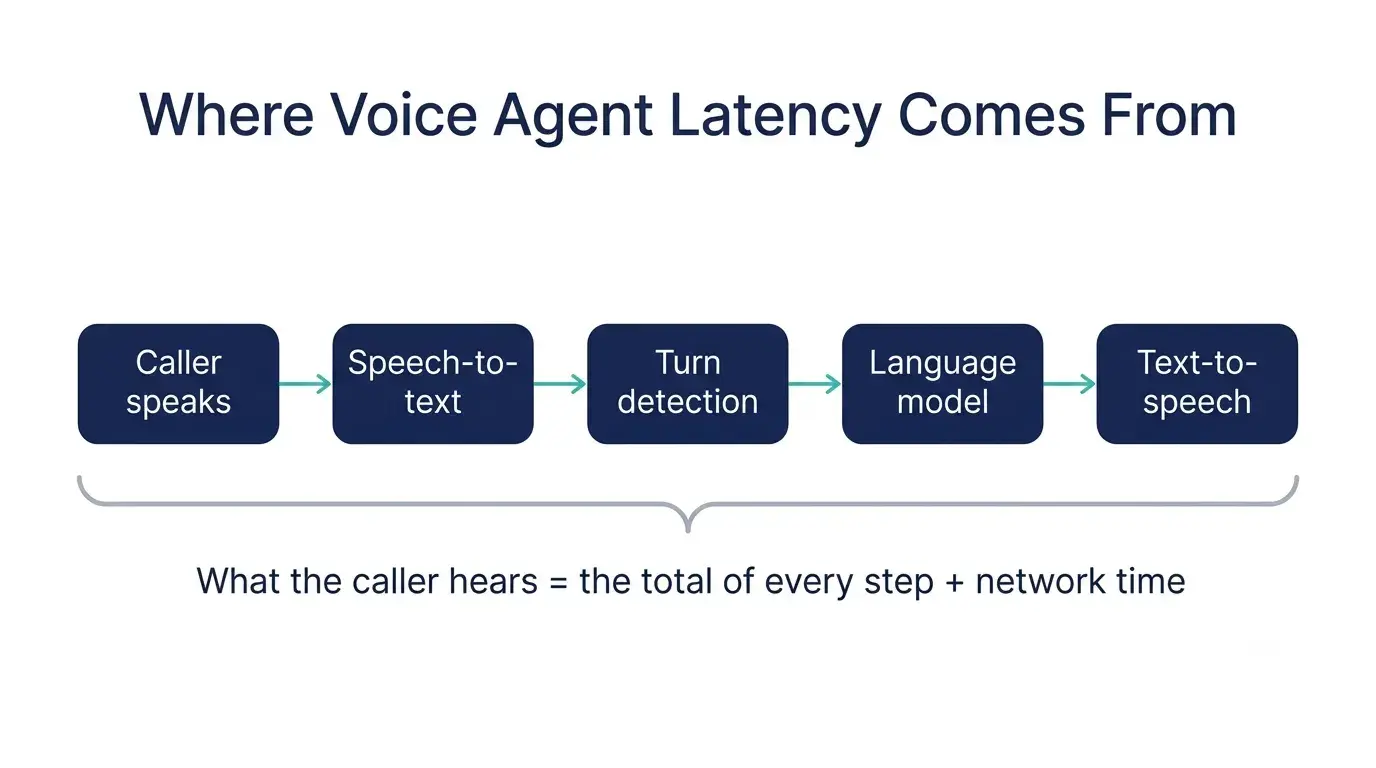
The caller hears the total of all five. That's why vendor latency figures don't line up. ElevenLabs' ~100ms figure for v4 Turbo describes the voice model. Vapi's 500–700ms target describes the whole response. Neither is wrong, but comparing them directly would be.
In practice, the biggest delays usually come from the language model and from turn detection set too cautiously. A fast voice model can't make up for a slow LLM, and an agent that waits too long to be sure the caller has stopped talking feels sluggish even with quick components.
When you compare platforms, measure from the moment a caller stops speaking to the first audible word. Run at least 50 calls from your callers' region and look at the median and the slowest 5% (P95). Callers remember the long pause, not the average.
HIPAA-Compliant AI Phone Agents: What to Check
All four vendors list HIPAA compliance, but the details differ:
- ElevenAgents: ElevenLabs offers Business Associate Agreements on Enterprise plans, alongside Zero Retention Mode and data residency options.
- Vapi: its pricing page lists HIPAA compliance as an extra-cost option.
- Retell AI: lists HIPAA and SOC 2 on its site. Confirm which plan includes a signed BAA.
- Bland AI: lists HIPAA among its compliance standards. Confirm BAA terms with sales.
Whichever you choose, check four things before handling patient data:
- A signed BAA, and the plan tier it requires
- Data retention for recordings and transcripts, including the option to turn storage off
- Every provider in the chain. On an orchestration platform, your speech, LLM and voice providers may each need to be covered.
- Add-on fees for compliance features, so they're in your cost model from day one
Pricing Models Compared
Headline per-minute rates change often and rarely tell you the real cost. The billing model matters more.
Plans with included minutes (ElevenAgents). A monthly plan includes a set number of call minutes, with overage charges and a cap on concurrent calls by plan. Language model and telephony costs depend on your setup. Good for predictable volumes. Check the concurrency cap against your peak hour.
Platform fee plus components (Vapi). You pay for the platform plan, then for each provider you plug in, plus transport costs. Most flexible, and the hardest to forecast.
Pay-as-you-go by configuration (Retell AI). You pay per minute, and the rate depends on the voice and model you choose. Easy to start, and costs move as you change your setup.
Flat all-in rate (Bland AI). One per-minute rate covers the language model and speech, with separate charges for transfers. Simple to forecast at high volume.
Hidden costs show up across all four: phone numbers and carrier minutes, extra concurrency, compliance add-ons, and the human time spent on calls the agent fails. Compare platforms on cost per resolved call, not cost per minute. Our AI call center cost comparison explains how to model it.
Which Platform Fits Your Use Case
Customer support. ElevenAgents, where natural voice and workflows for identity checks and handovers matter most. Retell AI is a reasonable alternative if you want a managed setup and fast launch.
Outbound sales and reminders. Bland AI for high-volume campaigns with a flat rate. ElevenAgents if voice quality affects conversion, since it also supports batch outbound calls. Check consent rules first; our guide to AI outbound calling covers them.
Real-time phone operations. ElevenAgents or Retell AI, depending on how much you value voice quality against setup speed. Test both under load.
Developers wanting full control. Vapi, if you want to choose every component. ElevenAgents also lets you choose your language model, with ElevenLabs voices built in.
How to Test All Four Before Choosing
Take 20 to 30 real recorded calls and turn them into test scripts. Run the same scripts on each shortlisted platform, and include:
- A caller who interrupts mid-sentence
- Background noise, such as a car, a café or a speakerphone
- A caller who changes their request halfway through
- A request the agent should refuse or hand over
- A burst of simultaneous calls to see how each platform handles load
For each platform, measure whether the call was resolved, when and how it transferred, response delay at the median and P95, and whether the details captured were correct. Then price the same month of traffic on each vendor's pricing page.
If you plan to build on ElevenLabs, our guide to ElevenAgents implementation covers the phases and timeline. If you're also weighing voice providers, see our comparison of the best TTS APIs and ElevenLabs vs Cartesia.
Frequently Asked Questions
Which AI voice agent platform is best?
ElevenAgents is the best AI voice agent platform for teams where voice quality and a complete feature set matter, such as customer support and sales. Vapi suits developers who want to choose every component, Retell AI suits teams that want a managed platform and fast launch, and Bland AI suits high-volume outbound calling with a flat per-minute rate.
Is ElevenLabs better than Vapi or Retell AI?
For voice quality, yes. ElevenLabs' Eleven v4 Turbo and Eleven v4 held the top two places on the Artificial Analysis blind-listening leaderboard in October 2026. Vapi gives developers more freedom to mix providers, and Retell AI offers a simpler managed setup. The better choice depends on whether voice, control or speed of launch matters most to you.
Which AI voice agent platforms are HIPAA compliant?
All four list HIPAA compliance, but terms differ. ElevenLabs offers Business Associate Agreements on Enterprise plans, Vapi lists HIPAA as a paid add-on, and Retell AI and Bland AI both list HIPAA on their sites. Before handling patient data, confirm a signed BAA, the plan tier required and the data retention settings with each vendor.
Which platform is best for outbound calls?
Bland AI suits high-volume outbound calling because one flat per-minute rate covers the language model and speech. ElevenAgents is the better fit when voice quality affects results, as it also supports batch outbound calling. Whichever you choose, confirm you have the consent outbound AI calls require in each region you call.
How do Vapi, Retell AI, Bland AI and ElevenLabs charge?
ElevenAgents uses plans with included call minutes, overages and concurrency caps. Vapi charges a platform plan plus the cost of each provider you plug in and transport fees. Retell AI charges pay-as-you-go per minute, with rates that vary by voice and model. Bland AI charges one flat per-minute rate by plan, with separate transfer charges.
Next Step: Pilot ElevenAgents on One Call Type
Pick one high-volume call type, such as order status or appointment booking, and build a pilot on ElevenAgents using 20 to 30 of your real recorded calls. You'll hear the voice quality, see how it handles interruptions and measure response delay on your own traffic before committing to any of these AI voice agent platforms.
If you'd like help scoping that pilot, our checklist for choosing an ElevenLabs implementation partner covers what to look for, or you can book a call with our team.