TL;DR
- For produced audio such as audiobooks, ads and narration, use Eleven v4. It has replaced Eleven v3 as ElevenLabs' highest-quality model.
- For live voice agents, use Eleven v4 Turbo when expressiveness matters and Flash v2.5 when the lowest latency and cost per character matter more.
- Multilingual v2 is still the most stable choice for very long, consistent narration and handles numbers better than Flash.
- Moving to v4 or v4 Turbo means using the Text to Dialogue API or WebSocket, so plan for some integration work.
You need to pick a model ID before you write any code, and the guides you find don't agree. Half of them still recommend Eleven v3, which ElevenLabs now calls its previous generation, and they don't mention the two models released on September 28, 2026.
This comparison of ElevenLabs v4 vs v3 vs Flash v2.5 uses ElevenLabs' own models documentation, checked on October 20, 2026. It covers what each model is for, where each falls short, what changes in your integration, and which one to pick for your use case.
Quick Verdict by Use Case
| Use case | Recommended model | Why |
|---|---|---|
| Audiobooks, narration, character voiceovers | Eleven v4 | Highest quality and emotional range, 10,000-character requests |
| Expressive live voice agents | Eleven v4 Turbo | v4-level expressiveness at around 100ms median inference |
| Lowest-latency, high-volume agents | Flash v2.5 | Around 75ms, and half the API price per character |
| Very long, consistent narration | Multilingual v2 | Most stable on long-form generations |
| Reading phone numbers, dates and amounts aloud | Multilingual v2, or Flash v2.5 with normalization | Flash doesn't normalize numbers by default |
| Existing v3 projects | Test Eleven v4 | v3 is now the previous generation |
ElevenLabs Models 2026 at a Glance
| Model | Model ID | Best for | Latency (per ElevenLabs) | Languages | Character limit | Access |
|---|---|---|---|---|---|---|
| Eleven v4 | eleven_v4 | Highest-quality produced audio | Not built for real time | 90+ | 10,000 | Text to Dialogue API |
| Eleven v4 Turbo | eleven_v4_turbo | Expressive real-time speech | ~100ms median inference | 90+ | See docs | Text to Dialogue WebSocket |
| Eleven v3 | eleven_v3 | Previous-generation expressive audio | Not built for real time | 70+ | 5,000 | Text to Speech and Text to Dialogue |
| Eleven v3 Conversational | eleven_v3_conversational | Previous-generation expressive real time | ~280ms | 70+ | See docs | Text to Dialogue WebSocket |
| Multilingual v2 | eleven_multilingual_v2 | Stable long-form narration | Higher than Flash | 29 | 10,000 | Text to Speech |
| Flash v2.5 | eleven_flash_v2_5 | Fast, low-cost real-time speech | ~75ms | 32 | 40,000 | Text to Speech |
ElevenLabs notes that its latency figures exclude application and network latency. They describe the model, not the full round trip your users experience. Full details are in ElevenLabs' models documentation.
How We Compared the Models
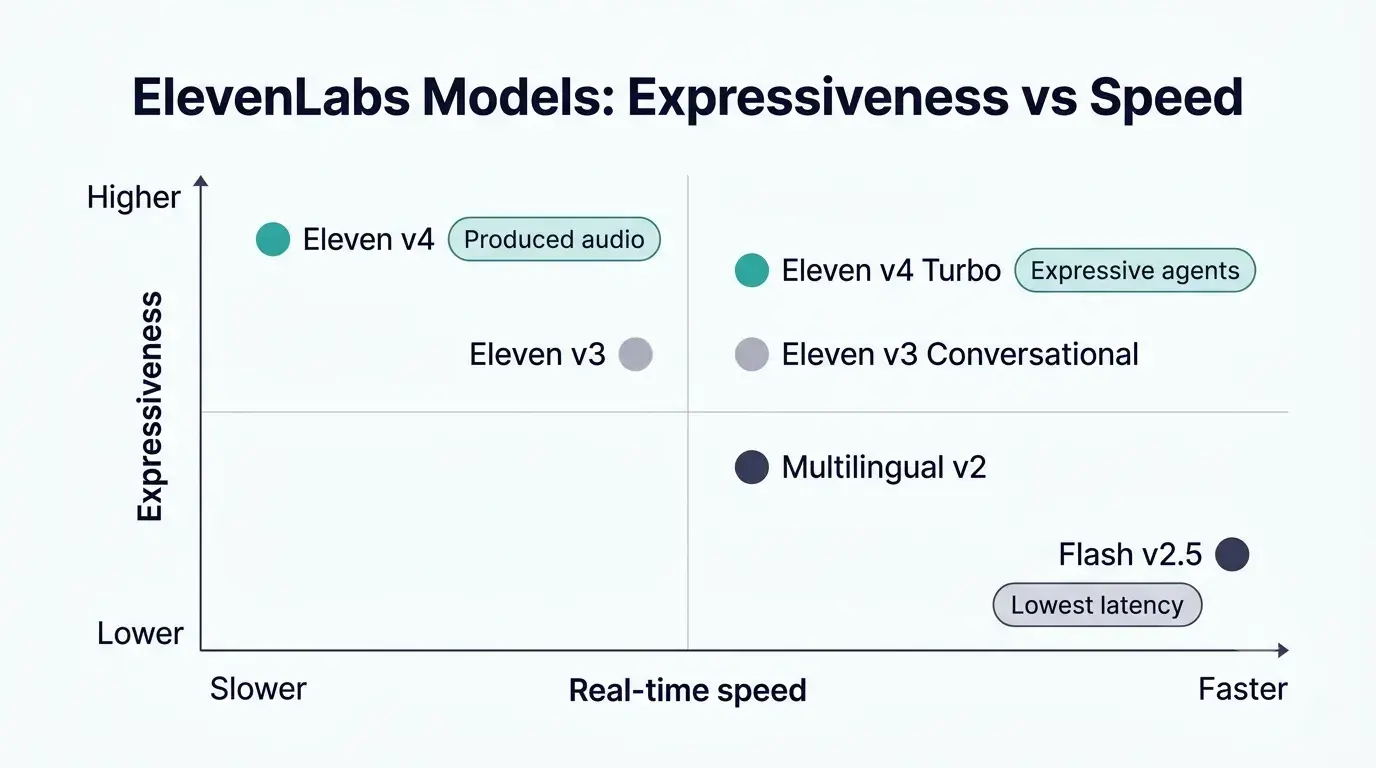
We compared six models on seven things: audio quality, latency, language coverage, character limits, how you access the model through the API, how it counts against concurrency limits, and price per character. Every specification comes from ElevenLabs' documentation. Where we give an opinion, such as which model suits a use case, we say so.
The Models
Eleven v4
What it is. ElevenLabs' highest-quality text-to-speech model, released September 28, 2026. It supports 90+ languages, 10,000 characters per request (about 10 minutes of audio), high-fidelity voice cloning and natural multi-speaker dialogue.
Pros. The best emotional range and audio quality ElevenLabs offers. Twice v3's character limit. More languages than any previous ElevenLabs text-to-speech model.
Cons. It isn't designed for real-time use. It runs through the Text to Dialogue API, so if your code calls the standard Text to Speech endpoint, you'll need to change it.
Who it fits. Audiobook producers, game studios, ad agencies and anyone generating audio ahead of time.
Eleven v4 Turbo
What it is. The real-time version of v4, with a median inference latency of around 100ms according to ElevenLabs. It supports 90+ languages and audio tags for fine control over delivery.
Pros. Brings most of v4's expressiveness to live conversations. ElevenLabs recommends it for agents when you want the most expressive delivery, and suggests it for support agents, AI assistants and interactive characters.
Cons. ElevenLabs v4 Turbo latency is about 25ms higher than Flash v2.5 at the model level. It runs through the Text to Dialogue WebSocket, which uses session-based concurrency (more on that below).
Who it fits. Teams building voice agents where tone and naturalness affect results, such as customer support and sales.
Eleven v3 and v3 Conversational
What they are. Eleven v3 is ElevenLabs' previous-generation expressive model, with 70+ languages and a 5,000-character limit. Eleven v3 Conversational is its real-time version at around 280ms, and it's the model behind expressive mode in ElevenLabs agents.
Pros. Still expressive and widely used, and works with both the Text to Speech and Text to Dialogue APIs.
Cons. ElevenLabs now describes both as previous generation. Compared with v4, they cover fewer languages and have half the character limit, and v3 Conversational is slower than v4 Turbo.
Who it fits. Existing projects that work well today. New projects should start with v4 or v4 Turbo.
Flash v2.5
What it is. ElevenLabs' fastest speech model, at around 75ms, designed for real-time applications and the agents platform. It covers 32 languages and accepts up to 40,000 characters per request.
Pros. The lowest latency and, per ElevenLabs, a 50% lower price per character for API generations. The large character limit also makes it efficient for bulk conversion.
Cons. Less expressive than v4 Turbo. ElevenLabs also notes that Flash v2.5 doesn't normalize numbers by default, so phone numbers, dates and currency amounts can be read out unclearly. Enterprise customers can turn normalization on with the apply_text_normalization parameter. Otherwise, ElevenLabs recommends having your language model write numbers out in full first.
Who it fits. High-volume agents, interactive apps and games, and bulk generation where cost and speed matter most.
Multilingual v2
What it is. A previous-generation model that ElevenLabs describes as the most stable on long-form generations, with 29 languages and a 10,000-character limit.
Pros. Consistent voice quality across long outputs, and better number normalization than Flash. ElevenLabs recommends it where reading phone numbers correctly matters.
Cons. Higher latency and cost per character than Flash, and fewer languages than v4.
Who it fits. Long audiobooks and e-learning where consistency over hours matters more than peak expressiveness.
ElevenLabs v4 vs v3: What Changed
If you're on Eleven v3 today, four things change with v4:
- Languages: 90+ instead of 70+
- Character limit: 10,000 per request instead of 5,000
- Real-time option: v4 Turbo at around 100ms, compared with v3 Conversational at around 280ms
- Ranking: when we checked the Artificial Analysis Speech Arena in October 2026, Eleven v4 Turbo and Eleven v4 held the top two places on its blind-listening leaderboard
Should you switch? For new projects, yes. For existing v3 projects, test first. Take 10 to 20 of your real scripts, generate them on both models with the same voice, and listen for differences in pacing, emotion and pronunciation. Voice behavior can change between model generations, so don't swap production audio without checking.
Best ElevenLabs Model for Real-Time: v4 Turbo vs Flash v2.5
This is the choice most voice agent teams face, and it comes down to what your callers notice more.
Choose Eleven v4 Turbo when tone matters, such as support calls with frustrated customers, sales conversations or branded assistants. The extra 25ms of model latency is small next to the delay from the language model, tool calls and the network.
Choose Flash v2.5 when every millisecond and every character counts, such as high-volume outbound reminders, simple status updates or apps generating large amounts of speech. Its lower price per character adds up at scale.
Two practical points affect the decision:
- Number reading. If your agent reads out policy numbers, phone numbers or amounts, Flash v2.5 needs normalization handled by your language model or the Enterprise setting. Test this before launch.
- Concurrency. Flash requests made through the standard Text to Speech WebSocket only count toward your concurrency limit while audio is being generated. The Text to Dialogue WebSocket, used by v4 Turbo, reserves a dialogue session for as long as the connection stays open, from a separate pool with its own limits per plan. Plan capacity differently for each.
If you're building on ElevenAgents, ElevenLabs' guide to choosing the right model points to v4 Turbo and Flash v2.5 for conversational agents, and its models documentation also lists Flash v2 and Multilingual v2 for the agents platform. For the full picture on response time, see our guide on how to cut ElevenLabs agent latency below one second.
ElevenLabs Pricing Comparison
ElevenLabs lists Flash v2.5 with a 50% lower price per character for API generations, which makes it the cheapest option at scale. Multilingual v2 has a higher cost per character than Flash. Pricing for v4 and v4 Turbo, plans and credit allowances changes over time, so check the ElevenLabs API pricing page for current rates before you budget.
When you compare costs, look at your whole workload rather than the price per character alone. A cheaper model that needs more retakes, or an agent that loses callers because it sounds flat, can cost more overall.
Switching Models: What Changes in Your Integration
API endpoint. Eleven v4 uses the Text to Dialogue API, and v4 Turbo uses the Text to Dialogue WebSocket. If your code calls the standard Text to Speech endpoint with a v3 or Flash model ID, moving to v4 means changing the endpoint as well as the model ID.
Concurrency. Text to Dialogue WebSocket connections are metered as dialogue sessions. Each open connection holds a session until it closes, and connections close automatically after 20 seconds of inactivity unless you send keep-alive messages. Close connections you no longer need, or new ones will be rejected when all sessions are in use.
Character limits. Moving from Flash v2.5 (40,000 characters) to v4 (10,000) means splitting long inputs into more requests.
Deprecated models. ElevenLabs has deprecated eleven_turbo_v2_5 and eleven_turbo_v2, which it describes as functionally equivalent to Flash v2.5 and Flash v2 but slower on average. If you're still using a Turbo v2 model ID, switch to the matching Flash model.
Which Model Should You Use? Verdict by Role
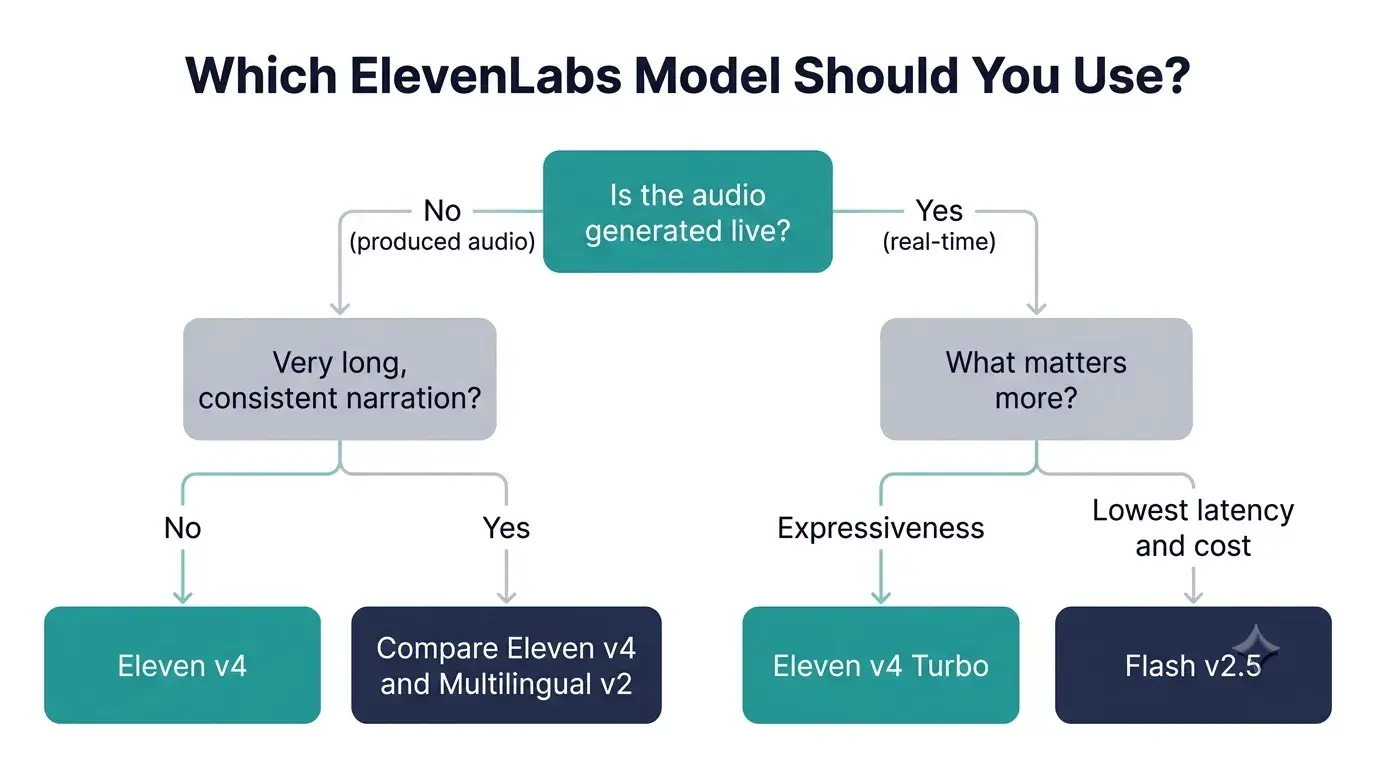
Developers and software engineers. Default to Eleven v4 Turbo for new real-time agents and Flash v2.5 for high-volume or cost-sensitive workloads. Budget time for the Text to Dialogue integration and session-based concurrency.
Product managers. Let the use case decide. If callers judge your product by how it sounds, v4 Turbo is worth the small latency trade-off. If speed and cost per call drive your numbers, choose Flash v2.5.
Business decision makers. For new projects, standardize on the v4 family, and keep Flash v2.5 for high-volume, low-margin calls. Ask your team to test before migrating existing v3 audio.
Content creators and authors. Use Eleven v4 for most produced audio. For very long audiobooks where consistency across hours matters most, compare it with Multilingual v2 on a full chapter before committing.
For background on the platform, see what ElevenLabs is and what it includes. If you're choosing a whole agent platform rather than a model, our comparison of AI voice agent platforms covers the wider options. If you're comparing ElevenLabs with other providers, read ElevenLabs vs Cartesia and our comparison of the best TTS APIs.
Frequently Asked Questions
What is the difference between ElevenLabs v4 and v3?
Eleven v4 is ElevenLabs' newest model and has replaced v3 as its highest-quality option. It supports 90+ languages instead of 70+, allows 10,000 characters per request instead of 5,000, and has a real-time version, v4 Turbo, at around 100ms. Eleven v4 runs through the Text to Dialogue API, so switching can require integration changes.
Is Eleven v4 Turbo better than Flash v2.5 for voice agents?
Eleven v4 Turbo is better when tone and expressiveness matter, such as support and sales calls. Flash v2.5 is better when lowest latency and cost matter most, at around 75ms and half the API price per character. Flash doesn't normalize numbers by default, so test how it reads phone numbers and amounts.
Which ElevenLabs model is cheapest?
Flash v2.5 is the cheapest ElevenLabs text-to-speech model for API generations, at 50% lower price per character according to ElevenLabs. It also has the largest character limit, at 40,000 per request. Prices and plans change, so check ElevenLabs' API pricing page for current rates before budgeting a project.
Is Eleven v3 still worth using?
Eleven v3 still works, but ElevenLabs now describes it as previous generation. For new projects, Eleven v4 offers more languages, a larger character limit and a faster real-time option. If you have existing v3 audio or agents that work well, test v4 on your own scripts before switching, since voice behavior can change between models.
Which ElevenLabs model is best for audiobooks?
Eleven v4 is best for most audiobooks, with the highest quality, emotional range and 10,000 characters per request. ElevenLabs describes Multilingual v2 as the most stable on long-form generations, so for very long books where consistency across hours matters, compare both on a full chapter before choosing.
Next Step: Test the Right ElevenLabs Model on Your Own Audio
The fastest way to settle ElevenLabs v4 vs v3 vs Flash for your project is to test on your own scripts. Pick 10 to 20 real examples, generate them on your two leading candidates with the same voice, and compare quality, latency and cost.
If you're building a voice agent and want help choosing and testing models, tuning latency or making the agent sound natural, see our guide on how to make an ElevenLabs agent sound natural or talk to our team.