TL;DR
- Older text-to-speech systems sound robotic because they stitch recordings together or predict speech with simple statistical models. Modern neural models largely fixed that.
- With a modern voice, robotic-sounding calls usually come from the conversation around it: scripted prompts, long replies, slow responses, poor turn-taking and badly read numbers.
- A voice that sounds human in a demo can still sound robotic on a live call, because a call adds speech recognition, a language model and network delay.
- Fix the conversation first, then choose a model built for natural, real-time speech.
The voice sounded human in the demo. On the first week of live calls, customers kept asking the same question: "Am I talking to a robot?"
Voice models have improved a lot, so why does AI voice sound robotic on so many live calls? The voice model is occasionally to blame, but the setup around it usually matters more. Below are answers to ten questions developers, AI leads and decision makers ask about this, with links to detailed fixes.
Disclosure: Haass is an ElevenLabs implementation partner.
1. Why does AI voice sound robotic?
AI voice sounds robotic for four main reasons: an older text-to-speech model that can't vary its delivery, a conversation that sounds scripted, delays and awkward turn-taking, and numbers or names read out mechanically. With modern neural voices, the last three cause most of the problem.
Listeners judge more than the sound of the voice. A natural voice that reads a long, formal script, pauses for two seconds before every answer and reads a phone number as one long figure will still sound like a machine.
2. What makes a voice sound human?
A human voice changes constantly. Pitch rises and falls, some words get more stress than others, speed varies with meaning, and people pause, breathe and change tone when they're unsure, apologetic or pleased. Linguists call this pattern of rhythm, stress and intonation prosody.
Conversation also depends on timing. People reply quickly, interrupt each other, say "mm-hm" while listening, and stop talking when someone cuts in. A voice can have good prosody and still sound robotic if its timing is wrong.
3. Neural voice models vs standard text-to-speech: what's the difference?
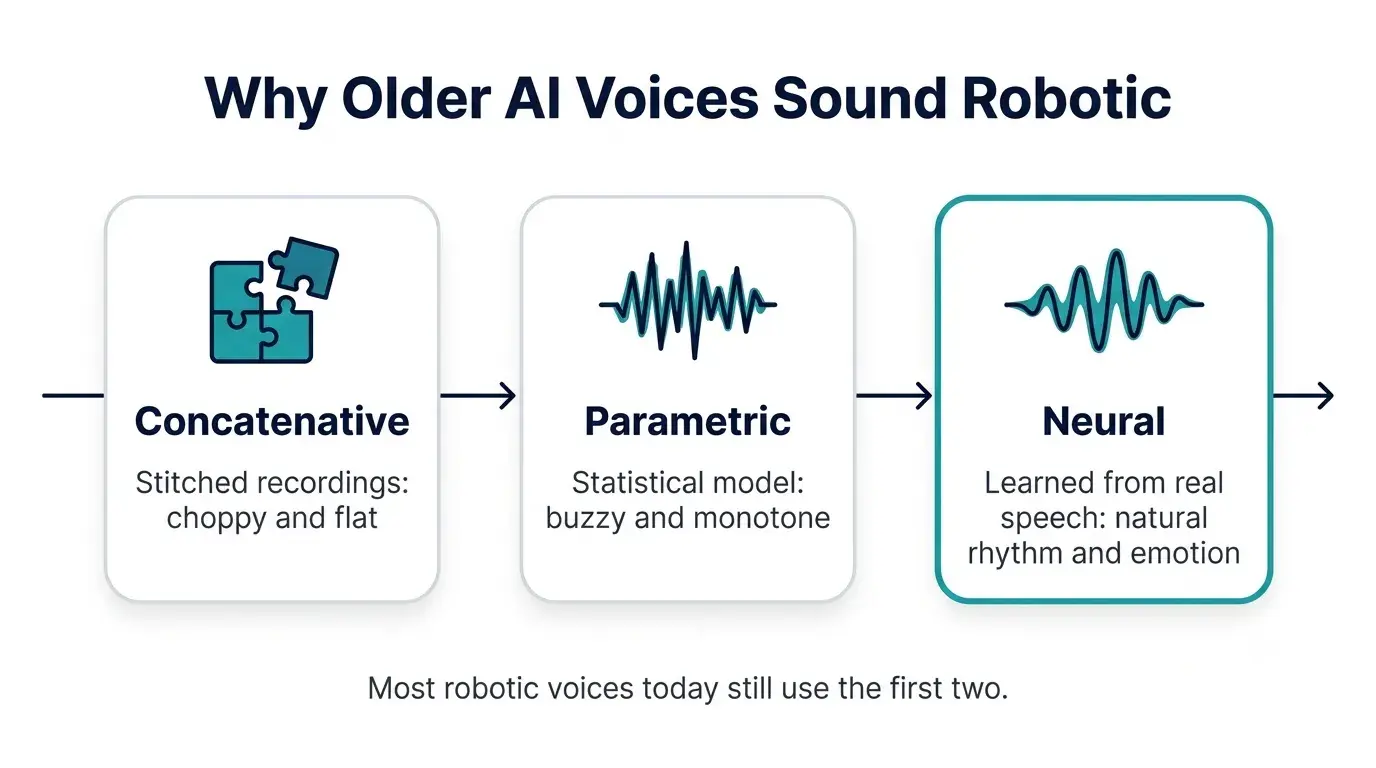
Standard text-to-speech covers older approaches that produce speech from rules, recordings or simple statistical models. Neural voice models are trained on large amounts of recorded speech and learn to generate audio directly, including the natural variation older systems couldn't produce.
Text-to-speech has gone through three broad generations:
| Generation | How it works | How it sounds |
|---|---|---|
| Concatenative | Stitches together small pieces of recorded speech | Clear but choppy, with audible joins and flat delivery |
| Parametric (statistical) | Predicts speech from a statistical model of the voice | Smooth but buzzy and monotone, the classic "robot" sound |
| Neural | Generates audio with deep learning trained on real speech | Natural rhythm, stress and emotion, close to human recordings |
Most robotic text to speech you hear today, in older phone menus and basic screen readers, comes from the first two generations, and current neural models sound very different. When we checked the Artificial Analysis Speech Arena in October 2026, where listeners vote between clips without knowing which model made them, ElevenLabs' Eleven v4 Turbo and Eleven v4 held the top two places.
4. Why does a voice that sounds great in a demo sound robotic on a live call?
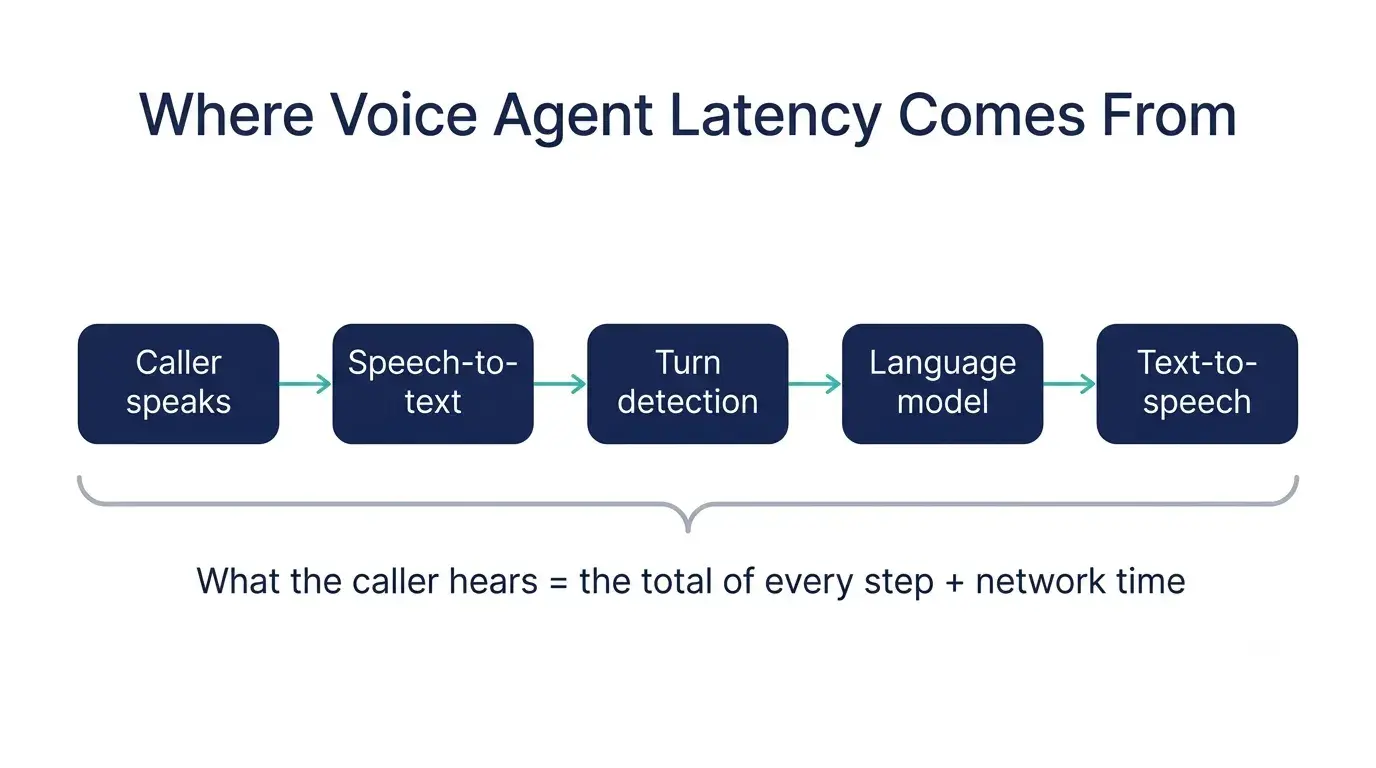
A demo plays one pre-generated clip. A live call runs a chain of systems in real time: speech recognition turns the caller's words into text, a language model writes a reply, and text-to-speech turns that reply into audio, with network delay in between.
Each link can make the call sound less human:
- Delay adds up. Every stage takes time, and the caller hears the total as a pause.
- Tone can get lost. Because the chain passes through text, the language model may not know the caller sounded frustrated or confused, so the reply can come out cheerful at the wrong moment.
- Turn-taking is hard. The system has to guess when the caller has finished speaking, so it either interrupts when it guesses too early or leaves a gap when it guesses too late.
Testing a voice on a single demo sentence tells you very little, so test it on a full live call flow. For the bigger picture of where voice fits in support, see why voice AI is becoming the main interface for customer support.
5. Is it the voice or the conversation?
With a modern neural voice, it's usually the conversation. The most common causes are:
- Scripted prompts. The language model repeats full sentences written into its instructions, so every call sounds identical.
- Long replies. Three sentences that read well on screen sound like a recorded message on the phone.
- Repeated or generic questions. Asking for details the caller already gave, or greeting every caller the same way, feels mechanical.
- No fallback for unexpected questions. The agent freezes or repeats itself when someone goes off-script.
Changing the voice won't fix any of these. Our guide on how to make an ElevenLabs agent sound natural covers how to rewrite prompts and replies so the agent stops sounding scripted.
6. Why do numbers, names and IDs sound robotic?
Numbers, dates, currency amounts, IDs and abbreviations are a common place for AI voices to slip. A model may read "4417" as "four thousand four hundred seventeen" instead of "four four one seven", or read an email address as one long string.
The fix is normalization: converting text into the exact words you want spoken before it reaches the voice model. Some models handle this better than others. ElevenLabs' models documentation notes that its fastest model, Flash v2.5, doesn't normalize numbers by default, and recommends having the language model write them out in full first. Test every number format your callers will hear before you launch.
7. Does latency make AI voice sound robotic?
Yes. A pause before every reply is a clear sign that the caller is talking to a machine, and it often causes the caller and the agent to talk over each other. In its guide to conversational AI latency, ElevenLabs puts the target below 700ms and says delays above 1,200ms lead to high abandonment.
The voice model is usually not the slowest part. The language model, slow tool calls and network distance usually add more delay. Our guide on how to cut ElevenLabs agent latency below one second shows how to find and fix each one.
8. Why does AI voice sound flat in some languages or accents?
Voice models perform best in the languages they were trained on most. Outside those, delivery can sound flatter, pronunciation can slip, and accents can drift during a long conversation.
Check the language coverage of the model you choose. ElevenLabs lists more than 90 languages for Eleven v4 and 32 for Flash v2.5. Then test with native speakers in each language you serve, including the regional accents your callers use. If callers switch languages mid-sentence, test that too, since it's harder for any model.
9. Which ElevenLabs model sounds most natural?
For produced audio such as narration, Eleven v4 is ElevenLabs' highest-quality model. For live conversations, Eleven v4 Turbo brings most of that expressiveness to real time, at around 100ms of model latency according to ElevenLabs. Agents can also use expressive mode, which ElevenLabs' expressive mode documentation describes as adjusting emotion and emphasis in real time based on how the caller sounds.
For a full comparison of quality, latency and cost, see ElevenLabs v4 vs v3 vs Flash v2.5.
10. How do you make AI voice sound natural?
If you're working out how to make AI voice sound natural, work through it in this order:
- Rewrite scripted prompts as instructions about tone and behavior, not lines to recite.
- Keep replies short: one idea and one question at a time.
- Normalize numbers, dates and IDs before they're spoken.
- Tune turn-taking so the agent doesn't interrupt or wait too long.
- Cut response delay, starting with the language model and tool calls.
- Choose a neural model built for real-time conversation, and test voices on your own scripts.
- Test on real calls, including interruptions and unexpected questions.
In most setups, the first five steps make more difference than the choice of voice. The how-to guide linked in question 5 covers each step in detail.
More Questions
Can AI voice sound 100% human?
On short, scripted clips, modern neural voices can be very hard to tell apart from human speech. On live calls, small gaps in timing, context or pronunciation can still reveal an AI. The goal for most businesses is a voice that sounds natural and gets the job done, while being honest that callers are speaking to an AI.
Does voice cloning make AI voice sound more natural?
Voice cloning can make a voice sound more familiar and on-brand, especially if you clone a warm, natural speaker. It won't fix robotic delivery caused by scripted prompts, long replies or slow responses. Clone quality also depends on the recording: clean, expressive audio gives better results than a flat or noisy sample.
Does SSML fix robotic AI voices?
SSML, a markup language for controlling speech, can help with pauses, pronunciation and emphasis on older, robotic text to speech systems. With modern neural models, writing natural text and giving clear tone instructions usually matters more. SSML won't fix problems caused by latency, turn-taking or scripted conversations.
Is ElevenLabs robotic?
No. ElevenLabs' current models are neural and rank at the top of independent blind-listening tests, with Eleven v4 Turbo and Eleven v4 in the top two places on the Artificial Analysis Speech Arena in October 2026. An ElevenLabs agent can still sound robotic if its prompts, latency or turn-taking are poorly set up.
Should an AI voice tell people it's an AI?
Yes. Being upfront builds trust, and in some places it's required. In the EU, Article 50 of the AI Act requires telling people when they're interacting with an AI system. A natural-sounding voice and an honest introduction work well together.
Why Does AI Voice Sound Robotic on Your Calls? Try ElevenLabs
If customers keep asking whether they're talking to a robot, the voice model may be holding you back, and the setup around it matters just as much. ElevenLabs' models lead independent listening tests, and its agent platform gives you control over expressiveness, turn-taking and latency.
Haass implements ElevenLabs voice agents and tunes the parts that make AI voice sound robotic: prompts, reply length, number handling, turn-taking and response time. If you'd like to hear the difference, send us one recording where your current voice AI sounds robotic, with personal details removed, and we'll show you what we'd change on ElevenLabs.
Talk to our team, read what ElevenLabs is and what it includes, or see our guide to choosing an ElevenLabs implementation partner.