TL;DR
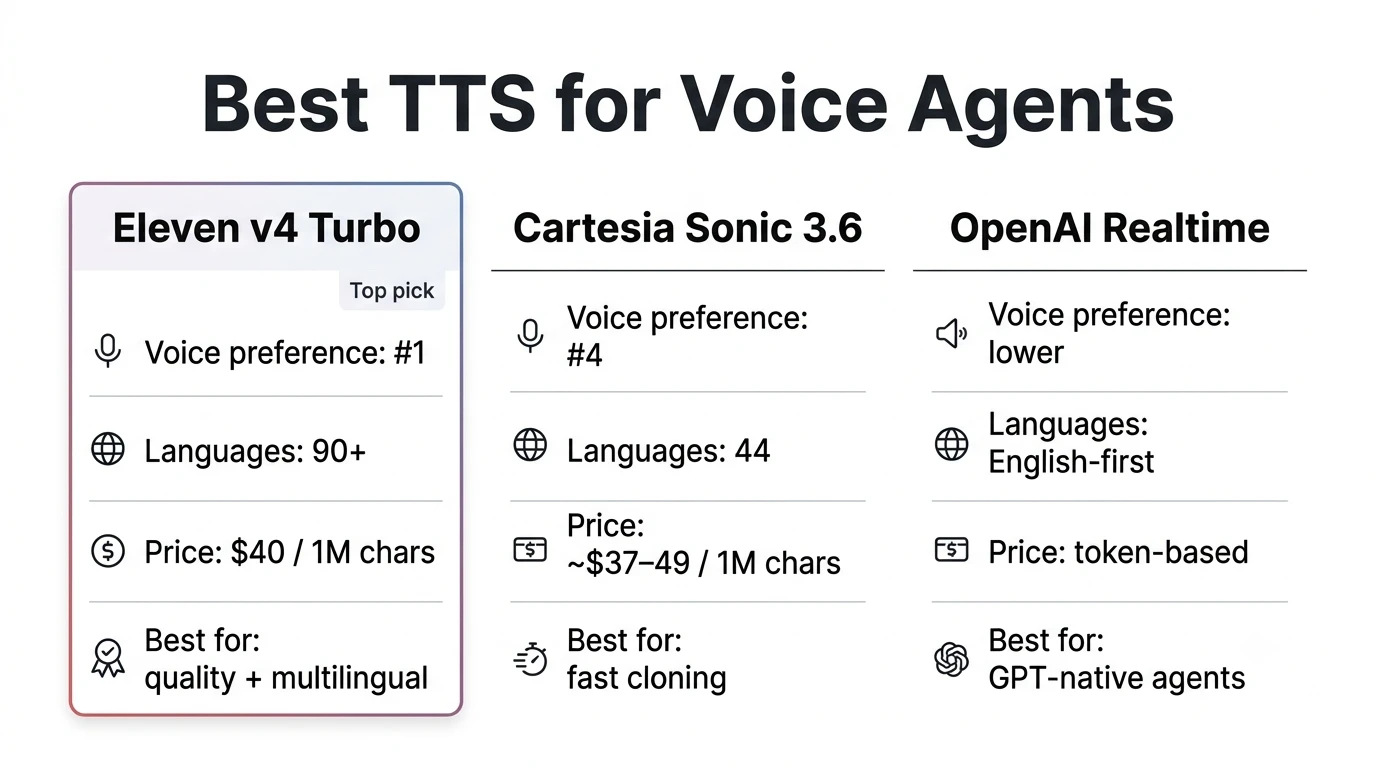
- For most production voice agents, Eleven v4 Turbo is the best TTS for voice agents right now. It ranks first on the Artificial Analysis blind listening board, speaks 90+ languages and costs $40 per million characters.
- Pick Cartesia Sonic 3.6 if you want voice clones from about 10 seconds of audio, interruption handling on a single open connection, and slightly more characters on its $299 plan.
- If you use OpenAI's tts-1 or gpt-4o-mini-tts, you have until January 6, 2027 to move. The replacement runs only on the Realtime API.
- Each vendor publishes a latency benchmark it wins. Test from the region you deploy in before you commit.
Your voice agent answers a caller, then pauses for almost a second before it speaks. Or it reads order number "B-4417" back as "B forty-four seventeen" and the caller hangs up. Choosing the best TTS for voice agents comes down to moments like these: how fast the first syllable arrives, how the voice handles numbers and names, and what happens when the caller cuts in mid-sentence.
This comparison covers the three options most teams shortlist in late 2026: ElevenLabs (Eleven v4 Turbo and Flash v2.5), Cartesia Sonic 3.6 and OpenAI's speech models. All prices and rankings were read on vendor pages and public leaderboards in October 2026. For the deeper two-way breakdown, read our full ElevenLabs vs Cartesia comparison.
The short answer: best TTS for voice agents at a glance
| Eleven v4 Turbo | ElevenLabs Flash v2.5 | Cartesia Sonic 3.6 | OpenAI gpt-realtime-2.1-mini | |
|---|---|---|---|---|
| Blind-preference Elo (Artificial Analysis, Oct 2026) | 1,335 (rank 1) | 1,077 | 1,289 (rank 4) | Not listed (GPT-Realtime-2 scores 1,075) |
| Vendor-published latency | ~100 ms inference, ~150 ms median to first speech | ~75 ms inference | Under 90 ms | No TTS-only figure |
| Languages | 90+ | 32 | 44 | Multilingual, voices tuned for English |
| Instant voice cloning | Yes | Yes | From ~10 seconds of audio | Eligible customers only |
| Expressive control | Audio tags such as [laughs] and [whispers] | Voice settings per call | Emotion, speed and volume tags (emotion in English only) | Natural-language instructions |
| API price | $40 per 1M characters | $40 per 1M characters | ~$37 to $49 per 1M characters (credits) | $20 per 1M audio output tokens (~$0.024 per minute) |
| Streaming interface | Text to Dialogue WebSocket | Text to Speech WebSocket | One WebSocket, one context per answer | Realtime API over WebRTC, WebSocket or SIP |
How we compared them
A voice agent asks more of TTS than an audiobook does. The voice speaks in short bursts, waits on a language model, gets interrupted, and often plays over an 8 kHz phone line. So we weighted six criteria for live conversations:
- Time to first audio: how long from the first word of text to the first sound the caller hears.
- Voice preference: how often listeners pick the voice in blind tests.
- Pronunciation on hard text: numbers, codes, names, email addresses and dates.
- Interruption handling: how fast the API stops speaking when the caller talks.
- Language coverage: every language your callers use, on the model you will run.
- Price and concurrency: cost per million characters and how many calls run at once on a plan.
We left out criteria that matter mostly for narration, such as consistency over a 30-minute render. If you also need audiobooks or dubbing, see the wider field of TTS APIs we compared.
ElevenLabs Eleven v4 Turbo (and Flash v2.5)
What it is
ElevenLabs released Eleven v4 and v4 Turbo in late September 2026. v4 Turbo is the low-latency version built for conversation. Flash v2.5, the previous real-time model, is still available and has slightly lower inference time. Both are listed on the ElevenLabs models page.
Strengths
v4 Turbo sits first on the Artificial Analysis Speech Arena provider-voice board, with an Elo of 1,335 from more than 2,000 blind votes. Eleven v4 is second. Flash v2.5 scores 1,077 on the same board, so moving from Flash to v4 Turbo is a large step up in how listeners rate the voice. If callers judge your agent by how human it sounds, that gap is the strongest reason to pick v4 Turbo.
v4 Turbo speaks more than 90 languages, against 32 on Flash v2.5. An agent serving India, the Gulf or Southeast Asia can run one model across every market. For Indian deployments, our comparison of ElevenLabs, Sarvam AI and Gnani AI covers regional voices and accents.
Your language model can write audio tags into the reply, such as [laughs], [sighs] or [whispers], and v4 Turbo performs them. A support agent can soften an apology without you tuning voice settings sentence by sentence.
In its Eleven v4 launch test, ElevenLabs measured v4 Turbo at a median of about 150 ms to first speech, against 262 ms for Cartesia Sonic 3.6 and 814 ms for OpenAI gpt-4o-mini-tts, with network time removed for every system. It is a vendor benchmark, so read it alongside the independent numbers in the latency section below.
Limitations
v4 Turbo streams over the Text to Dialogue WebSocket, so code written for Flash v2.5 needs changes. It also has no message to stop a synthesis mid-answer: when a caller interrupts, your client closes the connection and opens a new one. Flash v2.5 handles interruptions on its existing socket.
Instant voice clones work best with one to two minutes of clean audio, and professional clones need 30 minutes or more on a Creator plan or above.
Who it fits
Pick v4 Turbo when voice quality and language coverage drive the decision: customer support, healthcare intake, multilingual contact centers and branded agents. Pick Flash v2.5 for English-heavy traffic where the lowest inference time matters most. We explain the trade-offs in ElevenLabs v4 vs v3 vs Flash v2.5.
Cartesia Sonic 3.6
What it is
Cartesia builds Sonic for real-time voice on a state space model architecture. Sonic 3.6 shipped on August 27, 2026 and is backwards compatible with Sonic 3.5. Cartesia stopped serving sonic-turbo and sonic-2 after October 20, 2026, so any agent still configured with those model IDs has to move to sonic-3.6 now.
Strengths
Cartesia advertises Sonic latency under 90 ms on its own measurement. Its streaming design suits agents: one open WebSocket, a separate context for each answer, and a single cancel message when the caller interrupts. You never reconnect mid-call.
Cloning is its other strong point. Cartesia's instant voice clone starts from about 10 seconds of audio, which helps if you need many voices or let end users clone their own. Professional clones are available from the $49 Startup plan.
Sonic 3.6 ranks fourth on the Artificial Analysis board at 1,289 Elo, a clear jump from Sonic 3.5 at 1,191. It covers 44 languages.
Limitations
Independent latency numbers are less flattering. On the Coval TTS benchmark read on September 8, 2026, Sonic 3.6 measured a median perceived time to first audio of 440 ms. That was slower than Sonic 3.5 at 269 ms and ElevenLabs Flash v2.5 at 185 ms. Coval's figure includes network time and leading silence, so it measures something different from Cartesia's sub-90 ms number.
Sonic 3.6 understands more than 60 emotion, speed and volume tags, but applies emotion only in English. It covers 44 languages, about half of v4 Turbo's list.
Who it fits
Cartesia suits teams that clone many voices from short samples, run mostly English traffic with emotion tags, or want the simplest interruption handling in their own orchestration code. Our ElevenLabs vs Cartesia comparison goes deeper on the two-way decision.
OpenAI: gpt-realtime instead of tts-1
What it is
On October 1, 2026, OpenAI deprecated every model its speech endpoint accepts: tts-1, tts-1-hd and both gpt-4o-mini-tts snapshots. They stop working on January 6, 2027. OpenAI names gpt-realtime-2.1-mini as the replacement, and it runs only on the Realtime API over WebRTC, WebSocket or SIP. If you are looking for an OpenAI realtime TTS alternative, this is the decision point.
Strengths
The Realtime API handles speech input, the conversation and speech output in one session, so you skip separate speech-to-text and TTS vendors. You steer delivery with plain instructions such as "warm, short pauses." It returns PCM or G.711 audio, which plugs straight into phone systems. If your agent's reasoning already runs on OpenAI, it is the shortest path to a working prototype.
Limitations
Voice quality trails the other two. On the Artificial Analysis board, GPT-Realtime-2 scores 1,075 Elo, about 260 points behind v4 Turbo. Coval measured gpt-4o-mini-tts at a P95 of 3,927 ms on September 8, 2026, far too slow for live conversation, though that model is now on its way out.
Custom voices are limited to eligible customers through sales, and the built-in voices are tuned for English. Billing is per audio token rather than per character, so cost forecasts take more work. Moving to Realtime also changes your architecture: you are replacing a pipeline, which is a bigger job than swapping one TTS call for another.
Who it fits
Stay on OpenAI if your agent is GPT-native, English-first and voice quality is secondary to speed of delivery. If you already have a speech-to-text and LLM pipeline and only used OpenAI for the voice, the January deadline is a good moment to move speech output to ElevenLabs or Cartesia instead.
Before January 6, 2027: list every call to the speech endpoint in your code, pick a replacement voice, test it on your 20 most common agent replies, and switch at least two weeks before the cutoff.
Low latency text to speech: why every benchmark disagrees
The vendors measure different things. ElevenLabs quotes model inference time with the network removed. Cartesia quotes its own sub-90 ms figure. Coval measures perceived time to first audio from its own servers, including the network round trip and any silence at the start of the audio stream. All three numbers can be true at once.
| Source and date | What it measures | Eleven v4 Turbo | Flash v2.5 | Sonic 3.6 | OpenAI |
|---|---|---|---|---|---|
| ElevenLabs launch test, Sept 2026 | Median time to first speech, network removed | ~150 ms | Not reported | 262 ms | 814 ms (gpt-4o-mini-tts) |
| Coval leaderboard, Sept 8, 2026 | Median perceived time to first audio, network included | Not yet listed | 185 ms | 440 ms | 3,927 ms P95 (gpt-4o-mini-tts) |
| Vendor docs, Oct 2026 | Model inference | ~100 ms | ~75 ms | Under 90 ms | Not published |
Your caller hears none of these directly. They hear the whole loop: speech-to-text finishing, the language model producing its first tokens, any tool call, TTS first audio, and the network in between. As a working target, most teams aim for the agent to start replying within about one second of the caller finishing. TTS is only one slice of that budget, so a 100 ms difference between vendors matters less than a slow API lookup.
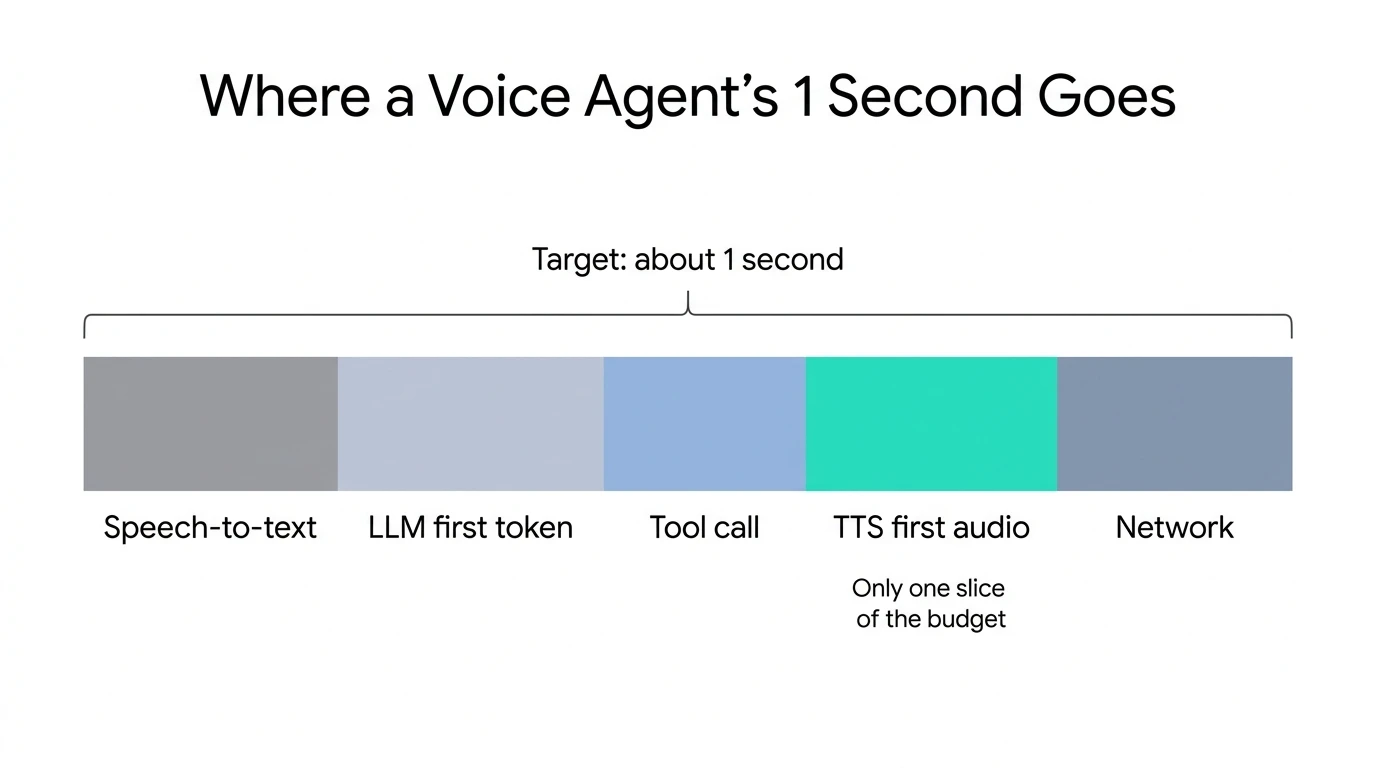
Three changes usually save more time than switching vendors: stream the LLM output into TTS word by word instead of waiting for full sentences, keep the WebSocket open between turns, and deploy your orchestration in the same region as the TTS endpoint. We cover the full set of techniques in how to cut ElevenLabs agent latency below one second.
Voice quality and pronunciation on real calls
Blind-preference scores tell you which voice listeners like on clean sample sentences. On the Artificial Analysis provider-voice board in October 2026, the order for these three vendors is Eleven v4 Turbo (1,335), Cartesia Sonic 3.6 (1,289), then OpenAI GPT-Realtime-2 (1,075). For a sales or support agent where tone carries the call, that ranking matters.
A preference score won't tell you whether the voice reads "INV-20391" correctly or says a customer's surname the way they do. Support and healthcare agents fail most visibly on order numbers, policy IDs, dates, drug names and email addresses. No public benchmark covers all three vendors on this kind of text, so test it yourself with the replies your agent actually gives.
Two fixes help with any vendor. Have your language model write numbers and codes the way they should be spoken ("I N V, two zero three nine one"), and keep a pronunciation list for brand and product names. ElevenLabs supports pronunciation dictionaries for this.
Phone calls add one more variable. Most voice agents play over telephone lines that carry 8 kHz audio, which strips detail from any voice. A voice that wins on studio-quality samples can lose some of its edge on a phone line, so run your comparison on real phone audio. OpenAI Realtime returns G.711 directly; for ElevenLabs and Cartesia, request their 8 kHz μ-law output format to skip a conversion step. If your agent still sounds flat after that, our guide on why AI voices sound robotic covers the usual causes, and how to make an ElevenLabs agent sound natural covers voice settings and prompt fixes.
Interruptions and turn-taking
Callers interrupt. They say "yes, yes" halfway through a confirmation or correct a date before the agent finishes reading it. When that happens, the TTS has to stop within a few hundred milliseconds, or the agent talks over the caller and the call feels broken.
| How it stops mid-answer | What it means for you | |
|---|---|---|
| Cartesia Sonic 3.6 | Sends one cancel message for that answer's context on the open connection | Simplest to build; the socket stays up for the whole call |
| ElevenLabs Flash v2.5 | Keeps the connection, flushes it and drops the old audio | Clean, with some client-side logic |
| Eleven v4 Turbo | Closes the connection and opens a new one | Adds a short reconnect delay on each interruption |
| OpenAI Realtime | Handled inside the Realtime session with its own turn detection | Least code, least control |
If you build your own orchestration, Cartesia's model is the easiest to get right. If you run on a managed platform such as ElevenLabs Agents, the platform handles turn-taking and interruption for you, so this difference mostly disappears. Our comparison of ElevenAgents, Vapi, Retell and Bland AI covers that platform layer.
Price and concurrency at scale
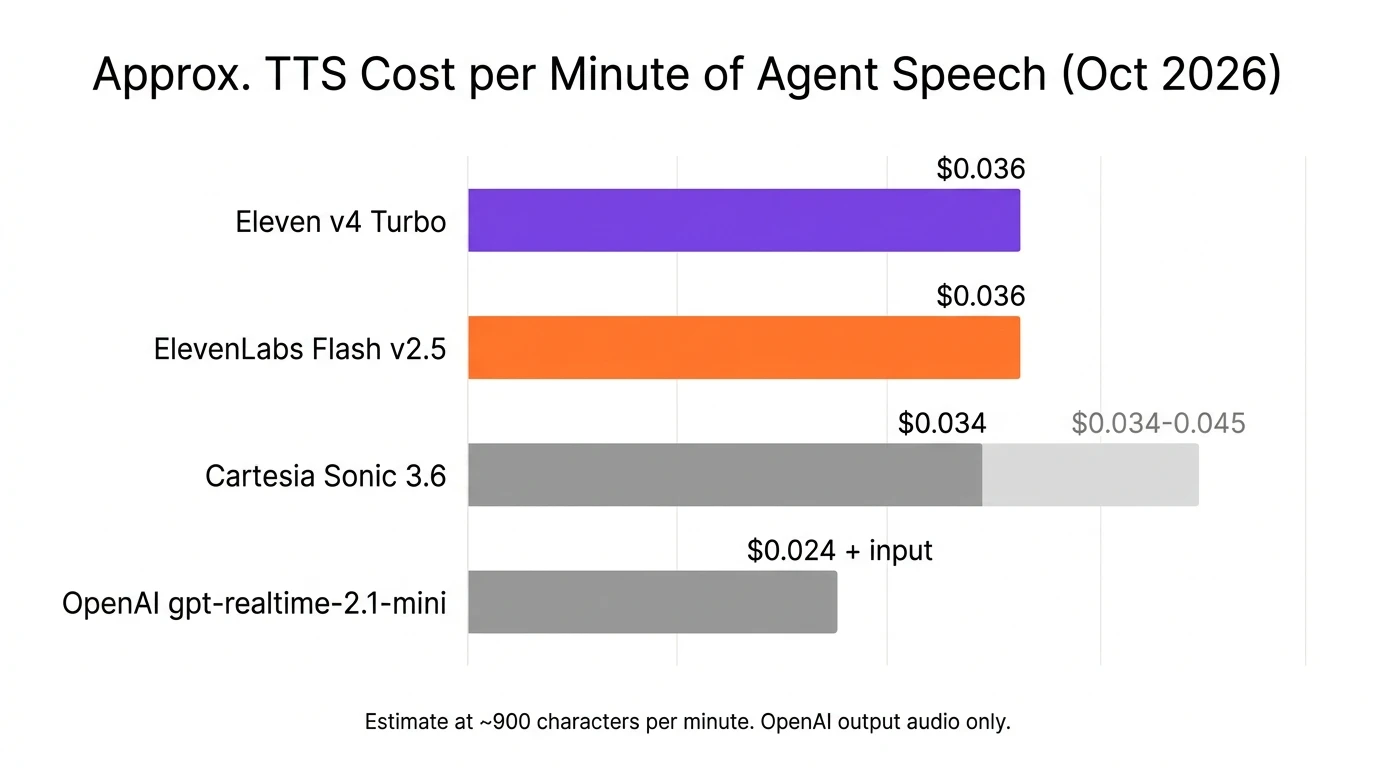
Per character, ElevenLabs and Cartesia now cost about the same. OpenAI bills audio by token, which makes it cheaper per minute on its mini model but harder to forecast. All figures below were read on vendor pricing pages in October 2026 and change often, so check them before you budget.
| Model | List price | Approx. cost per minute of agent speech* |
|---|---|---|
| Eleven v4 Turbo | $40 per 1M characters (ElevenLabs API pricing) | ~$0.036 |
| ElevenLabs Flash v2.5 | $40 per 1M characters | ~$0.036 |
| Cartesia Sonic 3.6 | ~1 credit per character: $5 for 100K (Pro), $49 for 1.25M (Startup), $299 for 8M (Scale) (Cartesia pricing) | ~$0.034 to $0.045 |
| OpenAI gpt-realtime-2.1-mini | $20 per 1M audio output tokens, $0.60 per 1M text input tokens (OpenAI pricing) | ~$0.024 for output audio, plus input |
| OpenAI gpt-realtime-2.1 | $64 per 1M audio output tokens, $32 per 1M audio input tokens | ~$0.077 for output audio, plus input |
*Our estimate at about 900 characters per minute of speech. OpenAI meters output audio at one token per 50 ms, or 1,200 tokens per minute.
Concurrency decides more than price once you scale. On the $299 Scale plans, ElevenLabs includes 7,475,000 Flash or v4 Turbo API characters with 30 concurrent Flash generations or 105 simultaneous v4 sessions. Cartesia includes about 8 million characters with 15 concurrent generations. The vendors count differently, though. Cartesia counts each open answer context, so a slot frees up as soon as an answer finishes. ElevenLabs v4 holds one dialogue session for the whole call, silences included. Size your plan on your peak of simultaneous answers or calls measured on real traffic.
If you would rather not run the TTS layer yourself, ElevenLabs Agents bundles speech, turn-taking and telephony at $0.08 per minute as of September 2026, with LLM usage billed on top.
Best TTS for voice agents by use case
| Use case | First pick | Why |
|---|---|---|
| Customer support and contact centers | Eleven v4 Turbo | Highest listener preference and 90+ languages on one model |
| Healthcare intake and scheduling | Eleven v4 Turbo, with a pronunciation list | Warm tone matters with patients; test drug names, dates and IDs before launch |
| EdTech tutoring | Eleven v4 Turbo | Audio tags let a tutor sound encouraging without extra voice tuning; strong multilingual coverage for global learners |
| Outbound sales and lead qualification | Eleven v4 Turbo or Flash v2.5 | Voice quality affects whether the person stays on; Flash v2.5 if your volume is mostly short English calls |
| Apps where users clone their own voice | Cartesia Sonic 3.6 | Clones from about 10 seconds of audio |
| English agent with your own orchestration code | Cartesia Sonic 3.6 or Flash v2.5 | Simplest interruption handling on one open socket |
| GPT-native prototype | OpenAI gpt-realtime-2.1-mini | One session for speech in, reasoning and speech out |
| Teams on tts-1 or gpt-4o-mini-tts with their own pipeline | Move speech to Eleven v4 Turbo | Keeps your existing LLM; better voice before the January 6, 2027 shutdown |
Many production teams also keep a second vendor as a fallback. If the primary TTS fails mid-call, the agent switches voices for the rest of the answer instead of going silent. Strip vendor-specific tags (ElevenLabs audio tags or Cartesia emotion tags) before sending text to the backup, or it will read them aloud.
Verdict: the best TTS for voice agents in late 2026
For most teams building a voice agent today, Eleven v4 Turbo is the best TTS for voice agents. It leads independent blind listening tests, covers more than twice as many languages as Sonic 3.6, and costs the same per character as Flash v2.5. Its weak spot is interruptions, which need a reconnect if you write your own orchestration, and a managed platform removes that problem.
Cartesia Sonic 3.6 is a strong second choice. It fits teams that clone many voices from short samples or want the simplest interruption handling in their own code, especially for English-only agents. OpenAI makes sense only if you move fully to the Realtime API and accept a lower voice-quality ceiling; anyone still on tts-1 or gpt-4o-mini-tts should plan the switch now.
Ship ElevenLabs voice agents with Haass
Picking the model is the quick part. Getting first audio under a second on real phone lines, handling interruptions, and reading order numbers correctly takes integration work. Haass is a premium ElevenLabs implementation partner: we run the bake-off on your own call data, integrate the ElevenLabs API with your telephony and backend systems, and tune the agent after launch.
See what our ElevenLabs API implementation service covers, read how to choose an ElevenLabs implementation partner, or book a call with our team to test Eleven v4 Turbo on your agent's real replies.
FAQ
What is the best TTS for voice agents?
Eleven v4 Turbo is the best TTS for voice agents for most teams in late 2026. It ranks first on the Artificial Analysis blind listening board, speaks more than 90 languages and costs $40 per million characters. Cartesia Sonic 3.6 is the strongest alternative for teams that clone many voices or want simpler interruption handling. Test both on your own agent replies before you commit.
Is Cartesia faster than ElevenLabs?
It depends on whose test you read. Cartesia advertises Sonic latency under 90 ms. ElevenLabs measured Eleven v4 Turbo at about 150 ms median to first speech against 262 ms for Sonic 3.6. Coval's independent board, read on September 8, 2026, had ElevenLabs Flash v2.5 at 185 ms and Sonic 3.6 at 440 ms. Measure both from your deployment region.
Is OpenAI shutting down its text-to-speech models?
Yes. OpenAI deprecated tts-1, tts-1-hd and gpt-4o-mini-tts on October 1, 2026, and they stop working on January 6, 2027. The named replacement, gpt-realtime-2.1-mini, runs only on the Realtime API over WebRTC, WebSocket or SIP. Teams that only need text in and audio out can move speech output to ElevenLabs or Cartesia instead.
Which TTS is best for phone calls?
Eleven v4 Turbo is the strongest choice for phone-based voice agents when voice quality matters, and Cartesia Sonic 3.6 is a close second. Phone lines carry 8 kHz audio, so request μ-law output at 8 kHz and judge voices on a real handset. OpenAI Realtime returns G.711 audio directly but scores lower on listener preference.
Can I use two TTS providers in one voice agent?
Yes, and many production teams do. A common setup runs one provider as the primary and a second as a fallback that takes over if the first fails mid-call, so the caller hears a voice change instead of silence. Strip vendor-specific audio or emotion tags before sending text to the backup, or it may read them aloud.