TL;DR
- With ElevenLabs IVR navigation, an agent can call an insurance carrier, work through its phone menu, wait on hold and hand the call to your team when a person answers.
- It works on the carrier's existing phone system, with no integration on the carrier's side.
- Getting it to work reliably across many carriers is harder than a demo suggests: menus change, holds run long and representatives ask verification questions.
- Haass designs, tests and runs these agents for insurance workflows.
Your team has a list of 60 benefits checks to get through today, and ElevenLabs IVR navigation can take most of the waiting off their hands. Today, each call starts the same way: dial the carrier, press 2 for providers, enter the NPI, press 1 for eligibility, then wait 35 minutes on hold with the same hold music looping.
That waiting time adds up to whole days every week, spent by people who should be helping patients or customers. If you want to automate insurance hold time with AI, this is the place to start. The agent does the dialing, the menu pressing and the waiting, and your team picks up the call only when a carrier representative is on the line.
Disclosure: Haass is an ElevenLabs implementation partner.
What Is ElevenLabs IVR Navigation?
IVR navigation means an AI agent calls a third party's automated phone system, works through the menu and reaches the right destination on your behalf. ElevenLabs describes it as letting agents work through other companies' phone menus and only bringing a person back in once the goal is reached.
It's worth separating this from conversational IVR, which is a different product. Conversational IVR replaces your own phone menu, so callers can speak instead of pressing buttons. IVR navigation works in the other direction: your agent is the caller, dealing with someone else's phone tree.
For insurance operations, that difference matters. You can't change how a carrier's phone system works, and carriers won't build an integration for you. An agent that navigates their existing menu the way a person would doesn't need either.
How an AI Agent Navigates an Insurance Phone Menu
Here's what a single call looks like when an ElevenLabs agent handles it.
- It dials the carrier from your phone number, connected through a provider such as Twilio, Telnyx, Vonage or a SIP trunk.
- It listens to the whole menu before choosing. ElevenLabs says its agents build an understanding of what each option means rather than following a fixed sequence of presses.
- It presses the right option. The agent sends keypad tones, the same signals your phone makes when you press a button. ElevenLabs provides this as a built-in tool, and if a tone doesn't register, the agent can retry or say the option out loud.
- It enters the details for that call, such as the member ID, date of birth or provider number, for the specific patient or customer.
- It waits on hold through hold music and recorded messages, without talking over them.
- It recognizes when a real person picks up, as opposed to another recording.
- It hands over to your team, passing the call with a summary of where it is and what's needed, or completes a simple request itself if the goal allows.
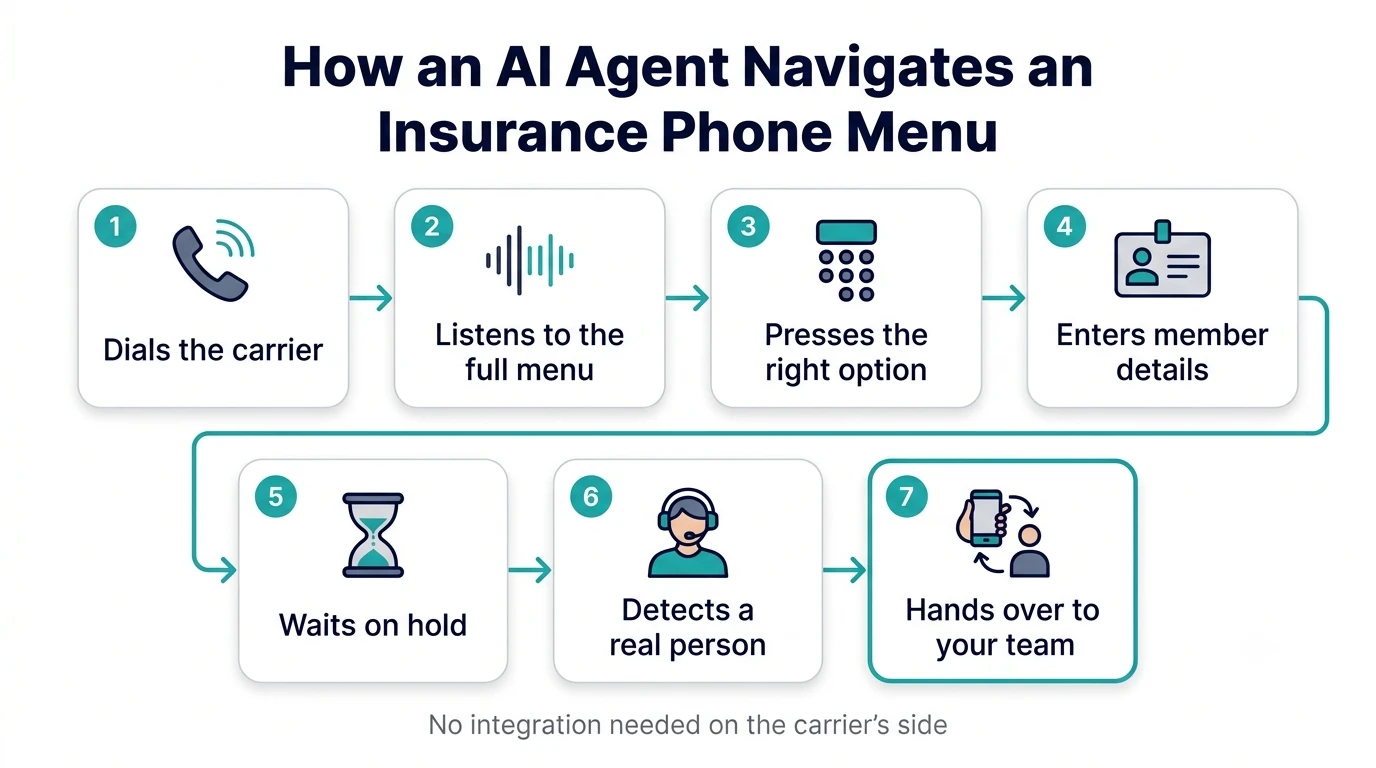
To the carrier's phone system, the agent behaves like a person pressing buttons. That's why it works without any cooperation from the carrier.
Where It Saves Time in Insurance Operations
Benefits and eligibility verification. The agent navigates to provider services, enters the member's details and waits for a representative, so your team only joins for the conversation itself. ElevenLabs uses this as its own example of the technology.
Claim status follow-ups. Health insurance claim phone queue automation is one of the clearest wins, because these queues are often the longest. An agent can work through a list of claims, reach the right queue for each, and hand over or record the status update.
Prior authorization status checks. These calls follow the same pattern of menu, member details and hold, which makes them a good fit.
Pharmacy and refill lines. Many of these systems are fully automated, so the agent can complete the request without a person joining at all.
Any repetitive carrier call. If your team makes the same kind of call dozens of times a day, it's a candidate. The more calls and the longer the holds, the more it helps reduce wait time on each insurance hotline your team depends on.
Why IVR Navigation Is Harder Than It Looks
Building a demo that navigates one menu takes an afternoon. Running it reliably across every carrier your team calls, every day, is a different job. ElevenLabs lists several of the challenges itself, and insurance calls add more.
Timing. Phone menus often speak slowly and pause between options. An agent that presses too early can derail the menu or loop back to the start.
Menus several layers deep. Carriers often route through multiple nested menus, each with its own wording and timing. One wrong choice early in the call wastes the whole hold.
Menus that change without warning. A carrier reorganizes its phone tree, and a fixed sequence of button presses stops working overnight. The agent needs to understand the options, not memorize them, and you need monitoring to catch failures quickly.
Tones that don't register. ElevenLabs notes that how reliably keypad tones land depends on the telephony provider, and some phone systems struggle to detect them. That needs testing carrier by carrier.
Long holds. A 40-minute hold with looping music and repeated recordings is easy for a person to sit through and easy for an agent to get wrong, by speaking into a recording, hanging up or missing the moment someone answers.
Real people versus recordings. "Thank you for holding, a representative will be with you shortly" sounds a lot like a person. Misreading it means either a missed handover or the agent starting a conversation with a recording.
Verification questions and honesty. Carrier representatives ask security questions, and some ask "Are you a virtual assistant?". The agent should answer honestly that it's an AI calling on behalf of the provider, have the verification details ready, and transfer to a person when the carrier requires one. Agents that freeze or dodge at this point are a common reason calls fail.
Recognize these problems? If your team is already testing IVR navigation and hitting these walls, tell us which carriers you call most and where the calls break down. Talk to our team.
What to Plan For Before You Automate Carrier Calls
Compliance. Benefits and claims calls involve protected health information. You'll need a Business Associate Agreement where HIPAA applies, decisions on whether and how calls are recorded, a retention policy for transcripts, and a check that your approach fits each carrier's policies for automated callers.
Cost. Hold time is call time. ElevenAgents plans include an allowance of call minutes, with overage charges beyond it, so an agent waiting 40 minutes on hold uses 40 minutes of call time. Check how your plan counts minutes on the ElevenAgents pricing page, and compare the result with the staff time the agent replaces. The case is usually strongest for calls with long holds, because that's where your team's time costs the most.
Handover design. A live operator transfer is where a hold bot either saves the call or loses it. Decide who takes the call when a representative answers, how quickly they need to pick up, and what summary they receive. A handover that leaves the representative waiting in silence often ends the call.
Volume and concurrency. Calling many carriers at once means many calls running in parallel. Plan your concurrency limits around your busiest hours.
For the wider rules on automated outbound calls, see our guide to AI outbound calling.
How Haass Builds IVR Navigation Agents on ElevenLabs
Haass designs and runs ElevenLabs agents for the calls your team makes to insurance carriers. That includes:
- Mapping your carrier calls: which carriers, which menus, which details each call needs and where the call should end up
- Designing the agent's behavior: listening, menu choices, entering details, waiting on hold and recognizing a real person
- Handover to your team, with a summary, so representatives aren't left waiting
- Honest handling of verification questions, including "Are you an AI?"
- Compliance setup: recording, data retention and HIPAA requirements
- Testing across each carrier before go-live, and monitoring afterward so menu changes are caught early
We also tune the parts that make an agent sound natural and respond quickly, which matters when a representative picks up. Our guides on making an ElevenLabs agent sound natural and cutting ElevenLabs agent latency cover that side in detail.
Frequently Asked Questions
Can an ElevenLabs agent navigate an insurance company's phone menu?
Yes. ElevenLabs agents can call a carrier, listen to its phone menu, choose options by sending keypad tones, enter member details, wait on hold and hand over when a person answers. ElevenLabs says this works across major telephony providers, including Twilio, Telnyx and Vonage, though reliability should be tested for each carrier.
Does ElevenLabs IVR navigation need an integration with the carrier?
No. The agent interacts with the carrier's existing phone menu the same way a person does, by listening and pressing keypad tones. The carrier doesn't need to build anything or cooperate. You need an ElevenLabs agent connected to your own phone number through a provider such as Twilio or a SIP trunk.
Does hold time count toward ElevenLabs agent minutes?
Hold time is part of the call, so plan for it to use call minutes. ElevenAgents plans include an allowance of call minutes with overage charges beyond it. Check the current ElevenAgents pricing page for how minutes are counted, and compare the cost with the staff time your team currently spends on hold.
What happens when a person answers the call?
The agent recognizes that a real person has picked up and either hands the call to your team with a summary of the details it has already entered, or handles a simple request itself if that's the goal. Designing this handover carefully matters, because a representative left waiting in silence may end the call.
Should the agent say it's an AI?
Yes. If a carrier representative asks, the agent should answer honestly that it's an AI calling on behalf of the provider, then continue with verification details or transfer to a person. Honesty builds trust, avoids breaking carrier policies, and in some places, such as the EU, telling people they're talking to an AI is a legal requirement.
Stop Losing Days to Carrier Hold Queues
ElevenLabs IVR navigation can take the dialing, menu pressing and waiting off your team, so they only join calls when a person is on the line. Getting it right across every carrier you call is where most of the work is.
Tell us which carriers your team calls most and roughly how many calls a week, and we'll show you how an ElevenLabs agent would handle them. Talk to our team, or read our guide to choosing an ElevenLabs implementation partner. For more on how ElevenLabs approaches this, see its own explanation of IVR navigation.