TL;DR
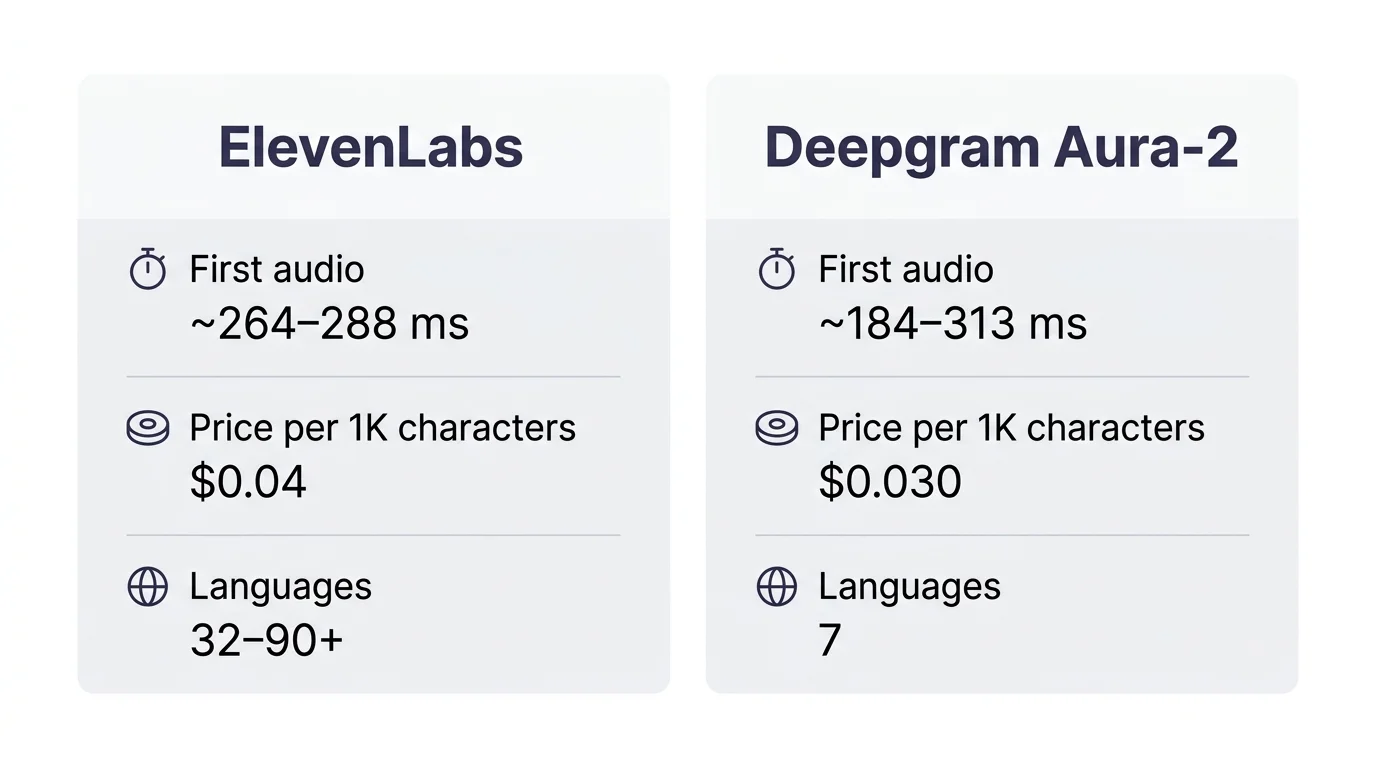
- Latency: On ElevenLabs vs Deepgram Aura latency, it's close, and the published numbers contradict each other. Deepgram's own test puts Aura-2 ahead; an independent 2026 benchmark puts ElevenLabs Flash and Turbo ahead. Test on your own phone path before you trust either.
- Price: Aura-2 costs $0.030 per 1,000 characters against $0.04 for ElevenLabs Flash v2.5. At 100,000 five-minute calls a month, that gap is about $2,000.
- Quality and languages: ElevenLabs wins clearly. Its top models lead blind listening tests, and it covers 32 to 90+ languages against Aura-2's seven, none of them Indian.
- Verdict: Pick Aura-2 for English-only, high-volume, price-sensitive bots. Pick ElevenLabs when the voice faces customers, speaks more than a few languages, or has to sound like your brand.
Your voice agent sounded great in the demo. Then it went live on a phone line, callers started talking over it during the pause before each reply, and finance flagged a TTS bill that grows with every word the bot says. If you're comparing ElevenLabs vs Deepgram Aura, you're probably trying to fix one of those problems without creating the other.
This comparison is for the person who has to make that call: a developer, product lead or CTO picking the text-to-speech engine for a real-time voice agent or phone bot. It answers three questions. Which one is faster in a live call? What will it cost at your volume? And is Aura-2's lower price worth what you give up in voice quality and languages? If you run a call center and are looking at Deepgram as a cheaper ElevenLabs alternative, the pricing and verdict sections are written for you.
ElevenLabs vs Deepgram Aura at a glance
| ElevenLabs | Deepgram Aura | |
|---|---|---|
| Real-time TTS models | Flash v2.5, Turbo v2.5, v4 Turbo, v3 Conversational | Aura-2 (plus the newer Flux TTS) |
| Highest-quality models | Eleven v4, v3, Multilingual v2 | Aura-2 / Flux TTS |
| API price per 1,000 characters | $0.04 (Flash v2.5, v4 Turbo) to $0.08 (v4, v3) | $0.030 (Aura-2), $0.045 (Flux TTS), lower on volume plans |
| Languages | 32 (Flash v2.5), 90+ (v4 and v4 Turbo) | 7 (Aura-2); English plus 41 others on Flux TTS, some in early access |
| Voice cloning | Instant and Professional cloning | No self-serve cloning |
| Phone-ready output | μ-law and PCM | μ-law, A-law and PCM |
| Speech-to-text from the same vendor | Scribe v2 Realtime | Nova-3 and Flux |
| Managed agent product | ElevenAgents | Voice Agent API |
| Deployment | Cloud, data residency on Enterprise, private deployment for selected models | Cloud, dedicated single-tenant, self-hosted |
Prices are pay-as-you-go list rates from the ElevenLabs API pricing page and Deepgram's pricing page as of November 2026. Check both before you commit, because both vendors revise rates often.
What you're actually comparing in 2026
Model names cause half the confusion in this comparison, so pin them down before you test anything.
ElevenLabs
ElevenLabs sells a family of TTS models that trade speed for expressiveness. Flash v2.5 is the one built for live conversation, with ElevenLabs targeting around 75 ms of model latency. Eleven v4 and v4 Turbo sit at the top of the quality range. The full list is in the ElevenLabs models documentation.
One detail catches teams mid-build. The standard TTS WebSocket does not accept v3 or v4. Those models use a separate Text to Dialogue WebSocket that buffers text differently, as the ElevenLabs WebSocket guide explains. If you prototype on Flash and later upgrade to v4 for quality, expect to change your connection handling as well as the model ID.
ElevenLabs also sells Scribe for speech-to-text and ElevenAgents as a managed agent platform. If you're building on the raw API, our step-by-step ElevenLabs text-to-speech API integration guide covers authentication, streaming and retries.
Deepgram Aura
Aura-2 is Deepgram's text-to-speech model for voice agents. Deepgram built its name on speech recognition, and Aura-2 is tuned for what a business bot says all day: numbers, dates, addresses and product names, delivered clearly and without much emotional range. Deepgram now also lists Flux TTS, a separate model family with wider language support and a higher price. The Deepgram TTS models documentation lists the current voices.
When someone says "Deepgram TTS" in 2026, ask which one they mean. Aura-2 and Flux TTS have different prices, language lists and audio-format rules.
Latency: which is faster in a live call?
The two most-cited numbers point in opposite directions, and both are probably true for the setup that produced them.
Deepgram's number vs an independent benchmark
Deepgram's own comparison page reports a time to first byte (TTFB) of 184 ms for Aura-2 against 221 ms for ElevenLabs. It doesn't say which ElevenLabs model, region or network path it tested.
Gradium's 2026 TTS latency benchmark measured median time to first audio and got a different order: ElevenLabs Turbo v2.5 at 264 ms, Flash v2.5 at 288 ms, and Aura-2 at 313 ms.
Latency depends on where your servers sit relative to the vendor's, which model you call, whether you use HTTP streaming or a WebSocket, and how much text you send per request. A vendor testing from its own infrastructure will usually look good. Both engines land somewhere between 180 and 320 ms for first audio, and your own setup will move that number more than the choice of vendor does.
TTFB is one slice of the silence your caller hears
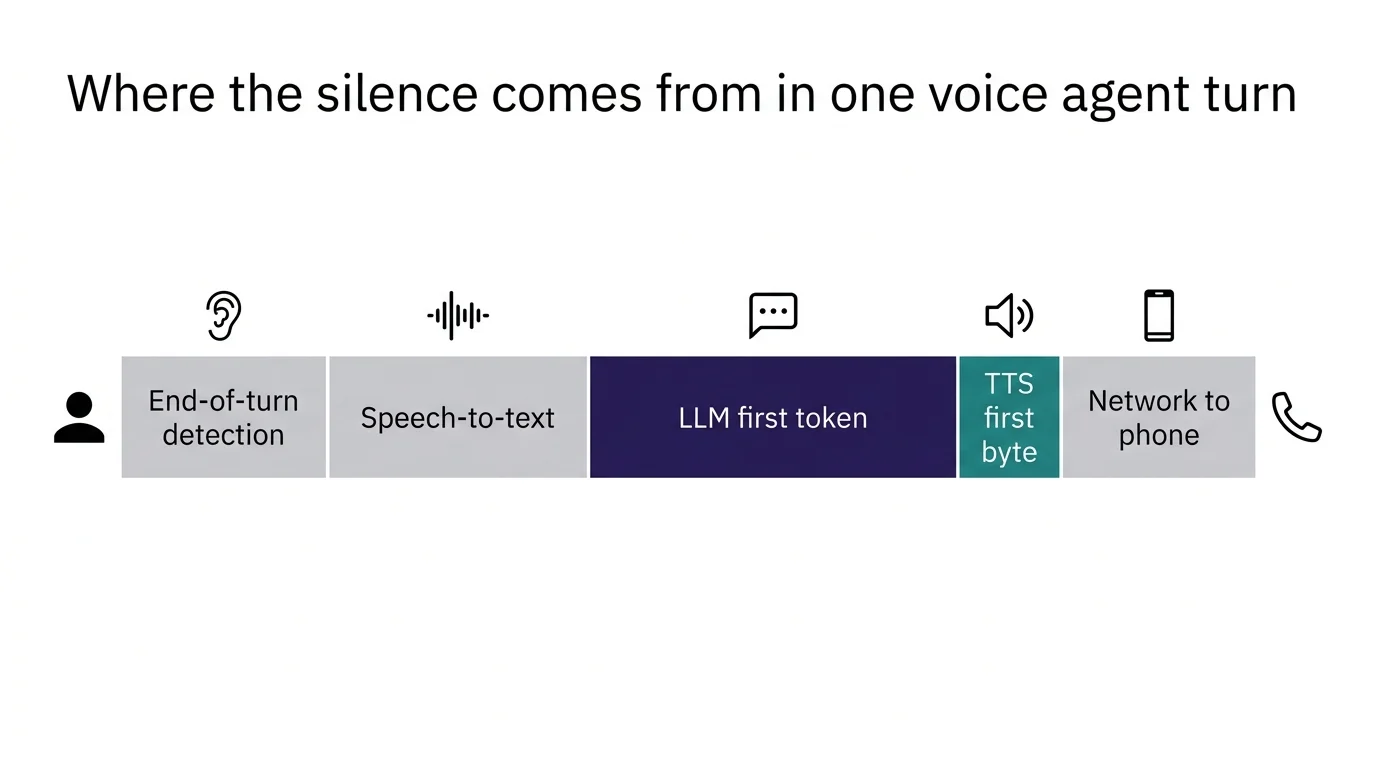
Callers experience the silence between finishing their sentence and hearing the bot start talking. That gap includes end-of-turn detection, speech-to-text, the language model's first token, TTS first byte, and the network hop to the phone carrier.
In most agents the language model is the biggest piece. Streaming LLM tokens into the TTS engine as they arrive, instead of waiting for the full reply, saves far more time than a 40 ms difference between TTS vendors. Both vendors support that pattern over WebSockets.
Deepgram has a fair argument that running speech-to-text and TTS with one vendor cuts a network hop. ElevenLabs offers the same pairing with Scribe v2 Realtime, so that edge is smaller than it was a year ago.
Run your own latency test in an afternoon
Thirty real requests will tell you more than any published chart.
- Deploy a small test script in the same cloud region as your production agent.
- Pick 20 to 30 sentences your bot will actually say, including a phone number, a date and a product name.
- Send each sentence to Aura-2 and to ElevenLabs Flash v2.5 over WebSocket streaming. Request μ-law 8 kHz output if you're on phone lines.
- Record the time from sending text to receiving the first audio chunk. Report the median and the 95th percentile, because the slow outliers are the calls people complain about.
- Repeat at your expected peak concurrency. Latency under load rarely matches a single request.
Voice quality: is Aura-2 good enough?
ElevenLabs leads on blind listening tests, but only with its top models. On the Artificial Analysis Speech Arena, where listeners vote between unlabeled clips, Eleven v4 and v4 Turbo held the top two places at the time of writing. Flash v2.5, the model most teams use for low latency, sat outside the top 50, and Deepgram's Flux voices ranked around 70th. Rankings move as votes come in, so check the live board.
So the fair matchup for a phone bot is Aura-2 against Flash v2.5, and that one is fairly close on quality. Aura-2 against Eleven v4 isn't close, but v4 costs twice as much per character as Flash and needs the Text to Dialogue WebSocket.
Aura-2 does one thing particularly well. A bot that reads out "your balance is $1,204.50, due 03/15" has to say it the way a person would, and Deepgram built Aura-2 around that kind of content. ElevenLabs gives you more manual control instead, with pronunciation dictionaries, phoneme tags and audio tags on v3. Put your own awkward strings (order numbers, drug names, local street names) into the latency test above and listen to both outputs side by side.
For customer-facing calls where tone carries the conversation, such as sales, collections or support for upset customers, ElevenLabs' expressiveness earns its price. For an appointment-reminder bot that reads dates and times, most callers won't hear a difference worth paying for.
Deepgram Aura pricing vs ElevenLabs at your volume
Why you'll see three different ElevenLabs prices
Search for ElevenLabs pricing and you'll find $0.04, $0.05 and even $0.18 per 1,000 characters. The $0.04 figure is the current API rate for Flash v2.5 and v4 Turbo. The $0.05 figure is an older Flash rate that still shows up in comparisons, including Deepgram's "40% cheaper" claim. Numbers around $0.18 or higher come from dividing a creator subscription by its character allowance, which isn't how API customers pay. Use the ElevenLabs API pricing page as your source.
Against today's API rates, Aura-2 is 25% cheaper per character than ElevenLabs Flash v2.5, and 62.5% cheaper than Eleven v4.
What a month of calls costs
TTS bills on what the bot says, so the useful unit is a call. The table below assumes a five-minute call where the agent speaks about 400 characters per minute, or 2,000 characters per call. That's an assumption for illustration; pull the real average from your call logs.
| Calls per month | Deepgram Aura-2 ($0.030/1K) | ElevenLabs Flash v2.5 ($0.04/1K) | ElevenLabs Eleven v4 ($0.08/1K) |
|---|---|---|---|
| 1,000 | $60 | $80 | $160 |
| 10,000 | $600 | $800 | $1,600 |
| 100,000 | $6,000 | $8,000 | $16,000 |
On Deepgram's growth tier, Aura-2 drops to $0.027 per 1,000 characters, which takes the 100,000-call row to $5,400. ElevenLabs also negotiates enterprise rates, so ask for a quote above that volume rather than trusting list prices.
At 1,000 calls a month the difference is $20, which is less than an hour of engineering time. At 100,000 calls it's around $2,000 a month against Flash, which is real money but still small next to the language model and telephony charges on the same calls. The jump that hurts is choosing Eleven v4 for every call: it doubles the TTS line against Flash.
Costs the per-character rate leaves out
If you'd rather buy a managed agent than wire up the pieces yourself, the comparison changes unit. Deepgram's Voice Agent API lists $0.075 per connected minute on its standard tier, which bundles speech-to-text, a managed language model and TTS. ElevenAgents lists $0.08 per additional call minute beyond your plan, with speech-to-text and TTS included and the language model billed on top. ElevenAgents also discounts silence periods longer than ten seconds by 95%, which helps on calls with long holds.
Carrier minutes and phone numbers are extra on both. So is the engineering time to connect your CRM, handle overages and monitor quality, which is where most implementation budgets actually go. Our breakdown of ElevenLabs implementation costs walks through those line items.
Two cheap ways to cut the TTS line regardless of vendor: cache audio for fixed phrases like greetings and hold messages, and keep the bot's replies short. A chatty prompt raises the bill on every single call.
Languages, accents and voice cloning
Language coverage is where the price argument for Aura-2 usually falls apart. Aura-2 speaks seven languages: English, Spanish, German, French, Dutch, Italian and Japanese. ElevenLabs Flash v2.5 covers 32, and Eleven v4 and v4 Turbo cover more than 90. If your callers need even one language outside Aura-2's list, you either switch to Deepgram's pricier Flux TTS or run two vendors.
Flux TTS lists English plus 41 other languages, but some are in early access, and Deepgram's documentation notes that early-access languages lack text normalization for numbers, dates and abbreviations. For a phone bot reading account numbers and appointment times, that gap matters, so test those exact strings.
Indian languages and Hinglish
None of Aura-2's seven languages are Indian. If you serve customers in India, that settles the Aura-2 question for most of your traffic. ElevenLabs supports Hindi and Tamil natively, offers a large library of Indian-accented voices, and integrates with Indian telephony providers such as Exotel, Ozonetel and Plivo. Real Hinglish code-switching is still the hardest test for any vendor, so run your demo with genuine mixed-language scripts and caller responses. Our guide to ElevenLabs for Indian businesses covers the voices and telephony setup, and our comparison of ElevenLabs, Sarvam AI and Gnani AI looks at India-native alternatives.
Voice cloning
ElevenLabs offers Instant Voice Cloning from a short sample and Professional Voice Cloning, which the voice owner must create and verify. Aura-2 has no self-serve cloning. If your brand already has a recognizable voice, or you want the bot to sound like a specific spokesperson with their permission, ElevenLabs is the only option of the two.
There's a lock-in cost. A cloned ElevenLabs voice lives behind a voice ID and can't be exported as a model file, so moving vendors later means losing that exact voice.
Phone bot fit: telephony, deployment and lock-in
On a real phone line
A phone call carries 8 kHz audio, half the sample rate of a typical browser test. Voices that sound rich in a demo lose detail on the line, which narrows the quality gap between a premium and a budget model. Both vendors output μ-law, the format most US carriers and SIP trunks expect, so you can skip a transcoding step on either. Deepgram also outputs A-law, which European telephony often uses.
Neither vendor gives you phone numbers as part of TTS. You still need a carrier or a CPaaS provider such as Twilio, Plivo or Exotel, plus the code that streams audio between the call and the TTS socket. ElevenAgents ships with telephony integrations that shorten that work; with Deepgram's Voice Agent API you write more of the bridge yourself.
Deployment and compliance
Deepgram offers cloud, dedicated single-tenant and self-hosted deployment. If your security team needs the model inside your own network, that's a genuine advantage.
You may read that ElevenLabs is cloud-only. That's out of date. ElevenLabs now documents private deployment for ElevenAgents and selected models, including the v2 and v2.5 TTS models and Scribe v2, and offers data residency endpoints on Enterprise plans. It doesn't cover every model yet, so confirm that the exact one you want is on the private-deployment list.
Can you use both?
Yes, and many teams do. A common setup uses Deepgram for speech-to-text and ElevenLabs for the voice, because Deepgram's Nova-3 scored well on live-stream recognition in the open Pipecat STT benchmark while ElevenLabs leads on voice. Deepgram's Voice Agent API even accepts ElevenLabs as a bring-your-own TTS provider.
The cost is two vendor accounts, two bills and two things that can fail mid-call. If you're building a full agent, our walkthrough on building an ElevenLabs conversational AI voice agent shows the single-vendor route for comparison.
Pros and cons
ElevenLabs
- Pros: the best-rated voices on blind tests (v4 and v4 Turbo), 32 to 90+ languages, Instant and Professional voice cloning, fine pronunciation control, and a managed agent platform with telephony integrations.
- Cons: costs 33% more than Aura-2 per character on Flash and more than double on v4, cloned voices can't be exported, and v3/v4 need a different WebSocket from Flash.
Deepgram Aura-2
- Pros: the lowest per-character price of the two, clear delivery of numbers and dates, A-law and μ-law output, and a self-hosted option.
- Cons: only seven languages, no self-serve voice cloning, a narrower emotional range, and Flux TTS (the multilingual option) costs more than ElevenLabs Flash.
Which should you choose?
| Your situation | Pick | Why |
|---|---|---|
| English-only reminder or status bot, high volume | Deepgram Aura-2 | Lowest price per character, and callers rarely notice the quality gap on short factual lines |
| Call center moving off ElevenLabs to save money | Test Aura-2, but model the savings first | At 100,000 calls a month the gap is about $2,000; check it against migration work and any cloned voice you'd lose |
| Customer-facing sales or support agent | ElevenLabs Flash v2.5 | Better delivery on emotional calls at a small premium |
| Branded voice or a cloned spokesperson | ElevenLabs | Aura-2 has no self-serve cloning |
| Callers in several languages, or anywhere in India | ElevenLabs | Aura-2 covers seven languages and none are Indian |
| Model must run inside your own network | Deepgram, or check the ElevenLabs private-deployment list | Deepgram self-hosts broadly; ElevenLabs covers selected models |
For most teams building a customer-facing voice agent, ElevenLabs Flash v2.5 is the better default. It's competitive on latency, the per-call premium is a few cents, and you keep the option to move premium calls to v4 or add languages without changing vendors. Aura-2 earns its place when your bot speaks English, reads mostly facts and runs at a volume where every fraction of a cent shows up in the budget.
Next step: test it on your own calls
The ElevenLabs vs Deepgram Aura decision comes down to your own audio, your own volume and your own callers. Run the five-step latency test above with 30 of your real sentences, price your actual call volume with the table, and listen to both voices over a real phone line before you sign anything.
If you'd rather have someone else wire it up, Haass designs and deploys ElevenLabs voice agents end to end: model and voice selection, telephony integration, latency tuning and cost controls. Talk to Haass about your ElevenLabs implementation.
FAQ
Is Deepgram Aura faster than ElevenLabs?
Neither is consistently faster. Deepgram reports Aura-2 at 184 ms time to first byte against 221 ms for ElevenLabs, while Gradium's independent 2026 benchmark measured ElevenLabs Flash v2.5 at 288 ms and Turbo v2.5 at 264 ms against 313 ms for Aura-2. Results depend on region, model and protocol, so test both from your own servers.
Is Deepgram Aura cheaper than ElevenLabs?
Yes, per character. Aura-2 costs $0.030 per 1,000 characters on pay-as-you-go, against $0.04 for ElevenLabs Flash v2.5 and $0.08 for Eleven v4. For a five-minute call where the bot speaks 2,000 characters, that's about 6 cents on Aura-2 and 8 cents on Flash. Language model and telephony costs usually outweigh the difference.
Does Deepgram Aura support voice cloning?
No, Aura-2 has no self-serve voice cloning. You choose from Deepgram's stock voices. ElevenLabs offers Instant Voice Cloning from a short sample and Professional Voice Cloning created and verified by the voice owner. If you need a branded or custom voice for your agent, ElevenLabs is the option of the two.
Which is better for a phone bot or call center?
It depends on the calls. Aura-2 suits English-only bots that read facts like dates, balances and order numbers at high volume. ElevenLabs Flash v2.5 suits customer-facing agents where tone matters, callers speak several languages, or you need a cloned voice. Both output μ-law audio for phone lines and stream over WebSockets.
Does Deepgram Aura support Hindi or other Indian languages?
No. Aura-2 supports seven languages: English, Spanish, German, French, Dutch, Italian and Japanese. Deepgram's Flux TTS covers more languages, some in early access, so check its current list before you plan around it. ElevenLabs supports Hindi and Tamil natively and integrates with Indian telephony providers such as Exotel, Ozonetel and Plivo.