TL;DR
- Pick ElevenLabs if voice realism, voice cloning, multilingual output or an API/voice agent is the priority. Its paid plans start at $6/month with a commercial licence and instant cloning.
- Pick Murf AI if you produce narrated videos, slides or e-learning and want a timeline editor, music and team workspaces in one place.
- On API cost, Murf's Falcon model is cheaper per character ($0.01 vs $0.04 per 1,000 characters for ElevenLabs Flash). ElevenLabs wins on model range, cloning access and developer tooling.
- Run one test script through both before paying. The difference shows up within two paragraphs.
You have a 12-minute training script, two free trials and a Friday deadline. Every review you open says something different about which tool sounds better, and half the pricing numbers you see don't match what's on the vendors' sites.
This ElevenLabs vs Murf AI comparison is written for that moment. We implement ElevenLabs for businesses at Haass, so we lean one way and we'll say so upfront. We also think Murf is the better buy for a specific kind of team, and we'll tell you exactly which one. Every price below was checked against the official pricing pages in November 2026.
ElevenLabs vs Murf AI at a glance
| ElevenLabs | Murf AI | |
|---|---|---|
| Built for | Voice engine and developer platform, plus creative tools | Voiceover studio for video, slides and training |
| Voice realism | Best in class, strong emotional range | Clean, consistent, "broadcast" tone |
| Main editor | Studio (long-form projects, chapters, dubbing) | Timeline editor with video, slides and music |
| Instant voice cloning | From Starter ($6/mo) | Enterprise plan only (API) |
| Professional voice cloning | From Creator ($22/mo) | Enterprise plan only (Studio and API) |
| Cross-lingual cloning | Yes, one voice across languages | Yes, instant clones are multilingual (Enterprise) |
| Free plan | 10k credits/month, no commercial licence | Studio: 10 minutes in total; API: $10 free credit |
| Billing unit | Credits (roughly characters) | Studio: generation hours; API: characters |
| Cheapest API rate | $0.04 / 1K chars (Flash, Turbo) | $0.01 / 1K chars (Falcon 2.1) |
| Streaming API | Yes (HTTP and WebSocket) | Yes, on Falcon |
| Voice agents | ElevenAgents (phone, web, chat) | Murf Agents (inbound and outbound calls, chat) |
| Sound effects, music, dubbing | All built in | Stock music library, dubbing |
What each tool is built for
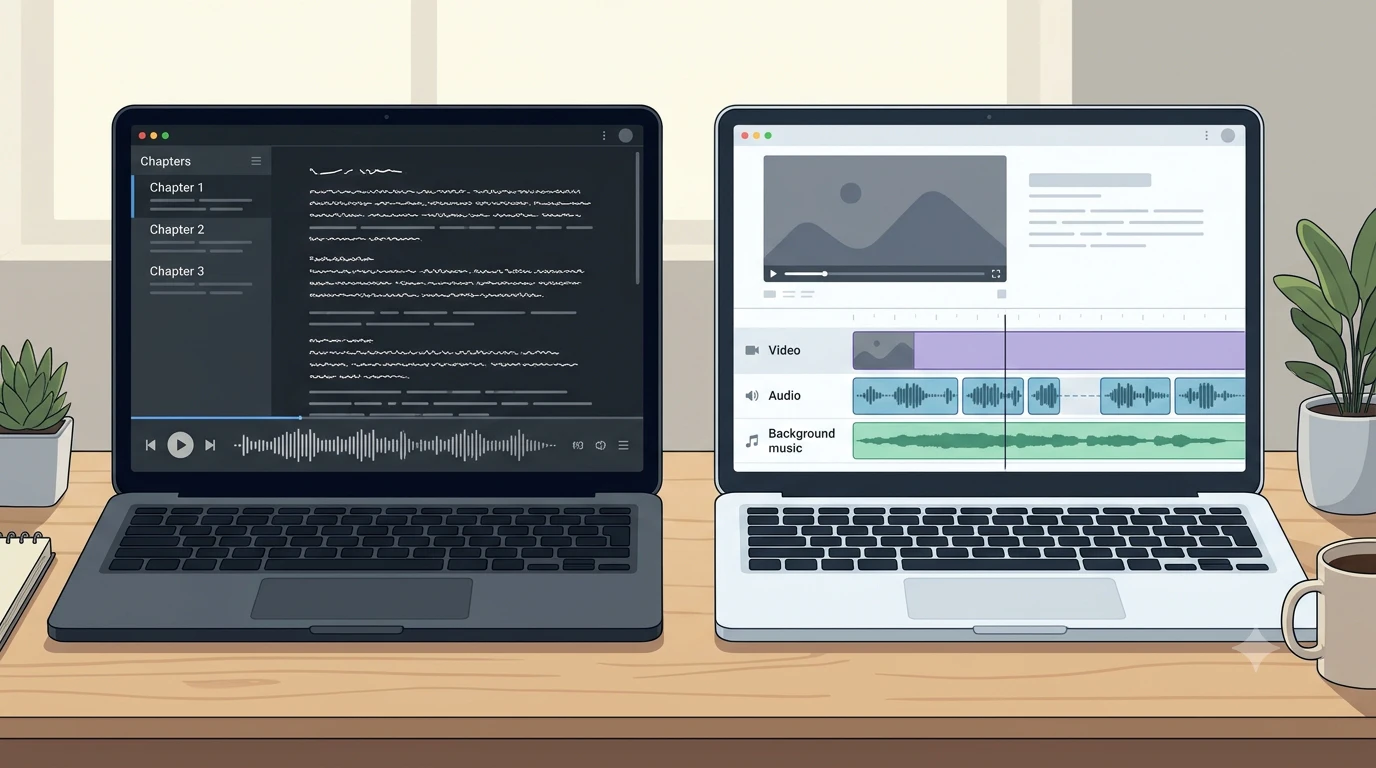
Most of the differences between these two products come from one design choice.
ElevenLabs started as a voice model. Everything else (Studio, dubbing, sound effects, voice agents) was built on top of a speech engine that developers can call directly. If you're new to the platform, our overview of what ElevenLabs is and how it works covers the full product range.
Murf started as a production tool. You paste a script, pick a voice, drop in your video or slides, and adjust timing on a timeline until it lines up. The voice models matter, but the product is really the editor around them.
That's why so many comparisons seem to contradict each other. A developer testing APIs and a marketing manager making a product demo are judging different products that happen to share a category name.
Text to speech quality: the same script, both tools
The best way to judge ElevenLabs vs Murf AI text to speech is to run one script through both. We suggest a 300 to 500-word passage that includes:
- a conversational opener ("So here's the thing…")
- a product name and an acronym
- a number with units ("$1,249 for 3.5 TB")
- one emotional sentence and one dry, instructional sentence
Naturalness and emotion
ElevenLabs is ahead here, and the gap is easy to hear. Its newer models vary pacing between sentences, place breaths where a speaker would, and change energy to fit the meaning of a line without you marking it up. Eleven v3 also supports audio tags such as whispers, laughs or a sigh, so you can direct a performance in the text itself. Our breakdown of ElevenLabs v4 vs v3 vs Flash explains which model to use for which job.
Murf handles emotion with style presets on many of its voices: conversational, newscast, promo, calm and others. That's a structured, predictable system. You choose "friendly but authoritative" and get it every time. What you can't do as easily is shift emotion halfway through a paragraph.
Independent data backs this up. On the Artificial Analysis text-to-speech leaderboard, which ranks models by blind listener preference, ElevenLabs' Eleven v4 sits at #1 (Elo 1338) and Eleven v4 Turbo at #2 (Elo 1337). Murf's best model, Falcon 2, ranks #31 (Elo 1157), and Murf Speech Gen 2 ranks #88 (Elo 984). Rankings as of 11 November 2026; they move as new models are added.
Long-form consistency
This is where Murf earns its place. Its voices sound almost identical from the first module of a course to the fortieth, and that matters when learners binge a training series.
ElevenLabs gives you more range, and range comes with variation. At low stability settings, two generations of the same paragraph can differ in pacing. Raising stability evens things out, but you lose some expressiveness. In practice, long narration on ElevenLabs works best when you split it into chapters in Studio and fix one voice and one set of settings per project. If narration starts to feel mechanical on either tool, our guide on why AI voices sound robotic and how to fix them lists the usual causes.
Names, numbers and acronyms
Both tools get common words right. Your brand name, SKU codes and industry acronyms are where they slip.
ElevenLabs supports pronunciation dictionaries with phoneme or alias rules that you upload once and apply across projects and API calls. Murf lets you set pronunciation per word inside the editor, which is quick for a single video but harder to standardise across a team unless you save it at the project level. If you produce a lot of content full of jargon, the ElevenLabs approach scales better.
ElevenLabs vs Murf AI voice cloning
Cloning is the clearest win for ElevenLabs, both in quality and in how easy it is to get.
Instant vs professional cloning
ElevenLabs offers two kinds of cloning:
- Instant Voice Cloning builds a clone from a short sample in about a minute. It's included from the Starter plan at $6/month.
- Professional Voice Cloning trains on a longer, clean recording (ElevenLabs recommends 30 minutes or more) and includes a verification step to confirm the voice is yours. It's available from Creator at $22/month. The Scale and Business plans include several professional clones.
The ElevenLabs voice cloning documentation lists the recording requirements.
Murf supports cloning too, but only on its Enterprise plan. According to Murf's instant voice cloning documentation, instant cloning builds a voice from a single reference recording of up to 30 seconds and is available through the API only. Professional cloning is available in both Murf Studio and the API, also on Enterprise. Neither is included in the Creator or Business Studio plans.
For a solo creator or small team, that difference decides it: you can clone your own voice on ElevenLabs this afternoon for $6.
Cross-lingual cloning
With ElevenLabs, one cloned voice can speak other supported languages and keep its identity. Record in English and generate Spanish, Hindi or German in the same voice. Expect it to sound strongest in the original language and a little less natural in languages with less training data.
Murf's instant clones are also multilingual, but because cloning is Enterprise-only, most Murf users work with its stock voices, where each language has its own native voice. That's fine if you have separate presenters per market, and limiting if your brand is built around one recognisable voice and you aren't on an Enterprise contract.
Consent and safeguards
Both platforms require you to have the rights to any voice you clone. ElevenLabs adds voice verification for professional clones and runs detection for misuse. If you're cloning a CEO or a hired voice actor, get written consent that covers AI cloning and the markets you'll publish in. That protects you on either platform.
Editing and production workflow
This is Murf's strongest ground, and it isn't close.
Murf's timeline puts your script, video, slides and background music on one screen. You can stretch a pause between two sentences by dragging it, speed up one line by 10%, or line up a phrase with a click in a screen recording. It has a built-in stock music library and team workspaces where a writer, an editor and a reviewer can work on the same project. If your deliverable is a narrated product demo or a training module, you can finish it without opening another app.
ElevenLabs is built around audio. Studio handles long-form work well: chapters, multiple speakers, regenerating single paragraphs and exporting a full audiobook or podcast episode. It also includes AI dubbing, sound effects generated from text, and music generation, which Murf doesn't match. What it lacks is a video timeline. Most ElevenLabs users export audio and finish in Premiere, DaVinci Resolve, Descript or CapCut.
A simple test: if you'd end up in a video editor anyway, ElevenLabs costs you nothing extra in workflow. If you don't want to touch a video editor at all, Murf saves real hours each week.
Languages and accents
Competitor articles quote anything from 20 to 70+ languages because the answer depends on which model you use.
On ElevenLabs, language support is set per model. The multilingual and v3-generation models cover far more languages than the speed-optimised ones, so check the ElevenLabs models documentation for the exact list on the model you plan to use. Murf's pricing page lists 150+ voices in 35+ languages and styles for its API, including several accents of English (American, British, Australian, Indian and Scottish) as well as Hindi and Tamil.
Two practical points matter more than the headline count. First, test accents, not just languages: "English" covers American, British, Australian and Indian voices, and the right accent affects trust more than the right language. Second, if you serve Indian audiences, check Hindi and regional-language output with native speakers before you commit. Our guide to ElevenLabs for Indian businesses covers language and accent choices for that market.
Pricing: what you'll really pay
The two products charge in different units, and the cheapest-looking plan isn't always the cheapest.
Subscription plans (checked November 2026)
ElevenLabs (official pricing):
| Plan | Price | Credits / month | Commercial licence | Cloning |
|---|---|---|---|---|
| Free | $0 | 10k | No | No |
| Starter | $6 ($1 first month) | 30k | Yes | Instant |
| Creator | $22 ($11 first month) | 121k | Yes | Instant + Professional |
| Pro | $99 | 600k | Yes | Instant + Professional |
| Scale | $299 | 1.8M | Yes | 3 Professional clones |
| Business | $990 | 6M | Yes | 10 Professional clones |
One credit is roughly one character on standard models, and 1,000 characters is about one minute of speech.
Murf AI Studio (official pricing, Studio tab):
| Plan | Billed yearly | Billed monthly | Voice generation |
|---|---|---|---|
| Free | $0 | $0 | 10 minutes in total, no downloads |
| Creator | $19/mo ($228/yr) | $29/mo | 24 hours a year (2 hours a month if monthly) |
| Business | $66/mo ($792/yr) | $99/mo | 96 hours a year (8 hours a month if monthly) |
| Enterprise | Custom | Custom | Custom, includes voice cloning |
Murf's API is billed separately: pay-as-you-go by characters, with $10 of free credit to start and purchased credit that never expires.
API rates per 1,000 characters
| Model | Price |
|---|---|
| Murf Falcon 2.1 | $0.01 |
| Murf Gen 2 | $0.03 |
| ElevenLabs Flash / Turbo | $0.04 |
| ElevenLabs Multilingual v2, Eleven v3, v4 | $0.08 |
Source: ElevenLabs API pricing and Murf pricing.
On raw API cost, Murf Falcon is four times cheaper than ElevenLabs' fastest models. For a backend pipeline producing millions of characters of plain narration, that adds up quickly.
The hidden costs
Three costs rarely show up in comparisons:
Re-generations. On ElevenLabs, every regeneration uses credits. If you regenerate each paragraph twice to get the delivery right, your real usage is about three times your script length. Budget for that, or turn up stability so you need fewer retries.
Commercial rights. The ElevenLabs free plan doesn't include a commercial licence. Anything you publish for a business needs at least Starter. Check Murf's terms per plan for the same thing.
Seats. Murf prices teams by seat. Five people who each need editing access cost more than one shared generation budget on ElevenLabs.
Three worked examples
- Solo creator, about 1 hour of finished audio a month (about 60k characters, about 120k with retakes). ElevenLabs Creator at $22/month (121k credits) covers it and includes voice cloning. Murf Creator at $29/month (2 hours a month) or $19/month billed yearly also covers it, but without cloning.
- L&D team, about 8 hours of audio a month. Murf Business at $99/month (8 hours a month), or $66/month billed yearly for 96 hours a year, fits that volume exactly and includes the timeline editor. On ElevenLabs, 8 hours is about 480k characters before retakes, which points to Pro at $99/month (600k credits). The prices match, so the deciding factor is whether your team wants Murf's editor or ElevenLabs' voice quality.
- App generating 5M characters a month via API. Murf Falcon is about $50. ElevenLabs Flash is about $200, and Eleven v3 about $400. Pick ElevenLabs only if the quality, cloning or latency difference justifies it for your users.
API, streaming and developer experience
Both vendors now have serious APIs, so "Murf doesn't stream" is no longer true. Falcon supports HTTP and WebSocket streaming for real-time apps.
ElevenLabs still has the deeper developer platform. You get several models tuned for different trade-offs (Flash for low latency, v3 for expressive delivery, Multilingual v2 for long-form), official SDKs, pronunciation dictionaries, voice cloning through the API, dubbing and speech-to-text in the same account. Teams can start with one endpoint and add capabilities without changing vendors. If you're planning an integration, our ElevenLabs text to speech API integration guide walks through it step by step, and our roundup of the best TTS APIs in 2026 compares ElevenLabs with the wider market.
Murf's API is more focused: two main models, character billing with a low minimum purchase, and voices that match what you'd use in Studio. If you need consistent corporate narration generated in batches, that simplicity helps.
Latency claims need care. Vendors measure time-to-first-audio under different conditions. Test both from your own region, with your output format, inside your actual app.
Voice agents and phone calls
This is where the two products differ most, and the topic most comparisons skip.
ElevenLabs runs a full agent platform, ElevenAgents. It combines speech-to-text, your choice of LLM, ElevenLabs voices, turn-taking and telephony, so an agent can answer support calls, qualify leads or book appointments. API pricing lists agent minutes at about $0.08 per minute plus LLM usage. The agent can use the same cloned brand voice you use in your marketing videos.
Murf has also moved into this space. Its site describes Murf Agents as multilingual agents that "handle outbound and inbound calls, are always available on chat, and escalate issues to a human". It's a newer product than ElevenAgents, so ask for references and test integrations, call transfer and latency on your own call flows. If an AI phone or support agent is on your roadmap, test that use case directly instead of assuming the voiceover leader is also the agent leader.
From our implementation work, the voice is rarely what breaks an agent. Latency, interruption handling and prompt design are. Our guides on choosing the best TTS for voice agents and reducing ElevenLabs agent latency go deeper, and our ElevenAgents implementation process shows what a production rollout involves.
Security, data and commercial rights
If you're buying for a company, ask both vendors the same five questions before signing:
- Which compliance reports can you share (SOC 2, ISO 27001), and under what terms?
- Is there a zero-retention or data-deletion option for scripts and generated audio?
- Where is data processed and stored, and can we choose the region?
- Who owns cloned voices, and what happens to them if we cancel?
- Does the commercial licence cover broadcast, paid ads and resale?
ElevenLabs publishes security and compliance information in its trust and security documentation and offers data residency and zero-retention options on enterprise plans. Murf's pricing page lists HIPAA and GDPR compliance, ISO 27001 and SOC 2 Type II certification, and data residency and on-premise deployment on its API Enterprise plan. Both vendors are credible on paper, so the five questions above are what separate them for your use case.
Pros and cons
ElevenLabs
Pros:
- The most realistic, expressive voices of the two
- Instant cloning from $6/month and cross-lingual cloning
- Wide model choice for speed vs quality
- Dubbing, sound effects, music and speech-to-text on one platform
- A full voice agent platform for phone and web
Cons:
- No video timeline
- Credits get used up by regenerations
- More settings to learn
- The free plan has no commercial licence
Murf AI
Pros:
- An excellent timeline editor for video, slides and music
- Very consistent voices across long courses
- Team workspaces suited to non-technical staff
- The cheapest API rate of the two (Falcon)
Cons:
- Cloning is Enterprise-only
- Most users are limited to one native voice per language
- Less emotional range
- A smaller developer ecosystem
Which should you choose?
Content creators (YouTube, podcasts, audiobooks): ElevenLabs. Listeners stay with natural narration, and cloning your own voice for $6 a month is hard to beat.
L&D, marketing and corporate video teams: Murf AI, if your team wants one tool from script to finished video. The editor time it saves outweighs the realism gap for training content.
Developers building products: ElevenLabs for quality, cloning and model range. Look at Murf Falcon if cost per character is your main constraint and plain narration is enough.
Businesses building voice or phone agents: ElevenLabs. Agents, voices, cloning and telephony live on one platform.
Using both is a real option: ElevenLabs for flagship content and Murf for high-volume internal training. The cost is two subscriptions and two places where voices live.
FAQ
Is ElevenLabs better than Murf AI?
ElevenLabs is better for voice realism, voice cloning, multilingual output and developer or agent use cases. Murf AI is better for teams that produce narrated videos and training content inside a single timeline editor. Neither wins outright. Test both with the same 300 to 500-word script and judge the output alongside the editing workflow you'll use every day.
Which is cheaper, ElevenLabs or Murf AI?
For API use, Murf AI is cheaper: Falcon 2.1 costs $0.01 per 1,000 characters vs $0.04 for ElevenLabs Flash. For individuals, ElevenLabs is cheaper to start, with a $6/month Starter plan that includes a commercial licence and instant voice cloning. For teams, Murf's seat-based Studio plans can work out cheaper if several editors need access.
Can I clone my voice on both ElevenLabs and Murf AI?
Yes, but access differs. ElevenLabs includes instant voice cloning from its $6 Starter plan and professional cloning from its $22 Creator plan. Murf offers both instant and professional cloning only on its Enterprise plan, so you can't clone a voice on Murf's Creator or Business plans. Both platforms' clones can speak multiple languages.
Does Murf AI have a streaming API like ElevenLabs?
Yes. Murf's Falcon model supports HTTP and WebSocket streaming for real-time applications, and ElevenLabs offers streaming across its models, with Flash tuned for the lowest latency. Published latency figures are measured differently by each vendor, so compare time-to-first-audio inside your own app, from the same region and with the same output format.
Can I move a voice from Murf AI to ElevenLabs?
Not directly. Voice IDs don't transfer between providers. If you own the original recordings and have permission to reuse them, create a new clone through ElevenLabs' instant or professional cloning workflow. Then test it on your real scripts, because the same recordings can produce slightly different pacing and pronunciation on a different model.
The bottom line
The ElevenLabs vs Murf AI choice comes down to what you're making. If your output is a video with a voiceover and your team lives in a timeline, Murf is a strong, sensible pick. If you need the voice itself to be the best it can be, cloned, multilingual, delivered through an API or answering phone calls, ElevenLabs is the platform to build on.
If you're building ElevenLabs into a product, support line or content pipeline and want it done right the first time, talk to our team. As an ElevenLabs implementation partner, Haass designs, builds and tunes ElevenLabs voice and agent deployments for businesses. You can also compare ElevenLabs against other options in our ElevenLabs vs Cartesia and ElevenLabs vs Google Text-to-Speech comparisons.