TL;DR
- Best overall: ElevenLabs Agents is the best voice AI agent for most teams, with the most natural-sounding voices on one platform for phone, web and WhatsApp.
- Best for developers: Vapi, if you want to choose your own speech-to-text, LLM and voice providers and wire them together.
- Best no-code option: Synthflow, if your team can't write code and can live with enterprise-only pricing.
- Best for large contact centres: PolyAI for complex calls, or Cognigy if you already run Genesys, Avaya or NICE.
You've watched five voice agent demos this month, and every one of them sounded great. Then you put one on a real phone line, a caller talks over it halfway through a sentence, and it either freezes or keeps reading its script.
That gap between the demo and the live call is what this guide is about. We compared the 8 best voice AI agents in 2026 on the things that break in production: how fast they respond, how they handle interruptions, how they connect to your phone system, and what a minute of conversation really costs.
A quick disclosure: Haass is an ElevenLabs implementation partner, and ElevenLabs is our top pick. We've tried to make every other section useful even if you end up choosing something else.
Quick picks: which voice AI agent fits your priority
| If your priority is... | Our pick | Why |
|---|---|---|
| The most natural voice on the call | ElevenLabs Agents | Best-in-class voices, 90+ languages, phone and web from one agent |
| Full control over every layer | Vapi | Swap STT, LLM and TTS providers with a config change |
| Inbound support, live fast | Retell AI | Quick setup and detailed post-call analysis |
| Thousands of outbound calls | Bland AI | Batch calling on self-hosted models |
| No code at all | Synthflow | Visual builder covering build, test, deploy and monitor |
| Messy, complex enterprise calls | PolyAI | Handles topic changes and heavy accents well |
| Designing agents as a team | Voiceflow | Shared canvas with comments, roles and version control |
| Adding AI to an existing contact centre | Cognigy | Plugs into Genesys, Avaya and NICE |
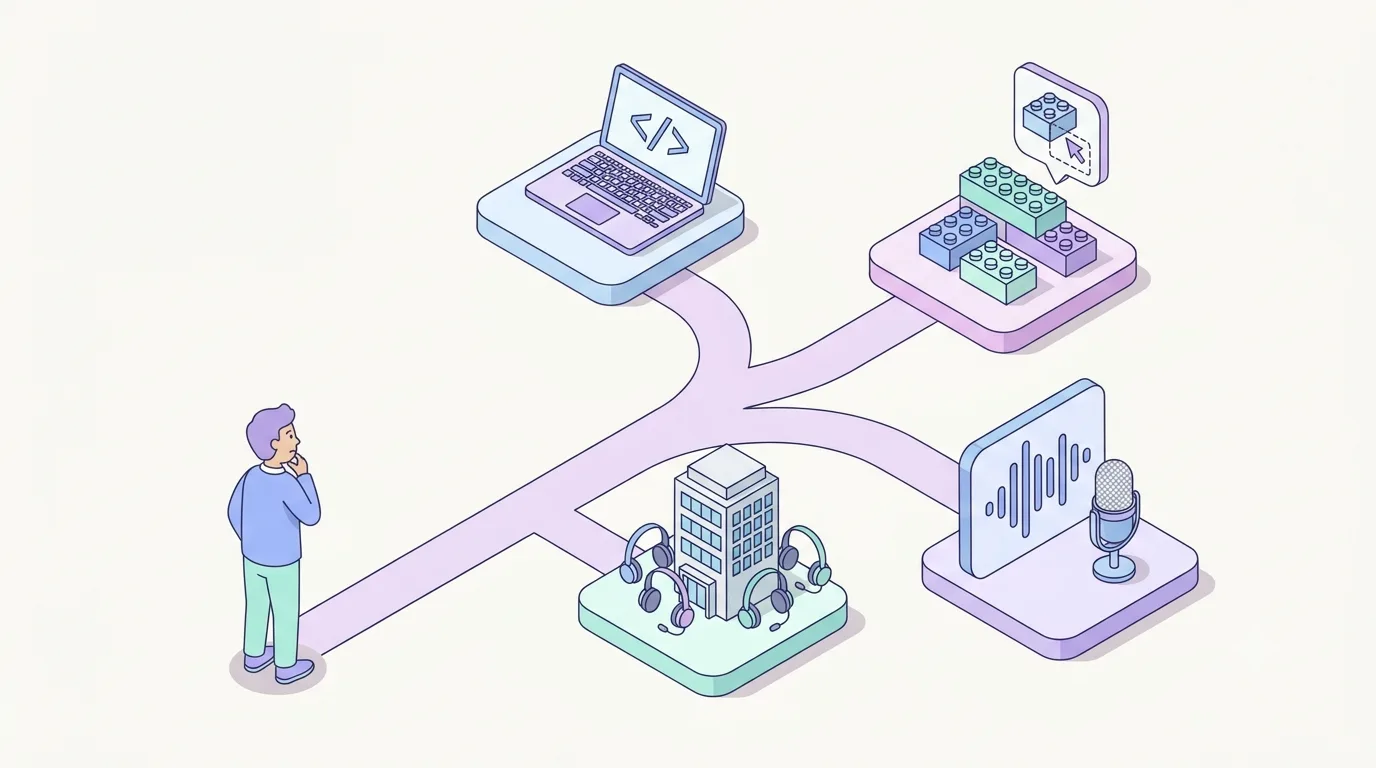
What a voice AI agent is (and what it isn't)
A voice AI agent holds a live, two-way phone or web conversation. It listens to the caller, works out what they want, takes an action such as booking a slot or looking up an order, and replies out loud, all within about a second.
That makes it different from a text-to-speech engine, which only turns text into audio. TTS is one layer inside a voice agent. If you're choosing the voice layer itself, our comparison of the best TTS APIs in 2026 covers it in depth. If you're newer to the topic, start with what an AI voice agent is and how it works.
The platforms below are complete agents. You give them a goal, a knowledge source and a phone number, and they handle the conversation.
How we evaluated the best voice AI agents
We looked at five things, because these are what decide whether callers stay on the line.
| Criterion | What we checked |
|---|---|
| Latency | How quickly the agent replies after the caller stops talking, and whether it handles interruptions |
| Voice quality | Whether the voice sounds like a person or a GPS unit, especially over long calls |
| Telephony | Built-in phone numbers, SIP trunking, and connectors to contact centre software |
| Languages | How many languages are supported, and whether that depends on a third-party provider |
| Cost per minute | The full price once platform, voice, LLM and telephony fees are added together |
We based the comparison on each vendor's published documentation and pricing pages as of October 2026. Prices change often, so confirm them before you sign anything.
Voice AI agents compared: all 8 at a glance
| Platform | Best for | Build approach | Telephony | Compliance (published) | Starting price |
|---|---|---|---|---|---|
| ElevenLabs Agents | Natural voices, multichannel | Low-code + API | Twilio, Vonage, Genesys, SIP | SOC 2 Type II, ISO 27001, PCI DSS, HIPAA, GDPR | Free plan; paid from $6/mo |
| Vapi | Custom developer stacks | Code | Built-in phone management | SOC 2, GDPR, HIPAA (paid add-on) | $0.05/min + provider costs |
| Retell AI | Inbound support | Low-code | SIP trunking, Twilio | HIPAA | $0.07 to $0.31/min |
| Bland AI | High-volume outbound | Code | Self-hosted infrastructure | HIPAA (Enterprise plan) | $0.14/min |
| Synthflow | No-code teams | No-code | Built in | GDPR, SOC 2, HIPAA | From $30,000/year |
| PolyAI | Complex enterprise calls | Managed service | 130+ integrations | ISO 27001, SOC 2, PCI DSS, GDPR, HIPAA | Custom |
| Voiceflow | Team design and prototyping | Low-code | Needs an external provider | SOC 2 Type II, HIPAA, GDPR | Free trial; usage-based |
| Cognigy | Existing contact centres | Enterprise platform | Avaya, Genesys, NICE | ISO 27001, SOC 2 Type II, HIPAA, PCI DSS, GDPR | Custom, per conversation |
The 8 best voice AI agents in 2026
1. ElevenLabs Agents
ElevenLabs started as a text-to-speech company, and its voices are still the reason most teams pick it. ElevenLabs Agents (formerly ElevenLabs Conversational AI) wraps those voices in a full agent platform: you set the agent's instructions, connect a knowledge base, add tools it can call, and deploy it to a phone number, a website widget or WhatsApp.
Example call: A customer rings a support line at 11pm about a delayed order. The agent pulls the order status through a tool call, explains the delay in a calm voice, and offers to text a tracking link. The caller hears a person, not a menu.
Benefit: Voice quality. A frustrated caller notices a robotic voice within seconds, and ElevenLabs is consistently the most natural-sounding option in this list. It supports 90+ languages, works with the LLM of your choice, and connects to Twilio, Vonage and Genesys.
Limitation: Per-minute pricing, with LLM costs billed separately, takes some planning at scale, and complex call routing (multi-department transfers, legacy IVR handoffs) usually needs telephony configuration alongside the agent itself.
Who it fits: Teams where the voice is part of the brand experience, such as customer support, sales and appointment booking, and anyone running the same agent across phone, web and messaging.
2. Vapi
Vapi is a developer platform for assembling your own voice agent. You choose the speech-to-text provider, the LLM and the voice, and Vapi handles the real-time streaming and phone call management between them.
Example call: An engineering team builds an inbound agent that checks a customer's account in their own database mid-call, using Vapi's tool calling, and uses ElevenLabs for the voice layer by changing one config field.
Benefit: Control. You're never locked into one model or voice vendor, and you can swap providers as better ones ship. Squads let several specialised agents share one call.
Limitation: Everything beyond the basics is your job, including error handling, retry logic and monitoring. Costs also stack, because the $0.05/min platform fee sits on top of separate LLM, voice and telephony charges.
Who it fits: Engineering-led teams building voice into their own product. Our ElevenAgents vs Vapi vs Retell vs Bland comparison goes deeper on how Vapi stacks up against the other developer-friendly options.
3. Retell AI
Retell AI focuses on the full call lifecycle. You build the agent in a visual flow builder, connect a knowledge base, attach a phone number, and every finished call is transcribed, summarised and scored for sentiment.
Example call: A clinic's agent answers a rescheduling request, confirms the new slot, and flags the call afterwards because the patient sounded unhappy about the wait. A manager reviews that one call instead of listening to fifty.
Benefit: Post-call visibility. Failed handoffs and low-sentiment calls surface on their own, so you know which part of the flow to fix. It also supports SIP trunking, so you can keep your existing numbers.
Limitation: Complex flows still need careful prompt tuning before live traffic, and costs climb at high volume if nobody watches them.
Who it fits: Support teams that want an inbound agent live quickly and want data to improve it over time.
4. Bland AI
Bland AI is built for enterprise-scale calling. It runs its own speech and reasoning models on its own infrastructure rather than routing through third-party providers, and it can dispatch thousands of outbound calls at once.
Example call: A lender runs a payment-reminder campaign across 5,000 customers in an afternoon. Each call follows a structured pathway, confirms the amount due, and logs the outcome through a webhook.
Benefit: Scale and data control. Because the models are self-hosted, call data stays on Bland's infrastructure, which matters for regulated teams. Conversational Pathways keep agents on script through awkward replies.
Limitation: The learning curve is steep, and outbound attempts and transfers add fees on top of the per-minute rate.
Who it fits: Enterprises running high-volume outbound campaigns with strict data rules. If Bland isn't the right fit, Retell AI suits inbound support better and Vapi suits custom builds.
5. Synthflow
Synthflow is a no-code platform for building and deploying voice agents. You design conversation flows visually, set up telephony, and manage the agent from build through monitoring in one place.
Example call: A home services company deploys an agent that books estimates into Google Calendar and writes the outcome back to its CRM, without anyone on the team writing code.
Benefit: Speed for non-technical teams. Structured calls such as bookings and FAQs work well, and the platform publishes GDPR, SOC 2 and HIPAA coverage.
Limitation: Off-script moments are its weak point. A caller who asks the agent to repeat itself mid-flow can trigger a canned fallback. Pricing is also now enterprise-only, starting at $30,000 a year.
Who it fits: Larger non-technical teams with predictable call types and the budget for an annual contract.
6. PolyAI
PolyAI sits at the heavy end of the market. It's built for large contact centres in banking, healthcare, retail and travel, and it handles routing, identity checks, bookings and payments inside one conversation.
Example call: A hotel guest calls to change a booking, switches topics to ask about parking, then goes back to the booking. The agent follows both threads without losing context, even with a strong accent on the line.
Benefit: Conversation quality on difficult calls. PolyAI publishes ISO 27001, SOC 2, PCI DSS, GDPR and HIPAA coverage, plus 130+ pre-built integrations.
Limitation: Implementation takes weeks and needs cross-functional resources. Pricing isn't published and works more like a managed service, so you're closely tied to the vendor.
Who it fits: Large enterprises where calls are unpredictable and compliance can't slip.
7. Voiceflow
Voiceflow is a collaborative build environment where product managers, designers and engineers work on the same agent. You design flows on a shared canvas and deploy to voice, chat or a custom interface from one project.
Example call: A product team prototypes a returns agent, reviews it with legal in comments on the canvas, then connects it to a telephony provider for a pilot.
Benefit: Collaboration. Role-based permissions, comments and version control stop a shared project from turning into chaos, and the platform is model-agnostic.
Limitation: Large flows get hard to debug, and Voiceflow isn't a full telephony stack, so phone deployment needs an external provider.
Who it fits: Cross-functional teams that design and iterate on agents together.
8. Cognigy
Cognigy adds AI agents to contact centres that already run on Avaya, Genesys or NICE, instead of asking you to replace them. It's now part of NiCE.
Example call: A customer calls back about an unresolved issue. The AI agent handles the routine part, then hands over to a human with the full history, CRM notes and a sentiment flag already on screen.
Benefit: Fit with existing infrastructure. The Voice Gateway connects to major telephony platforms without custom SIP work, and it supports more than 100 languages.
Limitation: It's built for large organisations. Setup needs IT, operations and CX working together, and pricing is custom, billed per conversation.
Who it fits: Large contact centres that want AI without a rip-and-replace project.
Other voice AI agent platforms worth knowing
Sierra builds AI agents for consumer brands where tone of voice carries real weight, and it charges per successful resolution rather than per minute. Expect an enterprise sales process.
Goodcall started inside Google's Area 120 incubator and targets small businesses. Setup takes minutes, and pricing starts at $79 a month per agent, billed per unique caller rather than per minute.
Leaping AI handles voice and SMS from one platform, so a call can book an appointment and a text can confirm it with the same context. Pricing is by quote.
What voice AI agents really cost per minute
Most voice agent prices you see are only part of the bill. A real per-minute cost has four parts: the platform fee, the voice (TTS), the LLM, and telephony. Some platforms bundle all four. Others pass three of them through to you.
| Platform | Published pricing | What 1,000 minutes costs |
|---|---|---|
| Vapi | $0.05/min platform fee, plus LLM, STT, TTS and telephony | Vapi estimates $82 to $129 depending on the models you pick |
| Retell AI | $0.07 to $0.31/min all-in | $70 to $310 |
| Bland AI | $0.14/min (Start), $0.12/min on the $299/mo Build plan | $140 on Start |
| ElevenLabs Agents | Plans from $6/mo; $0.08/min beyond included minutes | $80 in call minutes, plus LLM usage (billed separately) |
| Synthflow | Enterprise contracts from $30,000/year | Scoped to volume |
| PolyAI, Cognigy, Sierra | Custom | Scoped to volume |
Retell's own breakdown shows how the parts add up: about $0.055/min for voice infrastructure, $0.015 to $0.10/min for TTS, a wide range for the LLM depending on the model, and about $0.015/min for telephony. Your LLM choice often moves the total more than the platform does.
For a fuller picture, including how these costs compare with human agents, see our AI call centre vs traditional cost comparison.
Pricing sources: ElevenLabs, Vapi, Retell AI, Bland AI, Synthflow.
Free vs paid voice AI agents: what you get on each free tier
| Platform | Free option | The catch |
|---|---|---|
| ElevenLabs Agents | Free plan with 15 minutes of agent calls a month | Limited minutes; commercial use needs a paid plan |
| Vapi | $5 in free credits | Credits go quickly once LLM and voice costs are added |
| Retell AI | $10 in free credits | Enough for testing, not production |
| Bland AI | Free Start plan | You still pay $0.14 per connected minute |
| Voiceflow | Free trial, no card needed | Business pricing goes through sales |
| Goodcall | Free trial | Paid plans from $79/mo per agent |
| Synthflow, PolyAI, Cognigy | None published | Sales conversation required |
Free tiers are for testing your use case, not for running it. Use them to check latency and interruption handling on your own scripts before you compare paid plans.
Best voice AI agent by use case
| Use case | Best pick | Runner-up |
|---|---|---|
| Customer support (inbound) | ElevenLabs Agents | Retell AI |
| Outbound sales | ElevenLabs Agents | Bland AI |
| Appointment booking | ElevenLabs Agents | Synthflow |
| Payment reminders and collections | Bland AI | ElevenLabs Agents |
| AI receptionist for a small business | Goodcall | ElevenLabs Agents |
| Healthcare | PolyAI | Retell AI |
| Insurance | PolyAI | ElevenLabs Agents |
| Multilingual support | ElevenLabs Agents | Cognigy |
| Adding AI to an existing contact centre | Cognigy | PolyAI |
FAQ
What is the best voice AI agent in 2026?
ElevenLabs Agents is the best voice AI agent for most teams in 2026, because it pairs the most natural-sounding voices with a full agent platform covering phone, web and WhatsApp. Vapi is the better choice for developers who want to assemble their own stack, Synthflow suits no-code teams, and PolyAI or Cognigy suit large enterprise contact centres.
How much does a voice AI agent cost?
Most voice AI agents cost between $0.07 and $0.31 per minute once platform, voice, LLM and telephony fees are included. Retell AI publishes that range, Bland AI starts at $0.14 per minute, and Vapi estimates $82 to $129 per 1,000 minutes. Enterprise platforms such as PolyAI, Cognigy and Synthflow use custom contracts, with Synthflow starting at $30,000 a year.
What is the difference between a voice agent and an IVR?
An IVR routes callers through fixed menus ("press 1 for billing"), while a voice agent holds an open conversation in natural language. Callers can explain their problem in their own words, change topic or interrupt, and the agent still follows. Voice agents can also take actions, such as booking a slot or checking an order, instead of only routing the call.
Can voice AI agents handle multiple languages?
Yes, most voice AI agents handle multiple languages, though coverage varies a lot. ElevenLabs supports more than 90 languages and Cognigy more than 100. Platforms that let you bring your own providers, such as Vapi, depend on the speech-to-text and voice services you choose. Always test your target languages on real calls, since a listed language isn't always production quality.
What is the best alternative to Bland AI?
Retell AI is the best alternative to Bland AI for inbound support, because it's faster to set up and includes detailed post-call analysis. Vapi is better if you want full control over the models behind your agent. ElevenLabs Agents is the strongest option when voice quality matters most, which is often the case for sales calls where callers decide in seconds whether to stay on.
Final verdict: the best voice AI agent for most teams
The best voice AI agent depends on who's building it and what the calls look like. Developers who want every layer under their control should start with Vapi. Non-technical teams with predictable calls can move fast on Synthflow. Large contact centres should shortlist PolyAI and Cognigy.
For most teams putting an agent in front of real customers, ElevenLabs Agents is the strongest starting point. Callers judge your business by how the call sounds, and ElevenLabs gives you the most natural voices in this list on a platform that runs across phone, web and messaging.
If you're planning a deployment, Haass can help you scope, build and launch it. See our ElevenLabs voice AI implementation service or book a discovery call to map your first use case.