TL;DR
- ElevenLabs Agents is a full voice agent platform built on ElevenLabs' own speech models. It has telephony through Twilio and SIP, and it is no longer only a text-to-speech API.
- Retell AI is a call-center orchestration layer. It sells you the phone line, numbers and outbound extras, and lets you pick voices from several vendors, ElevenLabs included.
- On list prices with the same LLM, ElevenLabs Agents came out roughly 15–20% cheaper than Retell at 1,000, 10,000 and 50,000 minutes a month. Retell gives you one invoice that includes telephony.
- Pick ElevenLabs if voice quality, multichannel reach and developer control matter most. Pick Retell if you run a phone-first contact center and want the carrier, branded caller ID and a pay-as-you-go HIPAA BAA from one vendor.
You priced a voice agent at seven cents a minute, built a pilot, and the first invoice came in at nearly twice that. The model was billed separately, then the phone line, then the knowledge base, and then you hit the concurrency limit during a Monday-morning spike. Most people searching ElevenLabs vs Retell AI have already been burned like this once, or they're trying not to be.
The other problem is that nearly every comparison ranking for this search was written by a company selling a third option. We have a stake too. Haass implements ElevenLabs agents for clients, so read this knowing that. We've tried to say plainly where Retell is the better buy, and there are a few cases where it is.
This guide covers what each platform actually is in 2026, what a month costs at real volumes, how latency and telephony work, what building on each is like for developers, and where each one fits.
ElevenLabs vs Retell AI at a glance
| ElevenLabs Agents | Retell AI | |
|---|---|---|
| What it is | Agent platform from a voice-model company | Voice agent orchestration for contact centers |
| Speech models | Its own TTS, Scribe speech-to-text, Eleven Realtime models | Its own turn-taking model and platform voices, plus voices from ElevenLabs, OpenAI and others |
| LLM | Eleven Realtime models, or GPT, Claude, Gemini in Custom mode | Its own Tell-1 model, or GPT, Claude, Gemini |
| Telephony | Native Twilio, SIP trunking, plus Telnyx, Plivo, Vonage, Exotel | Sells numbers and minutes directly; native SIP to bring your own |
| Billing | Monthly plan with bundled minutes, then $0.08/min; LLM at cost | Pay per minute by component; no plan fee |
| Concurrency | 4 (Free) to 40 (Business); burst up to 3x at $0.16/min | 20 included, then $8/month per extra slot |
| Channels | Phone, web, WhatsApp, SMS via Twilio, chat | Phone, web calls, SMS, chat |
| HIPAA BAA | Requires Zero Retention Mode | Available on pay-as-you-go |
| Best for | Voice-led experiences, multichannel agents, developer-owned builds | Phone-first contact centers and outbound campaigns |
Prices from ElevenLabs Agents pricing and Retell AI pricing, checked November 2026. Both change often, so recheck them before you sign anything.
AI voice generator vs AI phone agent: what each product is
A lot of buyers still file ElevenLabs under "text-to-speech" and Retell under "phone agents", and then compare the wrong things. That view was roughly right in 2024. It's wrong now.
What ElevenLabs Agents is in 2026
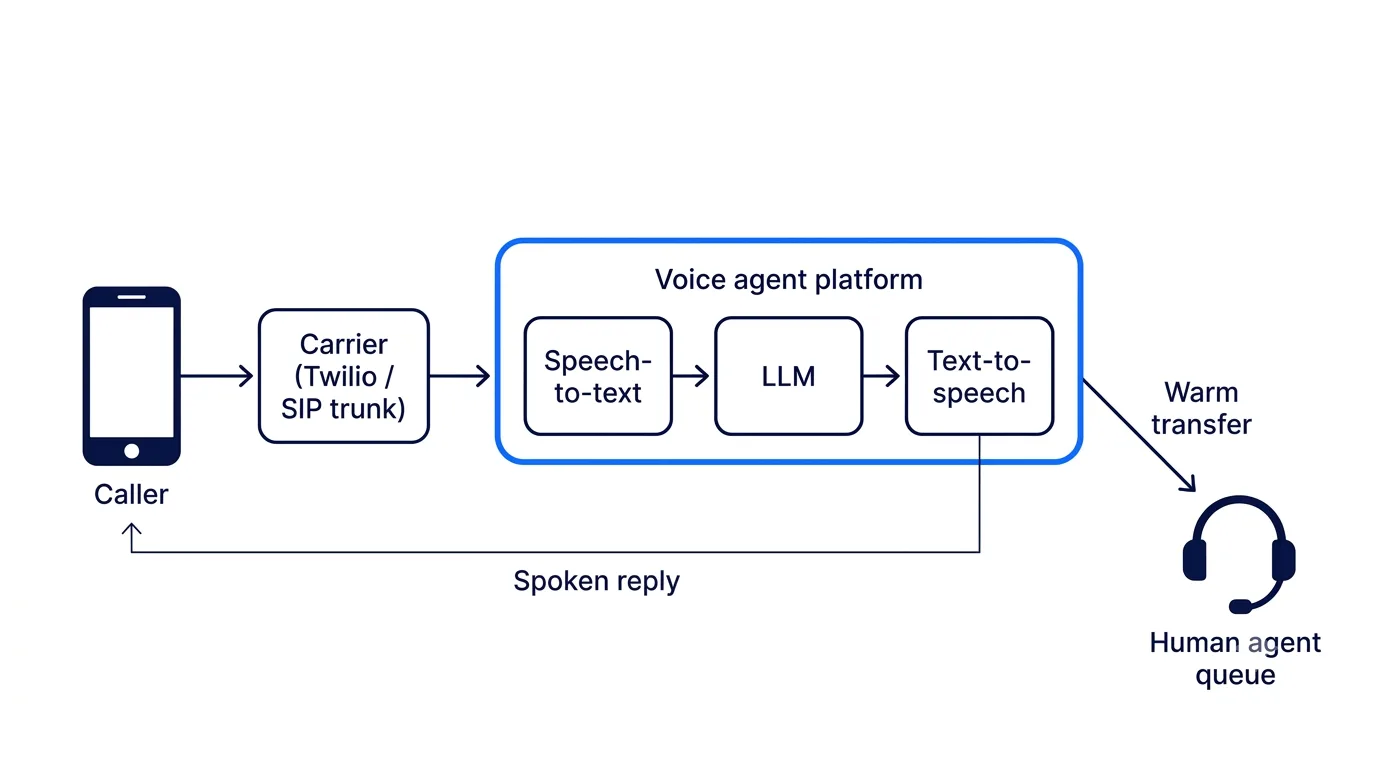
ElevenLabs Agents (sold as ElevenAgents, and earlier called Conversational AI) is a hosted agent platform. It handles speech recognition with its Scribe model, runs the conversation through either ElevenLabs' own Realtime models or an LLM you choose, and speaks the reply with its own TTS. You build agents in a visual Workflows editor or through the API, SDKs and CLI. Phone calls come in over a native Twilio integration or any SIP trunk.
ElevenLabs does not sell you phone numbers or carrier minutes. You bring a carrier. For teams that already run Twilio or a SIP trunk, that's a non-issue. For teams that don't, it's one more vendor to set up.
What Retell AI is
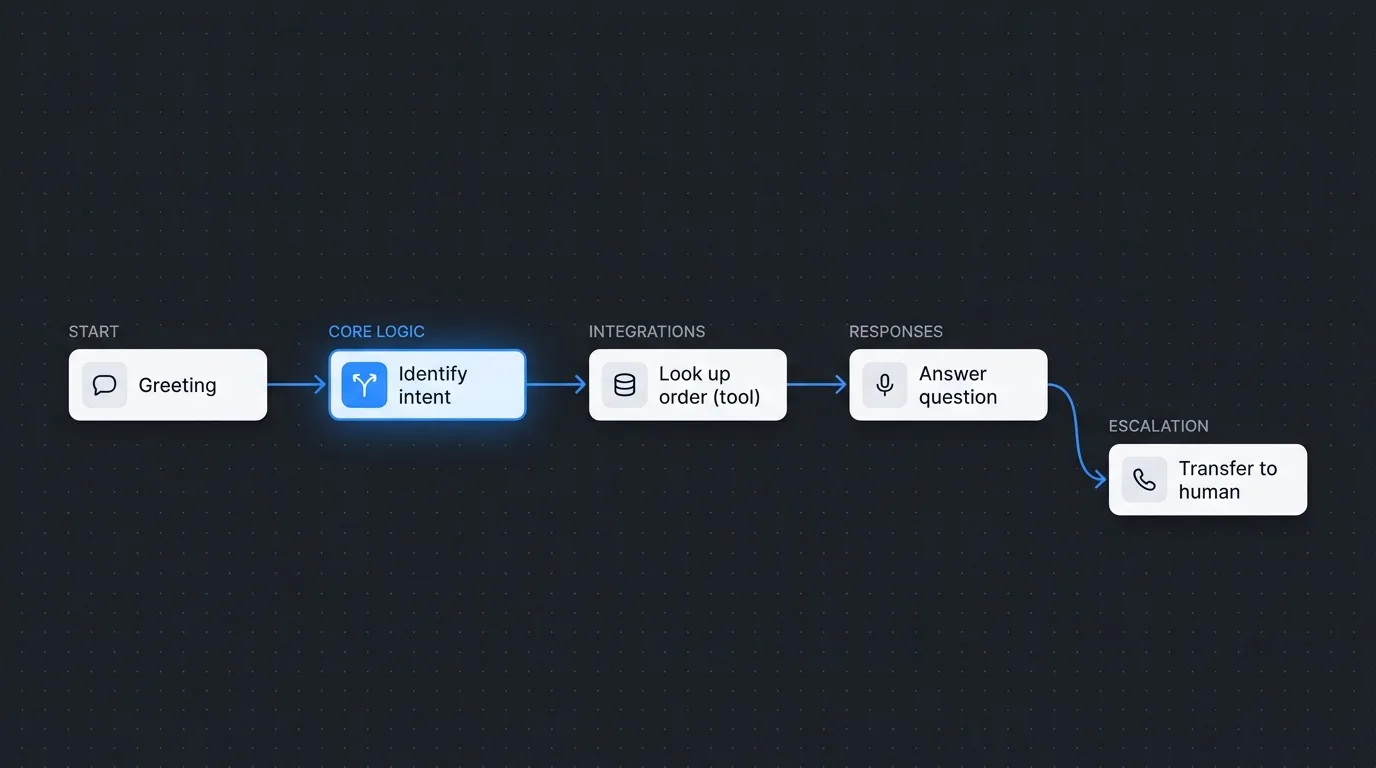
Retell is an orchestration layer built around the phone call. It runs its own turn-taking model (the part that decides when the caller has finished talking), lets you pick an LLM and a voice from several providers, and wraps all of it in contact-center tooling: warm transfers where an AI briefs the human before connecting, a Memory feature for returning callers, batch dialing, AI QA scoring and simulation tests.
Retell also resells ElevenLabs voices. So a Retell agent can sound exactly like an ElevenLabs agent, at a higher per-minute rate. More on that below.
Pricing: what a month costs
The headline rates ($0.07 a minute for Retell, $0.08 for ElevenLabs) don't describe what you'll pay. They measure different things.
How each one bills
Retell adds components per minute. Every minute carries voice infrastructure ($0.055, speech-to-text included), a voice ($0.015 for Retell's own, $0.040 for ElevenLabs voices), the LLM (GPT-5.4 Mini lists at $0.024), and US telephony at $0.015 if you use a Retell number. A knowledge base adds $0.005 a minute. There's no plan fee. Retell's docs also note that billed duration scales up for very long prompts, so check your token count before you estimate.
ElevenLabs sells a plan that includes a set number of minutes. Every minute past that costs $0.08 on any plan, the LLM is passed through at the provider's price (GPT-5.4 Mini shows at about $0.0067 a minute in the calculator), and your carrier bills telephony separately. ElevenLabs bills on connection time and discounts silence longer than ten seconds by 95%, which helps on calls with long hold periods.
One detail people miss: Retell charges its LLM margin per minute, ElevenLabs passes the model through at cost. On the same model, that gap alone is about $170 over 10,000 minutes.
Worked example at three volumes
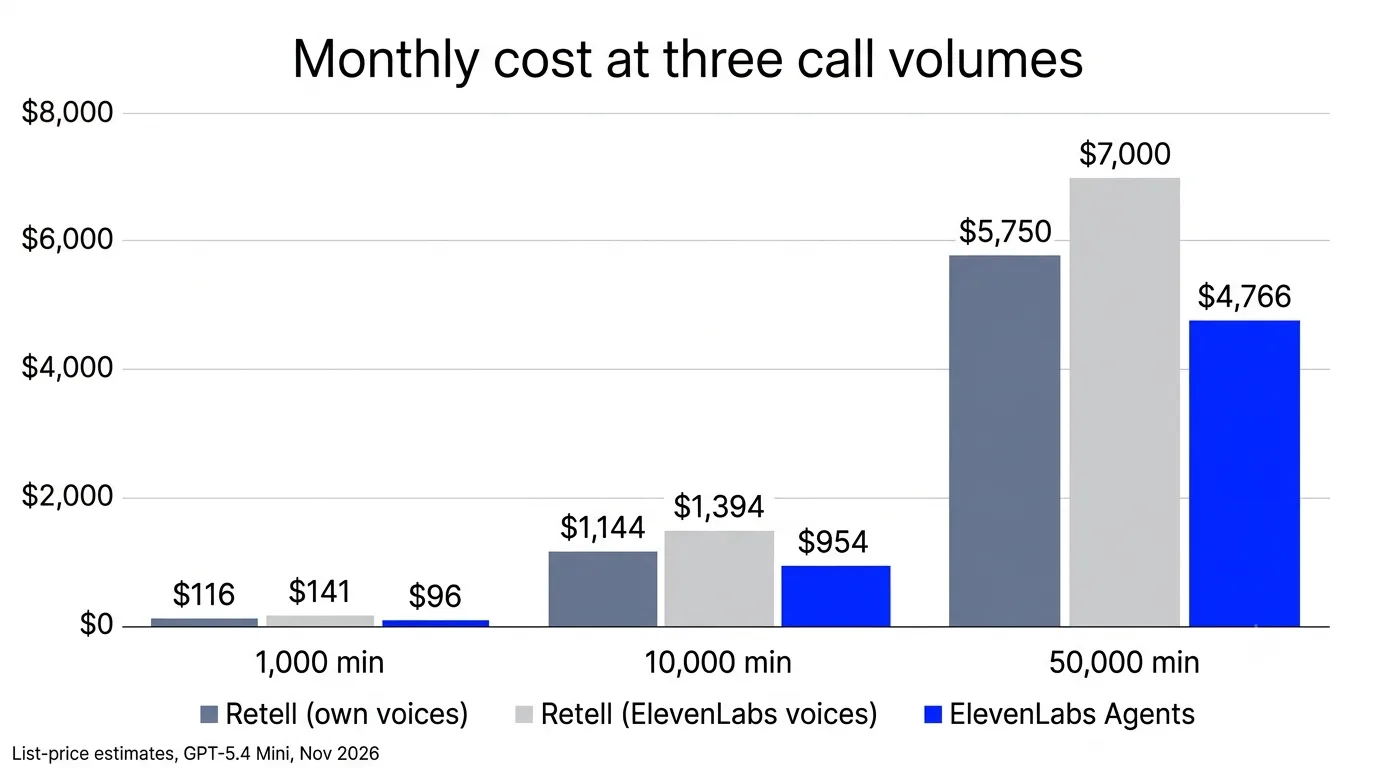
Assumptions: inbound support calls averaging four minutes, GPT-5.4 Mini on both platforms, a knowledge base on Retell, and Twilio local numbers for ElevenLabs at $1.15 a month and $0.0085 a minute inbound (Twilio US voice pricing). This is list-price arithmetic, not a bill we were sent.
| Monthly minutes | Retell (own voices, $0.114/min) | Retell (ElevenLabs voices, $0.139/min) | ElevenLabs Agents |
|---|---|---|---|
| 1,000 | ~$116 | ~$141 | ~$96 (Creator plan + overage + LLM + Twilio) |
| 10,000 | ~$1,144 | ~$1,394 | ~$954 (Pro plan + overage + LLM + Twilio) |
| 50,000 | ~$5,750 (incl. 5 extra concurrency slots) | ~$7,000 | ~$4,766 (Scale plan + overage + LLM + Twilio) |
ElevenLabs comes out cheaper at every volume. If you want ElevenLabs voices specifically, running them natively on ElevenLabs saves about 30% compared with renting them through Retell.
Two cautions. First, ElevenLabs' pricing calculator tends to recommend a bigger plan than you need. Every plan's overage rate is the same $0.08, so the plan fee mostly buys concurrency, seats and knowledge-base size. Pick the plan by how many simultaneous calls you need (Pro allows 20, Scale 30, Business 40), and let overage cover the rest. Second, outbound Twilio minutes cost more than inbound, so an outbound-heavy program closes some of the gap.
Costs that aren't in the headline rate
On Retell, add-ons are priced per minute or per call: branded caller ID at $0.10 per outbound call, PII removal, safety guardrails and advanced denoising as small per-minute fees, extra knowledge bases at $8 a month after the first ten. On ElevenLabs, the main surprise is burst pricing. Calls above your concurrency limit are allowed, but they cost $0.16 a minute, double the normal rate. A marketing email that triggers a wave of callbacks can do this.
On both platforms, the bigger hidden cost is engineering time: wiring the agent into your CRM, ticketing and telephony, writing guardrails, and testing. We break that down in our guide to ElevenLabs implementation costs.
Voice quality and realism
ElevenLabs is a voice company first, and you can hear it. Its library has thousands of voices, its cloning is strong, and the expressive v3 models add breathing, pauses and laughter that keep a long call from sounding like a recording. It also covers 70+ languages, including Indian languages such as Hindi and Tamil, which matters if you serve callers outside the US. We cover that in more detail in ElevenLabs for Indian businesses.
Retell's platform voices are good and cheaper per minute. Teams that care most about how the agent sounds usually switch to ElevenLabs voices inside Retell, which is a fair setup, but it costs $0.025 a minute more than Retell's own voices.
Our view: if callers are judging your brand by the voice (sales, hospitality, healthcare intake, anything premium), the voice is worth paying for, and it's cheaper to get it from the source. If the call is a two-minute order status check, most callers won't notice the difference between good and excellent.
Latency: what the numbers mean and how to test them
Vendor latency figures are hard to compare. Retell's homepage claims about 600ms. ElevenLabs quotes around 75ms for its Flash v2.5 TTS model, which measures only the speech-generation step, not the whole round trip. Neither publishes a shared test method.
End-to-end latency on a phone call is roughly speech-to-text, plus LLM time to first token, plus TTS time to first audio, plus the network and carrier hops in between. In our experience the LLM is usually the largest piece. A heavy reasoning model can add more delay than any platform difference. ElevenLabs shows an estimated latency next to each model in the agent settings, which helps when you're choosing one.
To compare the two fairly, run this test in about 15 minutes:
- Build the same simple agent on both, with the same LLM and a short prompt.
- Connect both to a real phone number, not the browser test widget.
- Call from a mobile phone and ask ten identical questions.
- Record the call and measure the gap between the end of your question and the first syllable of the reply.
- Repeat at a different time of day.
In a blind phone call, anything under about a second feels natural. Above about 1.5 seconds, callers start talking over the agent.
Telephony and contact center integration
Phone numbers, SIP trunking and Twilio
Retell sells phone numbers ($2 a month), toll-free numbers, verified numbers and US calling at $0.015 a minute. You can also bring your own carrier over SIP for free. If you don't want a separate telephony vendor, Retell is simpler.
ElevenLabs connects to the carrier you already have. It has a native Twilio integration, SIP trunking and published guides for Telnyx, Plivo, Vonage and Exotel. Teams that already run Twilio usually prefer this, because numbers, porting and carrier contracts stay where they are.
Transfers and human handoff
Both platforms do cold and warm transfers. Retell has the more developed handoff: a separate AI agent can talk to the human first, give them a summary of the call, play your hold music, and then connect or cancel. ElevenLabs offers conference, blind and SIP REFER transfers. One limit to plan around: per the transfer-to-number docs, warm transfer messages only work on numbers imported through the native Twilio integration. If your numbers sit on a SIP trunk and you need the human to hear a summary first, test that path before you commit.
Contact center platforms
Retell publishes setup guides for Five9, Genesys Cloud, Amazon Connect, Avaya, NICE CXone, Talkdesk and LiveVox. ElevenLabs connects to Genesys and Five9, with Amazon Connect in limited availability. If you're on Avaya, NICE or Talkdesk, Retell has the documented path today.
Developer experience
This is where the comparisons ranking for this search say the least, and where ElevenLabs is strongest for engineering teams.
ElevenLabs agents and their Workflows are stored as JSON, and the CLI lets you pull, edit and push them. That means you can keep agent configuration in Git, review prompt changes in pull requests and promote agents between environments the way you promote code. There are Python and JavaScript/TypeScript SDKs, a WebSocket API for custom clients, tool calling to your own endpoints, and an MCP server so you can manage agents from an AI coding assistant. Agent tests and plain-language evaluations run through both the dashboard and the API, so you can put them in CI. If you want the lower-level route of calling TTS directly and building your own orchestration, see our ElevenLabs text-to-speech API integration guide.
Retell has a solid API and SDKs too, plus a drag-and-drop flow builder with nodes for conversation, functions, transfers, keypad presses, SMS and logic splits. Its Flex Mode compiles a flow into one prompt at runtime so callers can jump between topics without breaking the flow. Retell's Conductor assistant builds agents from a description, writes simulation tests and investigates failed calls. ElevenLabs has a comparable assistant, Architect, but it's still in alpha.
Our take: if engineers own the agent and want it versioned and tested like any other service, ElevenLabs fits that workflow better. If an ops team will own the agent after launch, Retell's flow builder and Conductor are easier for non-developers. For a full walkthrough of the ElevenLabs build, see how to build an ElevenLabs voice agent from scratch.
For support leaders: QA, analytics and escalation
Retell has the deeper built-in QA. Its AI QA scores production calls automatically, Conductor groups failed calls by shared cause, and Memory gives returning callers a short brief built from past calls and texts, so they don't repeat themselves. ElevenLabs offers plain-language evaluation criteria scored on every conversation, simulation tests, and Spotlight, which groups conversations by topic and alerts you when success rate or sentiment shifts. For returning-caller context on ElevenLabs, you pass data in from your CRM through a webhook at the start of the call.
ElevenLabs wins on reach. The same agent configuration can answer the phone, a web widget and WhatsApp, which matters if your customers contact you across channels and you don't want to maintain three bots. It also integrates with Zendesk, Intercom, Salesforce, HubSpot and ServiceNow for ticket creation and lookups.
Whatever you choose, the things that decide whether an AI customer support phone agent works are the same: a narrow first use case, a clear escalation rule, and a weekly review of failed calls. Platform choice matters less than that discipline.
Outbound calling: features and compliance
For AI outbound calling, Retell has more built in. It offers batch dialing at $0.005 per dial, branded caller ID on US carriers so your business name shows up, and verified numbers that are less likely to be flagged as spam. ElevenLabs supports batch calling with no per-dial fee, but caller name display is something you set up with your carrier.
The bigger risk with outbound is legal, and neither platform handles it for you. In the US, the FCC ruled in 2024 that AI-generated voices count as "artificial" voices under the Telephone Consumer Protection Act, so AI robocalls need prior express consent. You also need to respect calling-hour rules and do-not-call lists. In India, commercial calls require registration on TRAI's DLT system before you dial. Get consent and registration sorted before you scale an outbound campaign on either platform.
Security and compliance
Both platforms list SOC 2 Type II, ISO 27001, GDPR and HIPAA. ElevenLabs also lists PCI DSS Level 1 and offers regional data residency, including an India residency program, which matters if your data can't leave a region.
The difference is in the HIPAA conditions. ElevenLabs signs a BAA, but it requires Zero Retention Mode, which restricts which LLMs you can use and limits stored conversation analytics. Retell offers a BAA on pay-as-you-go without an enterprise contract. For a small clinic or a health-tech startup handling patient calls at low volume, that alone can decide it in Retell's favor.
Pros and cons
ElevenLabs Agents
Pros
- The best voice quality and widest language coverage of the two
- Lower total cost on the same LLM at the volumes we modeled
- Agent config stored as JSON and managed through a CLI, so it fits Git and CI
- One agent across phone, web, WhatsApp and chat
- Works with the Twilio account or SIP trunk you already have
Cons
- You need a separate carrier for numbers and minutes
- Warm transfer messages only on native Twilio numbers
- HIPAA requires Zero Retention Mode
- Calls above your concurrency limit cost double
Retell AI
Pros
- Phone numbers, minutes and branded caller ID from one vendor
- Strong warm transfers and returning-caller memory
- Deep built-in QA and the Conductor assistant
- Documented guides for more contact center platforms
- HIPAA BAA on pay-as-you-go
Cons
- Higher per-minute cost, especially with ElevenLabs voices
- LLMs are marked up rather than passed through at cost
- Phone-first, with fewer messaging channels
- Billed duration can scale with long prompts
Which should you choose? A five-question checklist
Answer these honestly and the choice usually becomes obvious.
- Is this phone-only, or phone plus messaging? Phone-only leans Retell. Phone plus WhatsApp and web leans ElevenLabs.
- Who maintains the agent after launch? Engineers lean ElevenLabs. An ops or CX team leans Retell.
- Do you already have Twilio or a SIP trunk? Yes leans ElevenLabs. No, and you want one invoice, leans Retell.
- Does the voice affect revenue? If callers judge you by how the agent sounds, ElevenLabs. If they just want a quick answer, either works.
- What's your compliance tier? Low-volume HIPAA without an enterprise contract leans Retell. Data residency or PCI requirements lean ElevenLabs.
| Your situation | Better fit |
|---|---|
| SaaS product embedding a voice agent | ElevenLabs |
| Contact center on Avaya, NICE or Talkdesk | Retell |
| Outbound sales with branded caller ID | Retell |
| Premium brand, voice-led customer experience | ElevenLabs |
| Multilingual or India-based callers | ElevenLabs |
| Small clinic needing a BAA quickly | Retell |
| Cost-sensitive inbound support at volume | ElevenLabs |
Retell AI and ElevenLabs alternatives
If neither fits, three others come up most. Vapi suits engineers who want to pick and pay each provider (STT, LLM, TTS, carrier) separately. Bland builds its own models end to end and targets enterprise phone programs. Synthflow is a no-code option aimed at agencies and small businesses. If you're choosing a voice platform for the Indian market specifically, our comparison of ElevenLabs vs Sarvam AI vs Gnani AI covers the local players.
The verdict
In the ElevenLabs vs Retell AI decision, choose ElevenLabs if you want the most natural voice, the lowest bill on a given model, one agent across channels, and a build your engineers can version and test like code. Choose Retell AI if you run a phone-first contact center that wants the carrier, branded caller ID, polished warm transfers and a pay-as-you-go HIPAA BAA from one vendor.
For most SaaS builders and support teams we work with, ElevenLabs is the better foundation, provided someone handles the telephony, guardrails and testing. That's the work Haass does. If you're planning an ElevenLabs voice agent, talk to the Haass team about scoping your first use case.
FAQ
Is ElevenLabs better than Retell AI?
ElevenLabs is better for voice quality, multichannel agents and developer-owned builds, and it cost less on the same LLM in our list-price comparison. Retell AI is better for phone-first contact centers that want numbers, branded caller ID, advanced warm transfers and a pay-as-you-go HIPAA BAA from one vendor. Choose based on who owns the agent and whether you already have a carrier.
Which is cheaper per minute, Retell AI or ElevenLabs?
ElevenLabs is usually cheaper. With GPT-5.4 Mini and Twilio, 10,000 minutes worked out to about $954 a month on ElevenLabs Agents versus about $1,144 on Retell with its own voices. Retell's headline $0.07 excludes the LLM, telephony and add-ons, while ElevenLabs charges $0.08 per minute past your plan plus the LLM at cost and your carrier's fees.
Can I use ElevenLabs voices in Retell AI?
Yes. Retell offers ElevenLabs voices as a voice option for $0.040 a minute, compared with $0.015 for Retell's own platform voices. Over 10,000 minutes that adds about $250 a month. If ElevenLabs voices are the main reason you're choosing, running the agent natively on ElevenLabs Agents costs less for the same voice.
Does ElevenLabs Conversational AI work with Twilio and SIP trunking?
Yes. ElevenLabs Agents has a native Twilio integration and supports SIP trunking, with published setup guides for Telnyx, Plivo, Vonage and Exotel. ElevenLabs doesn't sell phone numbers itself, so you bring your own carrier. Warm transfer messages currently work only on numbers imported through the native Twilio integration, not over SIP.
Which has lower latency, ElevenLabs or Retell AI?
Neither has a clear published advantage. Retell claims about 600ms, and ElevenLabs' Flash TTS model generates speech in around 75ms, but those numbers measure different things. In practice, the LLM you choose affects latency more than the platform. Test both with the same model on a real phone line before deciding.