TL;DR
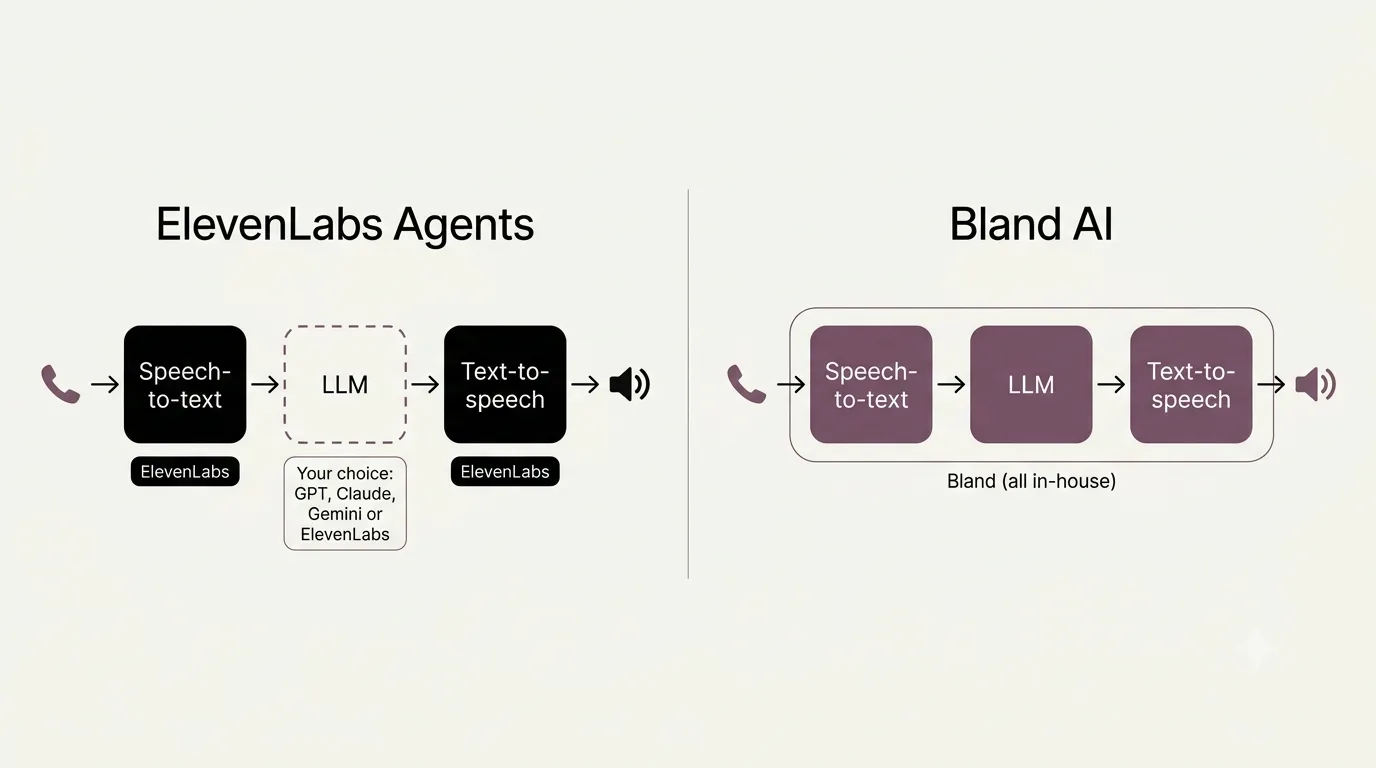
- ElevenLabs vs Bland AI comes down to who owns the language model. Bland bundles its own LLM, speech recognition and voices into one per-minute rate. ElevenLabs runs its own speech stack and lets you pick the LLM, billed on top.
- On list price, ElevenLabs is cheaper per minute: $0.08 plus the LLM against Bland's $0.12–$0.14. Your choice of model and your concurrency pattern decide how big that gap really is.
- ElevenLabs is the better fit for teams that want voice range, LLM choice, multilingual calls and mature testing tools. Bland suits phone-ops teams that want one vendor, one rate and hard spending caps.
- Run a two-week pilot on a real phone line before you sign anything.
Your finance lead has two quotes on the desk. One says $0.14 a minute, everything included. The other says $0.08 a minute, plus "LLM usage billed separately." Your security team wants to know how many AI vendors touch a call, and your developers want to know which one they'll still enjoy working with in six months.
That's the real ElevenLabs vs Bland AI decision, and most comparisons online are written by one of the two vendors or by a third platform trying to sell you something else. We implement ElevenLabs for clients at Haass, so we have a side. We'll say where Bland is the better pick, and we've cited the public source for every price and spec so you can check it yourself. Prices below were checked on vendor pages in November 2026.
ElevenLabs vs Bland AI at a glance
| ElevenLabs Agents | Bland AI | |
|---|---|---|
| Who builds the AI | ElevenLabs speech-to-text and voices; LLM from ElevenLabs or your choice | Bland's own LLM, transcription and voices |
| Headline price | $0.08/min past plan minutes, LLM extra | $0.14/min (Start) or $0.12/min + $299/mo (Build) |
| Plans | Free to Business ($0–$990/mo), Enterprise custom | Start, Build, Enterprise custom |
| Concurrent calls (self-serve) | 4 to 40 by plan | 10 (Start), 50 (Build) |
| Daily call cap | None listed | 100 (Start), 2,000 (Build) |
| Over the limit | Burst to 3x concurrency at $0.16/min, then queue or reject | Calls rejected |
| LLM choice | GPT, Claude, Gemini, Qwen families or a custom model | Bland's model only |
| Voices | Large library, professional voice cloning | 1 (Start), 5 (Build), unlimited on Enterprise |
| Languages | 31 for agents, opt-in mid-call switching | 40+ stated |
| Testing | Simulation tests, tool-call tests, CI via CLI/API, live A/B | Testbed replay, audio-graded evaluations |
| Telephony | Twilio native, SIP trunk; no ElevenLabs telephony fee | Your Twilio, SIP, or Bland's Twilio at cost |
| HIPAA | BAA on Enterprise, with Zero Retention Mode | BAA on Enterprise |
| Messaging channels | SMS, WhatsApp | SMS, web chat, iMessage (Enterprise) |
Sources: ElevenLabs Agents pricing and Bland pricing, both checked November 2026.
How each platform is built, and why it matters
Every AI phone call runs through three layers. Speech-to-text turns the caller's audio into words, an LLM decides what to say, and text-to-speech speaks the reply. The platforms split those layers differently, and that split drives almost every other difference in this post.
Bland: one company, one rate
Bland builds and runs all three layers itself, including a closed-source LLM it developed in-house. Its pricing page promises no token charges and no model-provider pass-throughs. You get a single number to budget, and your security team reviews one AI vendor instead of two.
The cost of that simplicity is control. If a newer model would handle your calls better, you wait for Bland to ship it. You can't swap in a model your team has already tuned prompts for, and you can't test one model against another on your own traffic.
ElevenLabs: its own speech stack, your choice of brain
ElevenLabs runs its own speech recognition and voices, plus its own turn-taking model, and all of that sits inside the $0.08 minute. For the LLM, you either use one of ElevenLabs' Realtime configurations or pick from a long list of third-party models: GPT-4.1, GPT-5 variants, Claude Haiku and Sonnet, Gemini Flash and Pro, and Qwen. You can also connect a custom model through a server integration.
For a developer team, that choice is the main draw. You can run a cheap, fast model for appointment booking and a stronger one for a support agent that has to reason through a refund policy. When a better model ships, you change a setting.
The trade-off is a second line on the invoice and, if you pick a third-party model, that provider's terms in your security review. ElevenLabs passes model costs through at the provider's rate. Budget for it from day one rather than finding out in month two.
ElevenLabs vs Bland AI pricing: what you'll actually pay
List prices side by side
ElevenLabs sells Agents plans with included call minutes. Every self-serve plan charges the same $0.08 per additional minute, so the plan you pick mostly buys concurrency, seats and features rather than a cheaper minute:
| ElevenLabs plan | Monthly | Included minutes | Concurrent calls |
|---|---|---|---|
| Free | $0 | 15 | 4 |
| Starter | $6 | 75 | 6 |
| Creator | $22 | 275 | 10 |
| Pro | $99 | 1,238 | 20 |
| Scale | $299 | 3,738 | 30 |
| Business | $990 | 12,375 | 40 |
| Enterprise | Custom | Custom | Higher |
Text messages cost $0.003 each. ElevenLabs charges no telephony fee; your carrier bills you directly.
Bland's Start plan is $0.14 a minute with no platform fee. Build is $0.12 a minute plus $299 a month. Transfers to a human cost $0.05 or $0.04 a minute on Bland's telephony, and each outbound attempt on Bland's lines carries a $0.015 minimum. Phone time is billed separately on both platforms.
A worked example: 10,000 minutes a month
Say you run 10,000 call minutes a month, averaging four minutes a call, with peaks under 20 simultaneous calls. Phone line costs are left out because both platforms let you bring your own carrier.
| Option | Platform cost | LLM cost | Total before phone |
|---|---|---|---|
| ElevenLabs Pro + Gemini 2.5 Flash | $99 + (8,762 × $0.08) = $799.96 | 10,000 × $0.0029 = $29 | ≈ $829 |
| ElevenLabs Business + Gemini 2.5 Flash | $990 (12,375 min included) | $29 | ≈ $1,019 |
| Bland Start | 10,000 × $0.14 = $1,400 | Included | $1,400 |
| Bland Build | $299 + (10,000 × $0.12) = $1,499 | Included | $1,499 |
With a light model, ElevenLabs comes in around 40% cheaper. With a large reasoning model, the gap shrinks, and for long, complex calls it can close. Before you compare quotes, open the ElevenLabs pricing calculator, set the model you plan to use, and rerun this table with your own minutes.
One catch on Bland Start: the 100-calls-a-day cap allows about 3,000 calls a month. At four minutes a call, 10,000 minutes is 2,500 calls, so it fits, but only just. Shorter calls push you onto Build.
Concurrency: hard stops vs burst pricing
The two vendors treat a busy hour in opposite ways. Bland caps self-serve plans on simultaneous calls and on calls per day, and calls past the cap are rejected. Your bill can't surprise you, but a caller can get a failed call.
ElevenLabs has no daily cap. When you go over your plan's concurrency, burst pricing lets the agent take up to three times the limit at $0.16 a minute. Past that, call queueing holds callers for a free line (180 seconds by default, up to 1,800), and the waiting time isn't billed.
For inbound support with Monday-morning spikes, we'd rather pay double for an hour than drop calls. For outbound campaigns where you control the dial rate, Bland's hard stop is easier to plan around. If your steady traffic sits above your ElevenLabs concurrency every day, move up a plan, because paying burst rates all day costs more than the upgrade.
Costs neither pricing page shows
Your real budget includes things no vendor page lists: telephony minutes and number rental, engineering time to wire the agent into your CRM and ticketing system, QA time to test prompts before each change, and monitoring once calls are live. In India and other regulated markets you also need carrier registration work, such as DLT compliance for outbound calls. We break these down in our AI call center cost comparison. On most projects we see, integration and testing cost more in the first quarter than the minutes do.
Voice quality: what the benchmarks do and don't tell you
ElevenLabs started as a voice company, and its library and cloning tools are the main reason most teams look at it. ElevenLabs Business includes 10 professional voice clones, and the library gives you accents, ages and speaking styles to audition against your actual script.
Bland's marketing leans hard on one result. In Design Arena's Audio Realism Bench from 4 August 2026, Bland Speech v3 ranked first of 13 AI voices with a score of 1365, and ElevenLabs' Eleven v3 ranked 12th at 938. That's a real, published result and you should weigh it.
Keep three things in mind, though. The test measured Eleven v3 only, on one date, and ElevenLabs has shipped newer models since (we compare them in ElevenLabs v4 vs v3 vs Flash). It's a blind listening test of read scripts, not live phone conversations with interruptions and background noise. And on a voice agent, latency and turn-taking shape how human a call feels as much as the timbre of the voice does.
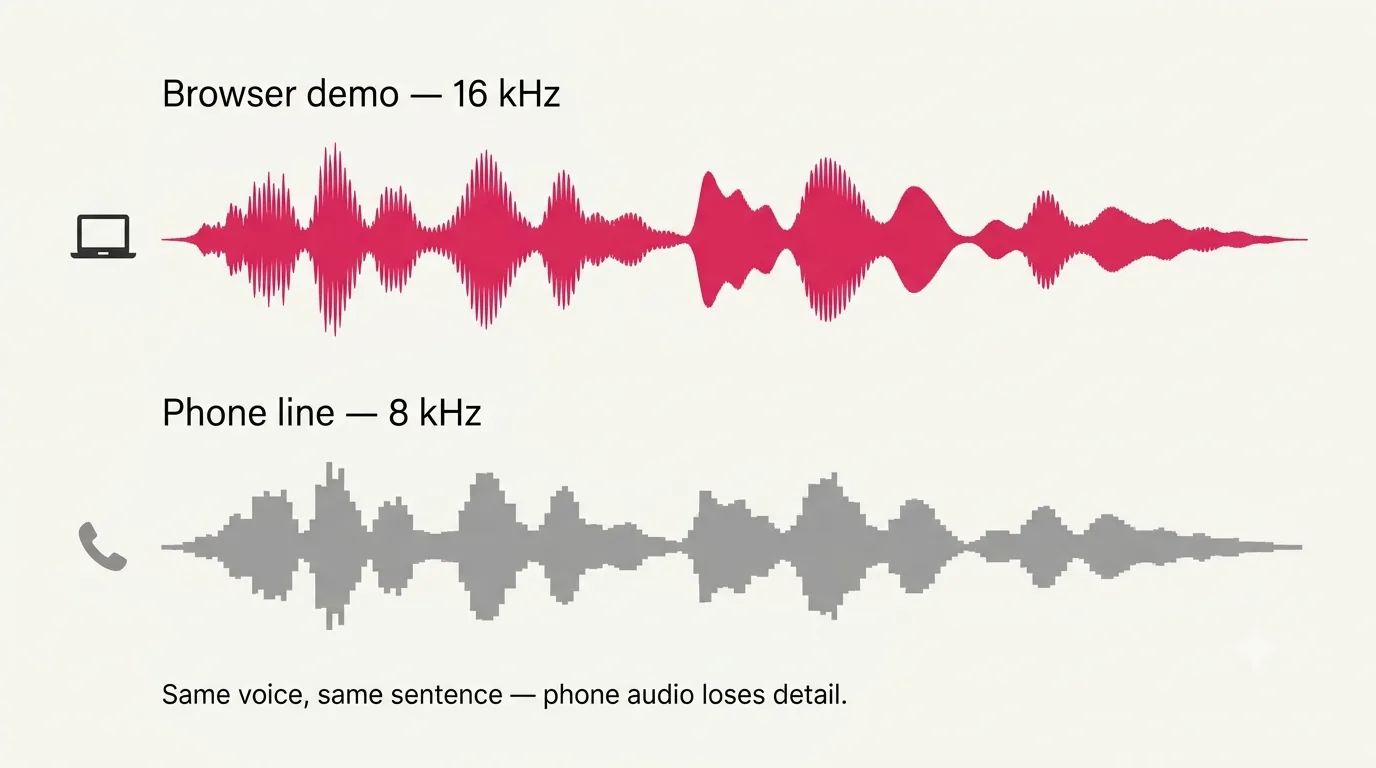
The most useful test is your own. Most phone calls reach the agent as 8 kHz audio, while a browser demo runs at 16 kHz or higher, so a voice that sounds perfect in a dashboard can sound flatter, and mishear more, on a real line. Put both agents on a phone number and listen to recorded calls. Our guide on making an ElevenLabs agent sound natural covers the prompt and voice settings that matter most.
Developer experience
Building the agent
Bland builds calls in Pathways, a visual editor that lays a conversation out as connected steps. It works well for scripted flows where you want every branch spelled out, such as qualification calls or payment reminders. It gets harder to maintain once the conversation needs to handle anything off-script.
ElevenLabs gives you a system prompt, tools, a knowledge base with RAG, and a workflow builder on every plan, including Free. You can create and manage agents from the dashboard, the API, or a CLI, and ElevenLabs offers an MCP server so you can build agents from an AI coding assistant. Agents live as configuration you can version and deploy like code. If your team already ships software through pull requests, this fits how you work. Our ElevenLabs text-to-speech API integration guide shows the API side in detail.
Testing before callers hear it
ElevenLabs is clearly ahead on testing. Its agent testing tools include simulated-user conversations, next-reply tests, tool-call tests and LLM evaluators, with pass rates you can run from CI on every prompt change. You can also A/B test agent versions on live traffic.
Bland has a testbed that replays one turn of a real conversation against an edited prompt, and its evaluations grade call audio as well as the transcript, which catches tone problems a transcript check misses. That audio grading is a real advantage. Bland's public docs say less about running a full regression suite in CI.
If you'll change prompts weekly, ElevenLabs' testing setup will save you from breaking production calls.
Telephony and integrations
Both platforms let you keep your numbers. ElevenLabs connects natively to Twilio and to any SIP trunk, supports batch outbound calling, and documents setups for carriers including Telnyx, Plivo and Vonage. Bland works with your own Twilio account or SIP trunk, or supplies Twilio lines at pass-through cost.
For messaging, ElevenLabs offers SMS and WhatsApp. Bland offers SMS and web chat, plus branded iMessage agents on Enterprise. If your customers are mostly on iPhones in the US and you want texting on the same agent, that's a point for Bland. Outside the US, WhatsApp usually matters more.
On CRM and helpdesk connections, both call your systems through tools and webhooks during the call. The work is in mapping fields and handling failures, not in the platform. Plan for it either way.
Security and compliance
Both vendors report SOC 2, ISO 27001, GDPR and PCI DSS, and both list FedRAMP 20x Class A. The differences are in the details.
HIPAA. Both put a BAA on Enterprise. ElevenLabs' BAA requires Zero Retention Mode to be on, which limits what conversation data and analytics you keep. Bland includes its BAA on Enterprise without that condition. For a healthcare line, ask both vendors exactly which features stay available under the BAA.
Vendors in the call path. On Bland, one AI company handles the call. On ElevenLabs with a third-party LLM, the model provider's terms apply too. Using an ElevenLabs Realtime model keeps it to one vendor, but limits your model choice.
Data residency and hosting. ElevenLabs offers regional data residency, including the US, EU and India, and private deployment through its sales team. Bland offers on-prem and VPC deployment on Enterprise.
Fraud controls. Bland maintains its own list of known fraudulent callers and adds country-code rules and per-caller rate limits. ElevenLabs offers a blocklist. If you run a public inbound number, ask how each handles spam and toll fraud.
None of this replaces a review by your own counsel. Take these questions to the vendors' trust teams and get the answers in the contract.
Languages and multilingual calls
ElevenLabs Agents support 31 languages, according to its language documentation. Language is fixed per call by default, and an opt-in language-detection tool lets the agent switch mid-call. Bland states 40+ languages with real-time translation in 23 of them. The counts measure different things, so test the specific languages and accents your callers use.
India is a good example of why. Real calls mix Hindi and English inside one sentence, phone audio quality varies by network, and outbound calling needs DLT registration. ElevenLabs works with Indian carriers including Exotel, Ozonetel and Plivo, and offers India data residency. ElevenLabs doesn't supply Indian phone numbers itself, so you pair it with one of those carriers. We cover the setup in ElevenLabs for Indian businesses. Bland is built mainly for US contact centers and publishes far less about Indian telephony.
Pros and cons
ElevenLabs Agents
Pros:
- Lower per-minute cost with lighter LLMs
- Choice of LLM, including custom models
- Large voice library and professional cloning
- Strong testing: simulations, CI, live A/B
- No daily caps; burst and queueing absorb spikes
- India data residency and Indian carrier partners
Cons:
- LLM billed as a second line, which varies with the model
- Burst minutes cost double
- BAA tied to Zero Retention Mode
- Third-party LLMs add a vendor to your security review
Bland AI
Pros:
- One rate covers all AI, which makes budgeting simple
- One AI vendor in the call path
- Top score on Design Arena's August 2026 realism test
- Audio-graded call evaluations
- iMessage agents and on-prem deployment on Enterprise
Cons:
- Higher per-minute list price
- Daily caps reject calls on self-serve plans
- No LLM choice; you wait for Bland's upgrades
- Few voices outside Enterprise
Which should you choose?
| If you are... | Pick | Why |
|---|---|---|
| An AI engineer or developer team | ElevenLabs | LLM choice, API/CLI, testing in CI |
| A customer support leader | ElevenLabs | Burst and queueing protect calls during spikes; voice range |
| A sales ops leader running steady outbound | Either; lean Bland for simple scripts | Hard caps keep campaign spend predictable |
| A healthcare compliance team | Shortlist both | Compare BAA terms and what each keeps under them |
| Serving India or multilingual callers | ElevenLabs | Mid-call language switching, Indian carriers, India residency |
| An agency building for many clients | ElevenLabs | Cheap starting plans, unlimited agents, voice library |
| An enterprise that wants one AI vendor, no model choices | Bland | One vendor in the call path |
For more on outbound use cases, see our guide to AI outbound calling.
How to run a fair pilot
- Pick one real call flow. Choose something you handle daily, like appointment booking or order status, and use the same script and knowledge base on both platforms.
- Use a real phone number. Test over a carrier line, not the browser widget, so you hear 8 kHz audio and real network latency.
- Price your actual LLM. On ElevenLabs, use the model you'd run in production, not the calculator default.
- Load-test your peak. Run calls at your busiest hour's concurrency and watch what happens at the limit: burst, queue or rejection.
- Send both through security review early. Compliance answers often take longer than the technical build.
Track containment rate, average handle time, transfer rate and cost per resolved call. Pick the platform that wins on your numbers.
Bland AI and ElevenLabs alternatives
If neither fits, the usual next shortlist is Retell AI, Vapi and Synthflow. Retell prices each component separately, Vapi charges a hosting fee and lets you bring your own provider keys, and Synthflow offers a no-code builder that uses ElevenLabs voices. We compare them in ElevenLabs vs Retell AI, ElevenLabs vs Vapi, our four-way ElevenAgents vs Vapi vs Retell vs Bland breakdown, and our list of the best voice AI agents.
Verdict
In the ElevenLabs vs Bland AI decision, ElevenLabs is the better default for most teams building production voice agents in 2026. It costs less per minute with sensible model choices, lets you pick and change your LLM, ships the most complete testing tools of the two, and handles traffic spikes without dropping calls. It also covers multilingual and Indian deployments far better.
Pick Bland if your priority is one AI vendor and one fixed rate, your calls follow tight scripts, and you're buying Enterprise anyway for on-prem hosting or iMessage.
FAQ
Is Bland AI cheaper than ElevenLabs?
No, not on list price. ElevenLabs charges $0.08 per additional call minute plus the LLM you choose, which comes to about $0.083 a minute with Gemini 2.5 Flash. Bland charges $0.14 on Start or $0.12 plus $299 a month on Build, with its own LLM included. With a large, expensive model the gap narrows, so price your actual model in the ElevenLabs calculator before comparing.
Which sounds more human, ElevenLabs or Bland AI?
Bland scored higher on one benchmark. In Design Arena's Audio Realism Bench of August 2026, Bland Speech v3 ranked first and ElevenLabs' Eleven v3 ranked twelfth. That test didn't include ElevenLabs' newer models and used read scripts rather than live calls. Latency, turn-taking and phone-line audio shape realism too, so compare recorded calls from both on a real number.
Are ElevenLabs and Bland AI HIPAA compliant?
Both offer a Business Associate Agreement (BAA) on Enterprise plans. ElevenLabs requires Zero Retention Mode to be enabled under its BAA, which limits stored conversation data and analytics. Bland includes its BAA on Enterprise. Both report SOC 2 and ISO 27001. Ask each vendor which features stay available under the BAA, and have your counsel review the terms.
Can I use my own LLM with ElevenLabs or Bland AI?
Only ElevenLabs lets you choose. You can pick from GPT, Claude, Gemini and Qwen models, use an ElevenLabs Realtime configuration, or connect a custom model through a server integration. LLM usage is billed on top of the $0.08 call minute. Bland runs its own in-house LLM on every call and doesn't support swapping in another model.
What happens when I exceed my concurrency limit?
It depends on the platform. On ElevenLabs, burst pricing lets agents take up to three times your concurrency limit at $0.16 a minute, and call queueing can hold extra callers for a free line without billing the wait. On Bland's self-serve plans, calls past the concurrency or daily cap are rejected, which protects your budget but drops the call.
Get ElevenLabs into production
If ElevenLabs looks like the right fit, the hard part is the build: telephony, CRM integration, prompt and guardrail design, testing and monitoring. Haass designs and deploys ElevenLabs voice agents for support and sales teams. Talk to us about ElevenLabs voice AI implementation and we'll scope a pilot around your real call flows.