TL;DR
- Pick ElevenLabs if you want a voice agent live this week, with the best-sounding voices, its own speech-to-text, and one vendor for the audio side of every call.
- Pick Vapi if your engineers want to choose and swap every layer (transcriber, LLM, voice, fallbacks) and are happy to manage several provider bills.
- Use both if you like Vapi's orchestration but want ElevenLabs voices. Vapi supports ElevenLabs as a TTS provider, so you pay Vapi's hosting fee plus ElevenLabs' voice cost.
- Neither headline price is the real price. Vapi's $0.05/min covers hosting only. ElevenLabs' $0.08/min overage leaves out the LLM. Budget roughly $0.10–$0.20 per minute all-in before telephony for either.
The demo sounded great. Then the phone bill arrived.
Most teams comparing ElevenLabs vs Vapi have already built something. A prototype agent answered a test call, sounded human, and everyone in the room got excited. Then someone asked what 20,000 minutes a month would cost, why the agent paused for a second and a half on a mobile line, or who signs the BAA.
That's the decision this post helps you make. We'll compare ElevenLabs vs Vapi AI on the things that decide a production phone agent: what a minute really costs, where latency comes from, how each one connects to a phone line, how much code you'll write, and what compliance looks like.
A disclosure up front. Haass is an ElevenLabs implementation partner, so we have a bias. We've tried to keep it out of the analysis, and there's a section on when ElevenLabs is the wrong choice. Every other article ranking for this comparison is written by a company selling a third product, so at least ours is the bias you can see.
ElevenLabs vs Vapi: the short answer
| ElevenLabs Agents | Vapi | |
|---|---|---|
| What it is | Voice-native agent platform | Voice agent orchestration layer |
| Speech-to-text | Its own (Scribe) | Third-party (e.g. Deepgram), billed at cost |
| LLM | Your pick (OpenAI, Anthropic, Google, custom) | Your pick, billed at cost |
| Text-to-speech | Its own voices and models | Third-party or Vapi voices, incl. ElevenLabs |
| Telephony | Native Twilio and SIP trunk integrations | Vapi numbers included, plus Twilio, Vonage, SIP |
| Headline price | $0.08/min beyond plan allowance | $0.05/min hosting |
| Realistic all-in, before phone | ~$0.10–$0.15/min | ~$0.12–$0.25/min |
| First working agent | Under an hour in the dashboard | A day or more for most teams |
| HIPAA path | BAA on Enterprise | Paid add-on, $2,000/month |
| Best for | Voice quality, speed to launch, multilingual | Full stack control, provider swapping |
What each platform is
ElevenLabs Agents
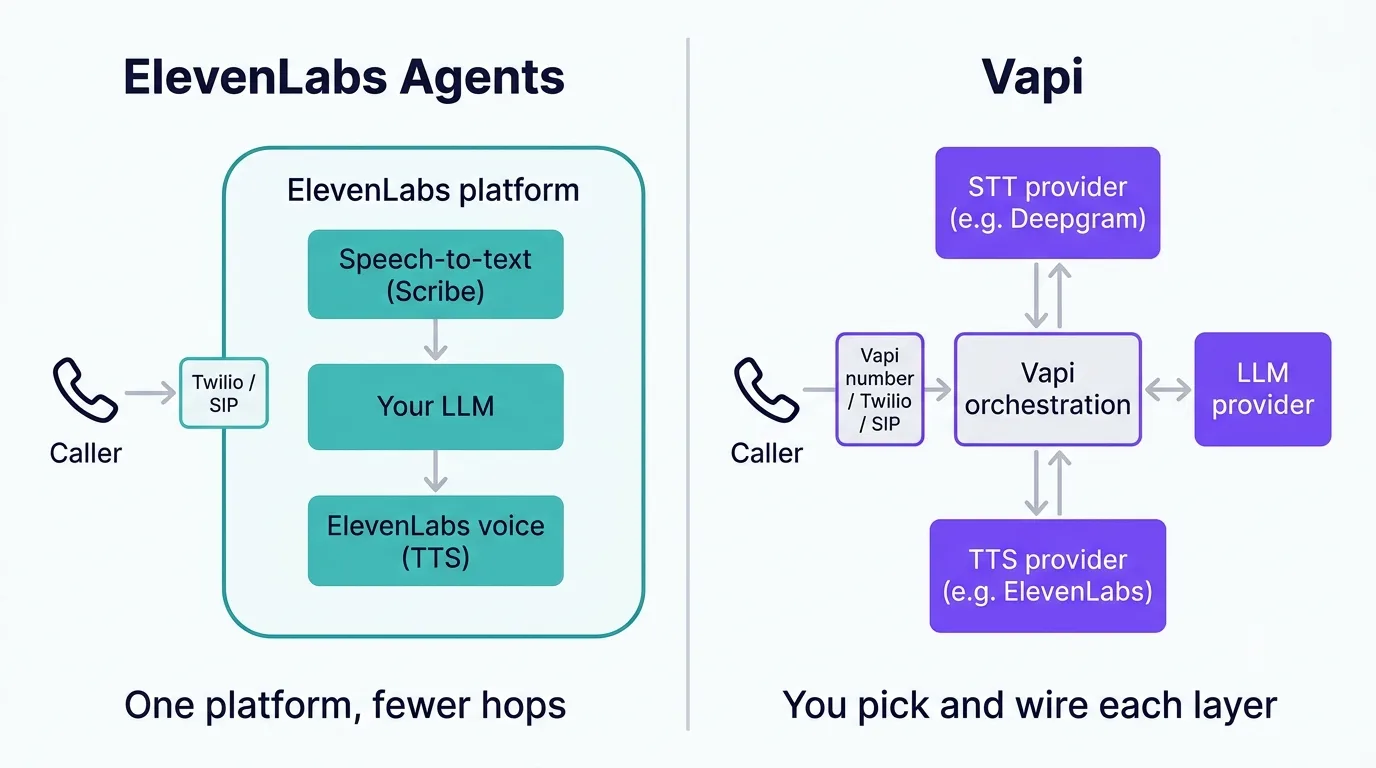
ElevenLabs started as a text-to-speech company and still sells the voices most other platforms license. Its agent product (now called ElevenAgents, previously Conversational AI) wraps those voices in a full agent: its own Scribe transcription, turn-taking and interruption handling, a knowledge base, tool calls, and analytics. You bring the LLM, picking from the hosted list or plugging in your own endpoint.
You can build an agent in the dashboard by writing a system prompt, choosing a voice, uploading documents and testing in the browser. Developers can do the same through the API, the Python and JavaScript SDKs, or an MCP server.
One thing other comparisons get wrong: Flash v2.5 is a TTS model, ElevenLabs' fastest, with around 100ms of model latency according to the ElevenLabs models documentation. It's the voice engine most agents use. The agent platform is a separate product.
Vapi
Vapi is the switchboard between other people's models. You choose a transcriber, an LLM, and a voice provider, and Vapi runs the real-time loop between them: streaming audio, endpointing, interruptions, tool calls, transfers, and the phone connection. Provider costs pass through at cost, and Vapi adds its hosting fee per minute.
That design gives your team control. You can run GPT on Monday and Claude on Tuesday, set a fallback transcriber, or chain several assistants with Squads. It also means your team owns every provider decision, every failure mode, and every retest when one vendor changes a model.
Yes, you can run ElevenLabs voices inside Vapi
This is the option most comparisons mention and then skip. Vapi lists ElevenLabs as a voice provider, so you can keep Vapi's orchestration and get ElevenLabs audio. You pay Vapi hosting, plus ElevenLabs TTS, plus your transcriber and LLM. It makes sense if your team already runs on Vapi and voice quality is the complaint. If you're starting fresh and want ElevenLabs voices anyway, running ElevenLabs Agents directly removes one vendor and one network hop.
ElevenLabs vs Vapi pricing: what a minute really costs
Both vendors publish a per-minute number, and neither number is what you'll pay. You need to add the pieces each one leaves out.
ElevenLabs pricing
ElevenLabs Agents plans include a monthly allowance of call minutes. Past the allowance, extra minutes cost $0.08 each, and minutes above your concurrency limit are billed at a burst rate of $0.16 (ElevenAgents pricing). Plans run from a free tier with 15 minutes to Business at $990/month with 12,375 minutes included. Transcription and the ElevenLabs voice are inside that minute. The LLM is billed on top, at whatever the model provider charges, and telephony comes from your carrier.
The catch is the plan fee. If you pay for a tier and use half its minutes, your effective rate climbs. If you blow past it, burst pricing doubles the cost of the overflow. Pick the tier that matches your steady-state volume, and set concurrency to match your real peak.
Vapi pricing
Vapi charges $0.05 per minute for hosting (Vapi pricing). Your transcriber, LLM and voice provider each bill per minute or per token at cost. Telephony on Vapi numbers or SIP carries no transport fee. If you bring Twilio, Vapi lists transport at $0.008/min inbound and $0.014/min outbound.
Add-ons change the picture for production teams. HIPAA mode is a $2,000/month add-on, and an SLA, RBAC and longer data retention sit in paid support packages: Core at $29/month, and Pro at a $999/month minimum with a 99% uptime SLA. A $0.05 platform fee looks cheap until a healthcare client needs a BAA.
Worked example at 1K, 10K and 50K minutes
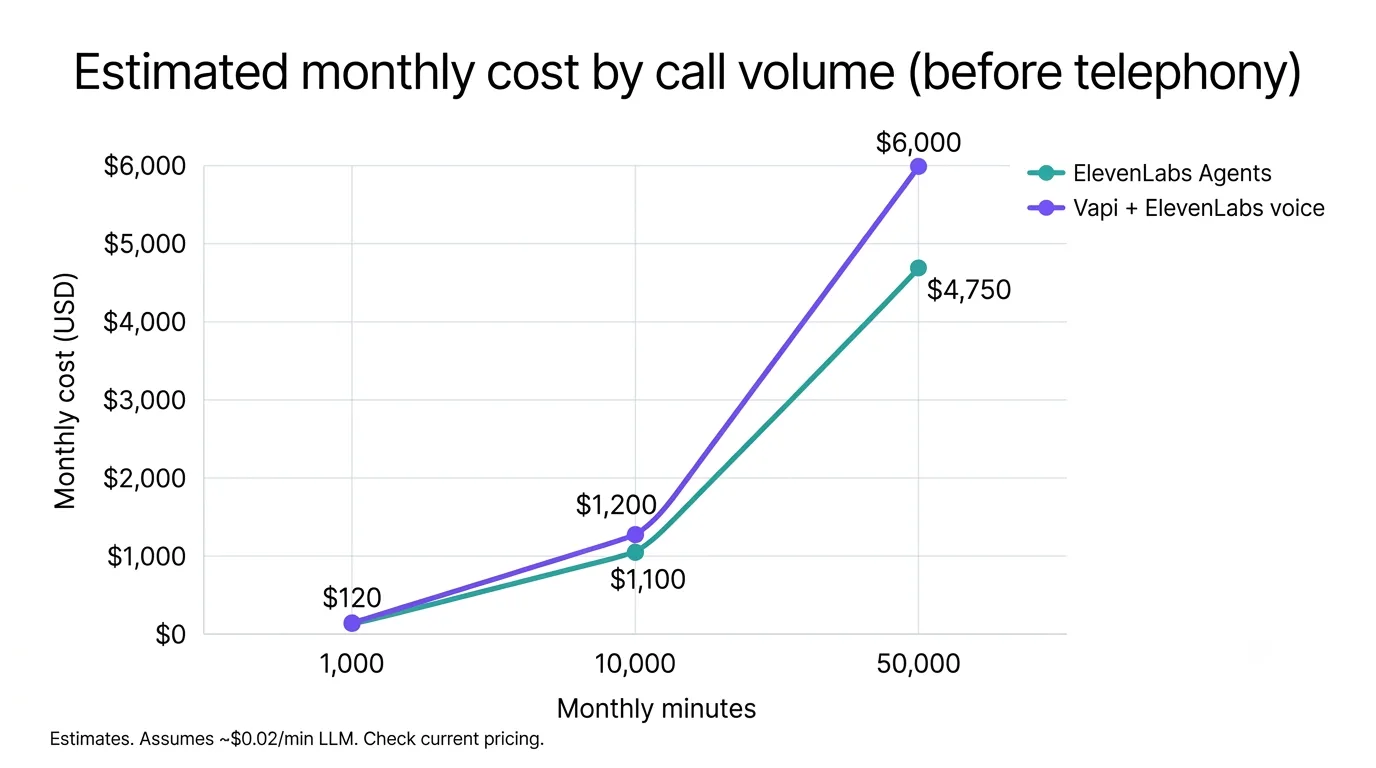
Here's one formula you can reuse with your own numbers:
\text{Monthly cost} = \text{plan or platform fee} + (\text{minutes} \times \text{per-minute stack cost}) + \text{add-ons} + \text{telephony}Assumptions, so you can swap in yours: LLM at about $0.02/min (a fast mid-tier model), a third-party transcriber at about $0.01/min, ElevenLabs-quality TTS through Vapi at about $0.04/min, and no compliance add-ons. These provider rates are our planning estimates, not published vendor prices, and they vary by model and voice tier. Telephony is left out because it's the same carrier cost on both.
| Monthly minutes | ElevenLabs Agents (plan + $0.08 overage + LLM) | Vapi (hosting + STT + LLM + ElevenLabs TTS) |
|---|---|---|
| 1,000 | Plan fee covers most minutes; ~$100–$120 | ~$120 ($0.12/min) |
| 10,000 | ~$1,000–$1,200 | ~$1,200 |
| 50,000 | ~$5,000 | ~$6,000 |
At pilot volume the two are close. As volume grows, ElevenLabs' bundled transcription and voice tend to beat paying for the same ElevenLabs voice through Vapi. Exact ElevenLabs figures depend on which plan tier you sit on, so run your own volume against the current ElevenLabs pricing page before you commit.
Costs neither pricing page shows
The subscription is the smallest line on most real projects. The bigger costs are engineering time to wire the agent into your CRM and phone system, prompt and guardrail design, QA before launch, monitoring after it, and compliance work (DLT registration in India, BAAs in US healthcare). Vapi asks for more engineering hours because you assemble more parts. ElevenLabs asks for fewer, but you still need someone to own the integration. If you're weighing outside help for that work, our guide to choosing an ElevenLabs implementation partner explains what to look for.
ElevenLabs vs Vapi latency: where the milliseconds go
A caller judges latency as the gap between finishing a sentence and hearing the agent start. That gap is a sum of several steps, and the TTS model is rarely the biggest one.
| Step in one turn | What drives it | Typical share |
|---|---|---|
| End-of-turn detection | How long the system waits to be sure the caller stopped | Often 200–500ms, tunable |
| Speech-to-text final transcript | Transcriber speed, audio quality | Tens to low hundreds of ms |
| LLM first token | Model size, prompt length, tool calls | Usually the largest, 200ms to over 1s |
| TTS first audio | Voice model (Flash v2.5 ~100ms) | Small with a fast model |
| Network and telephony hops | Distance between servers, carrier, each vendor hop | 50–300ms+ |
The ranges above are typical engineering figures, not vendor benchmarks. For a floor, ElevenLabs lists about 150ms for its Scribe v2 Realtime transcription model and about 100ms for Flash v2.5 speech, according to the ElevenLabs models documentation. That puts the speech layers alone at roughly 250ms, so expect a full turn to land well above that once the LLM and the phone network are added.
ElevenLabs runs transcription, turn-taking and voice in one platform, so audio crosses fewer company boundaries. Vapi can be just as fast with a tuned stack, but every provider you add is another network hop, and your slowest layer sets the pace. In both cases, the biggest lever you control is the LLM: a smaller, faster model with a short prompt saves more time than any voice setting. If a tool call has to hit a slow CRM mid-turn, have the agent say something first so the caller doesn't sit in silence.
Voice quality
ElevenLabs is the voice most teams are trying to match. It has a library of thousands of voices, instant and professional voice cloning, a large set of supported languages, and expressive models that handle emotion and pacing well. On Vapi, voice quality equals whichever provider you plug in. Choose ElevenLabs inside Vapi and you get the same audio; choose a cheaper voice to cut cost and you'll hear the difference.
Third-party blind listening tests exist, and their rankings move every few months as new models ship. Treat any single benchmark as one data point, especially one published by a vendor whose own voice wins it. The test that matters is your script, read by both stacks, played to a few of your own customers.
ElevenLabs vs Vapi for phone calls
How each connects to a phone line
ElevenLabs connects to phone networks through native integrations with Twilio and through SIP trunking, so you can import numbers from your carrier and handle inbound and outbound calls. It doesn't sell phone numbers itself. You buy them from a carrier and attach them to the agent.
Vapi includes a phone number on its plans and supports Twilio, Vonage and SIP for bringing your own. International teams usually import numbers from a local carrier over SIP.
For US-only inbound calls, both are straightforward. The differences show up with warm transfers to humans, outbound campaigns, and calling outside North America.
Outside the US: the India example
In India, the voice platform is the easy part. Outbound commercial calling needs DLT registration and numbers from a licensed provider, and the platform has to connect to that provider in real time. ElevenLabs integrates with Indian telephony providers including Exotel, Plivo and Ozonetel, and offers an India data residency option. ElevenLabs Agents also support Hindi, Tamil and other Indian languages natively. Vapi can reach Indian numbers through SIP or Plivo, but you'll assemble the transcriber and voice for Hindi or Hinglish yourself and test them on real Indian mobile lines.
If you're building for Indian customers, read our guide to ElevenLabs implementation for Indian businesses, which covers telephony partners, DLT and the Indian voice catalog.
Developer experience, with code
Both platforms let you create an agent with one API call. The difference is how many decisions that call forces on you.
Creating a basic ElevenLabs agent: you set the prompt, the first message, the language and a voice. Transcription and turn-taking use the platform defaults.
curl -X POST https://api.elevenlabs.io/v1/convai/agents/create \
  -H "xi-api-key: $ELEVENLABS_API_KEY" \
  -H "Content-Type: application/json" \
  -d '{
    "name": "Clinic booking agent",
    "conversation_config": {
      "agent": {
        "first_message": "Hi, this is the front desk. How can I help?",
        "language": "en",
        "prompt": { "prompt": "You book and reschedule appointments. Keep answers short." }
      },
      "tts": { "voice_id": "YOUR_VOICE_ID" }
    }
  }'
Creating the same assistant on Vapi: you name the transcriber, the model provider and the voice provider explicitly. Here the voice is ElevenLabs.
curl -X POST https://api.vapi.ai/assistant \
  -H "Authorization: Bearer $VAPI_API_KEY" \
  -H "Content-Type: application/json" \
  -d '{
    "name": "Clinic booking agent",
    "firstMessage": "Hi, this is the front desk. How can I help?",
    "transcriber": { "provider": "deepgram", "model": "nova-3", "language": "en" },
    "model": {
      "provider": "openai",
      "model": "gpt-4o-mini",
      "messages": [{ "role": "system", "content": "You book and reschedule appointments. Keep answers short." }]
    },
    "voice": { "provider": "11labs", "voiceId": "YOUR_VOICE_ID" }
  }'
Field names change between API versions, so check the current ElevenLabs Agents API reference and Vapi API reference before copying these into production.
The Vapi payload is longer because Vapi expects you to choose. That's an advantage when you have opinions about transcribers, and extra work when you don't. Vapi also lets you configure fallback providers, and its docs warn that without a fallback a call ends with an error if your transcriber fails, so plan to set those up.
On tooling, ElevenLabs offers Python and JavaScript SDKs, client SDKs for web and mobile, and an MCP server so you can create and manage agents from an AI coding assistant. Vapi offers server and client SDKs, Squads for handing a call between specialized assistants, and an in-dashboard assistant builder. One stability note: Vapi retired its Workflows feature on 18 August 2026 and points teams to Squads instead, so teams built on Workflows had to migrate. Check each platform's changelog before you commit to a feature.
If you only need ElevenLabs voices inside your own app, without the agent layer, our ElevenLabs text-to-speech API integration guide walks through streaming, retries and key security.
Compliance, security and support
| ElevenLabs | Vapi | |
|---|---|---|
| SOC 2 Type II | Yes | Yes |
| HIPAA / BAA | BAA on Enterprise, with Zero Retention Mode | $2,000/month add-on |
| GDPR / data residency | EU and India data residency options | GDPR supported |
| Support | Email on self-serve; dedicated support and SLAs on Enterprise | Discord and email on usage tier; SLAs in paid packages |
For regulated work, the two paths differ in shape. Vapi lets a smaller team buy HIPAA without an enterprise contract, at a fixed monthly cost. ElevenLabs requires an Enterprise agreement for a BAA, and its HIPAA setup uses Zero Retention Mode, which limits which LLMs and how much call analytics you can use. If you need a BAA and can't justify an Enterprise contract yet, Vapi's add-on is the faster route. If you're already at enterprise volume, the ElevenLabs agreement also brings negotiated pricing and dedicated support.
Pros and cons
ElevenLabs Agents
Pros:
- The best-sounding voices on the market, plus cloning and a large multilingual catalog.
- Transcription, turn-taking and voice in one platform, so fewer vendors and fewer hops.
- Fastest path from idea to a working agent, through the dashboard or the API.
- Native Twilio and SIP integrations, and regional telephony partners in markets like India.
Cons:
- The LLM is billed separately, so the headline minute price understates the total.
- Burst pricing doubles the cost of calls above your concurrency limit.
- A BAA requires an Enterprise contract.
- Less freedom to swap the transcriber or voice engine for a third-party one.
Vapi
Pros:
- Choose and swap any transcriber, LLM or voice, with fallbacks.
- Low hosting fee and pay-as-you-go billing.
- HIPAA available as an add-on without an enterprise contract.
- Squads for multi-assistant calls, and strong webhooks and tool calling.
Cons:
- Several provider bills to track, each with its own price changes.
- More engineering time before your first production call.
- Latency depends on every provider in your chain.
- Lower-tier support runs through Discord and email without an SLA.
When ElevenLabs is the wrong choice
We implement ElevenLabs for a living, and we'd still steer you away from it in a few cases. If your engineers want a specific non-ElevenLabs transcriber or a self-hosted voice model, Vapi or a custom pipeline will fit better. If you need HIPAA next month on a small budget, Vapi's add-on gets you there without an enterprise negotiation. If your call volume is huge and your callers don't care much how the voice sounds (automated reminders, say), a cheap voice through an orchestrator can cost less. And if your team wants to understand every layer of a voice stack from the inside, building on Vapi will teach you more.
Which should you pick?
The right answer depends on who's building and what the calls are for.
- Founder who needs a working agent this week: ElevenLabs. You'll be testing on real calls the same day, and you won't manage four vendor accounts.
- Engineering team that wants full control of the stack: Vapi, possibly with ElevenLabs as the voice provider.
- Product manager adding voice to an existing app: ElevenLabs, using its web and mobile SDKs, so the voice and the agent come from one vendor.
- Regulated industry, small budget: Vapi with the HIPAA add-on. At enterprise scale, compare that with an ElevenLabs Enterprise agreement.
- High-volume outbound with simple scripts: run the cost math both ways. A budget voice on Vapi may win on price, and ElevenLabs may win on answer and conversion rates.
- India or multilingual callers: ElevenLabs, for native Indian languages and local telephony partners. If you're also weighing India-native options, see our comparison of ElevenLabs vs Sarvam AI vs Gnani AI for Indian businesses.
How to run a fair two-week pilot
Don't decide from demos. Build the same agent on both platforms and measure them on your own calls.
- Write one system prompt, one knowledge base and one tool (for example, a calendar lookup), and use them on both platforms.
- Use the same LLM on both, so you're comparing the platforms rather than the models.
- Connect both to the same carrier and run at least 20 calls each from real phones, including mobile lines with background noise.
- Log turn latency (end of caller speech to first agent audio), interruptions handled correctly, task completion and transfer success.
- Have three or four people who don't know which platform is which rate each recording for naturalness.
- Price your expected monthly volume on both, using real token and minute counts from the pilot.
- Note how many engineering hours each build took. That number is part of the price.
Verdict
For most founders, developers and product teams building a phone agent in 2026, ElevenLabs is the better starting point. You get the strongest voices, fewer vendors in the call path, and a working agent in hours, and the per-minute cost is competitive once you add Vapi's provider bills. Vapi is the better pick when your team wants to own every layer, swap providers freely, or needs HIPAA without an enterprise contract. If you already run on Vapi and voice quality is the complaint, plug in ElevenLabs voices before you migrate anything.
FAQ
Can Vapi use ElevenLabs voices?
Yes. Vapi supports ElevenLabs as a text-to-speech provider, so you can keep Vapi's orchestration and get ElevenLabs audio. You pay Vapi's per-minute hosting fee, ElevenLabs' voice cost, and your transcriber and LLM separately. If you're starting a new project and already want ElevenLabs voices, running ElevenLabs Agents directly removes a vendor and a network hop from every call.
Is ElevenLabs cheaper than Vapi?
Often, yes, once you compare like for like. Vapi's $0.05 per minute covers hosting only, and transcription, the LLM and the voice are billed on top. ElevenLabs' $0.08 per extra minute already includes transcription and voice, with the LLM billed separately. With an ElevenLabs-quality voice on both, ElevenLabs usually costs less at volume.
Which has lower latency for phone calls, ElevenLabs or Vapi?
ElevenLabs usually has an edge because transcription, turn-taking and voice run in one platform with fewer network hops, and its Flash v2.5 voice model starts audio in about 100ms. A well-tuned Vapi stack can come close. On both, the LLM is the biggest source of delay, so a faster model and a shorter prompt matter more than the platform.
Does ElevenLabs include the LLM in its per-minute price?
No. ElevenLabs' per-minute price for agents covers the call itself, including its own transcription and voice. The language model is billed separately, based on the model you choose and the tokens your conversations use. Short prompts and smaller models keep that line low. Check the ElevenLabs agents pricing page for current model rates before you budget.
Do I need Twilio to make phone calls with ElevenLabs or Vapi?
Not necessarily. ElevenLabs connects to phone networks through native Twilio integration or a SIP trunk from your existing carrier. Vapi includes a phone number on its plans and also supports Twilio, Vonage and SIP. Outside North America, you'll usually bring numbers from a local carrier, such as Exotel or Plivo in India, and connect them over SIP or a native integration.
Ready to build on ElevenLabs?
The ElevenLabs vs Vapi decision comes down to whether you want the best voice with fewer moving parts, or full control of every layer. If ElevenLabs fits your use case, the next step is a scoped pilot on your own calls. Haass designs, builds and launches ElevenLabs voice agents, from prompt and guardrails to telephony, CRM integration and QA. Talk to Haass about an ElevenLabs pilot and we'll help you price it against your real call volume.