TL;DR
- ElevenLabs gives you the best-in-class voice stack and a self-serve agent platform. Your team builds, tests and owns the agent.
- Parloa sells a managed AI agent platform for large contact centers, with lifecycle tooling, CCaaS connectors and a quote-only contract.
- ElevenLabs Agents publishes its price ($0.08 per call minute, LLM and telephony extra). Parloa bills per minute too but publishes no rate.
- Pick ElevenLabs if you have engineers and want control. Pick Parloa if you want a vendor to own more of the operation and you can accept a longer sales cycle.
You have two vendors on the shortlist and two demos that both sounded good. One came from the company whose voices you've heard in a hundred products; the other came from a contact center specialist that talked mostly about governance and Genesys. Choosing between ElevenLabs vs Parloa is hard because the demos don't show what you'll be living with in month six: who changes the prompt when containment drops, what the bill looks like at 50,000 minutes, and whether the agent survives your telephony stack.
This comparison is written for the CTO, AI lead or product manager running that evaluation. We implement ElevenLabs for enterprise support teams, so we have a bias, and we'll say where Parloa is the better fit. If you're still building the shortlist, our roundup of the best voice AI agents in 2026 covers the wider field.
ElevenLabs vs Parloa at a glance
| ElevenLabs Agents | Parloa | |
|---|---|---|
| Origin | Voice model company (TTS, STT) that added an agent platform | Contact center AI company, founded 2018 in Germany |
| Core strength | Voice quality, latency, developer control | Managed agent lifecycle for large contact centers |
| How you buy | Self-serve plans up to Business, then Enterprise contract | Sales-led contract with a committed volume package |
| Published pricing | Yes: $0.08 per call minute on paid plans | No public rate |
| Speech models | ElevenLabs' own TTS and Scribe STT | Fine-tuned STT/TTS; outside providers in the stack |
| LLM choice | You choose the model per agent | Parloa picks the model for your use case; several providers available |
| CCaaS integration | Native Genesys Cloud Audio Connector, SIP trunking, Twilio, Telnyx | Connectors for Genesys, Five9, NiCE and others, plus SIP |
| Testing and change control | Built by your team with platform tools | Agent Builder, Performance Lab, Lens and Navigator |
| Compliance | SOC 2, GDPR, HIPAA with BAA on Enterprise | ISO 27001, SOC 2, PCI DSS, HIPAA, GDPR, DORA, EU AI Act |
| Time to first working agent | Hours to days | Weeks, after a sales process |
| Who maintains it | Your team or your implementation partner | Shared with Parloa and its partners |
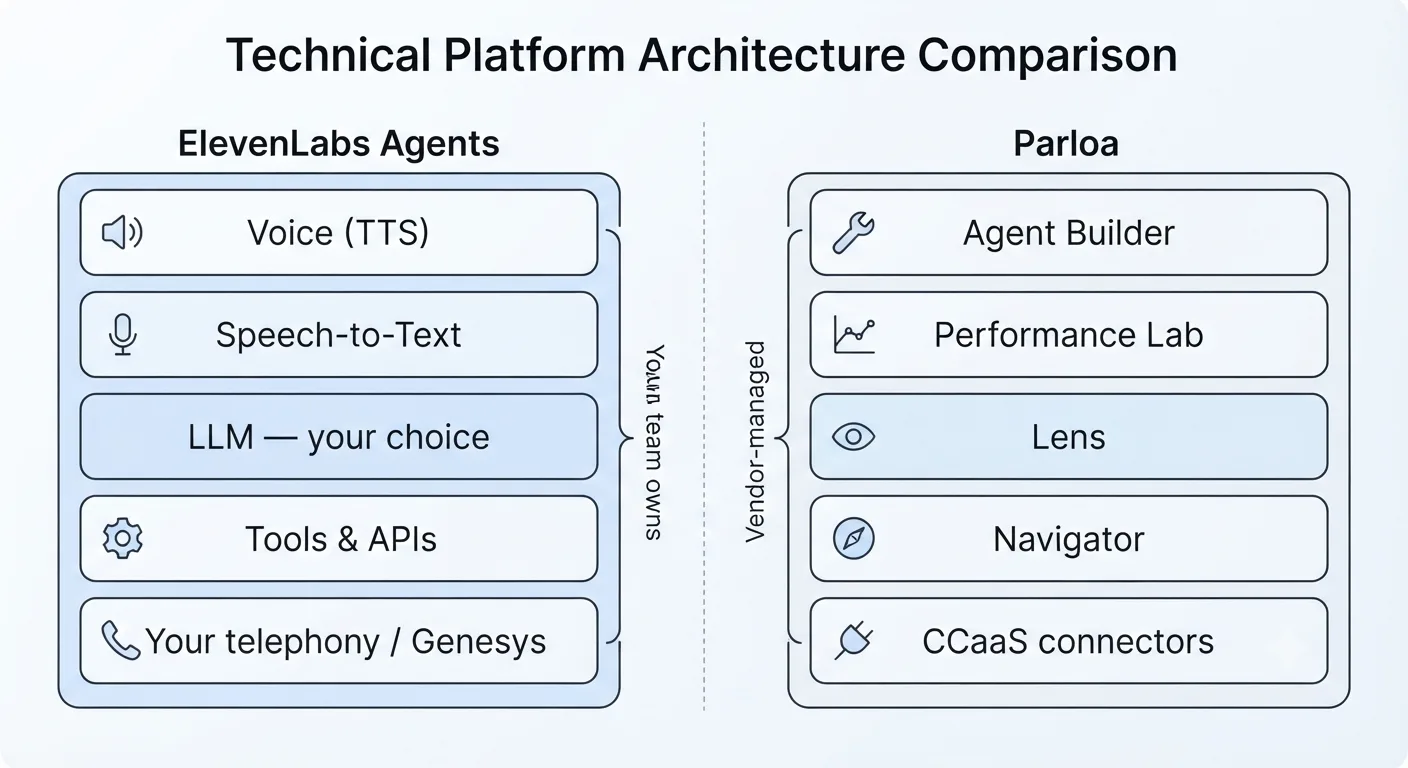
What each platform actually is
ElevenLabs Agents
ElevenLabs built its name on text-to-speech, then added speech-to-text (Scribe) and a conversational agent platform on top. When you build an agent you pick the voice, the LLM, the knowledge base and the tools it can call, then deploy it to a phone number, a SIP trunk, a web widget or a contact center.
The practical consequence is that every layer that affects how a call sounds belongs to one vendor. Latency tuning, interruption handling and voice choice all happen in one dashboard and one API. What you don't get out of the box is an opinionated operating model. Nobody at ElevenLabs will decide your regression test suite for you.
Parloa
Parloa calls itself an AI agent management platform. It was founded in 2018, raised a $350 million Series D in January 2026, and sells to large service organizations in insurance, financial services, retail and similar sectors. The product is split into stages: build agents in Agent Builder, test them in Performance Lab, review live calls in Lens, and diagnose problems with Navigator. Parloa Zones keeps data in a legal region you choose.
Parloa sells a process as much as software. Large rollouts often run with consulting partners, and Parloa keeps more control over the model layer than ElevenLabs does.
The detail most comparisons skip: Parloa can run on ElevenLabs
Parloa's 2026 release notes list ElevenLabs as a subprocessor that must be accepted before EU processing is enabled. So for some Parloa customers, the voice on the call already comes from ElevenLabs.
This changes the question. If voice quality is the main reason you're looking at either vendor, you may get similar voices from both, and the real decision is about the layer around the voice: who orchestrates the call, who owns testing, and who you pay.
Head-to-head: the criteria that decide enterprise deals
Voice quality and latency
ElevenLabs has the edge here because it builds the models. You can choose between expressive models for brand-sensitive calls and fast models for snappy turn-taking, and you can audition thousands of voices or clone your own. Our guides on cutting ElevenLabs agent latency below one second and making an agent sound natural cover the settings that matter.
Parloa says it fine-tunes its speech stack for phone calls, with contextual barge-in and noise cancellation. That matters on bad mobile lines. It doesn't publish a latency figure, so ask for p95 response time measured on production traffic, not a demo.
Who wins: ElevenLabs on voice and tunable latency. Test Parloa on your noisiest call types before ruling it out.
Contact center and telephony integration
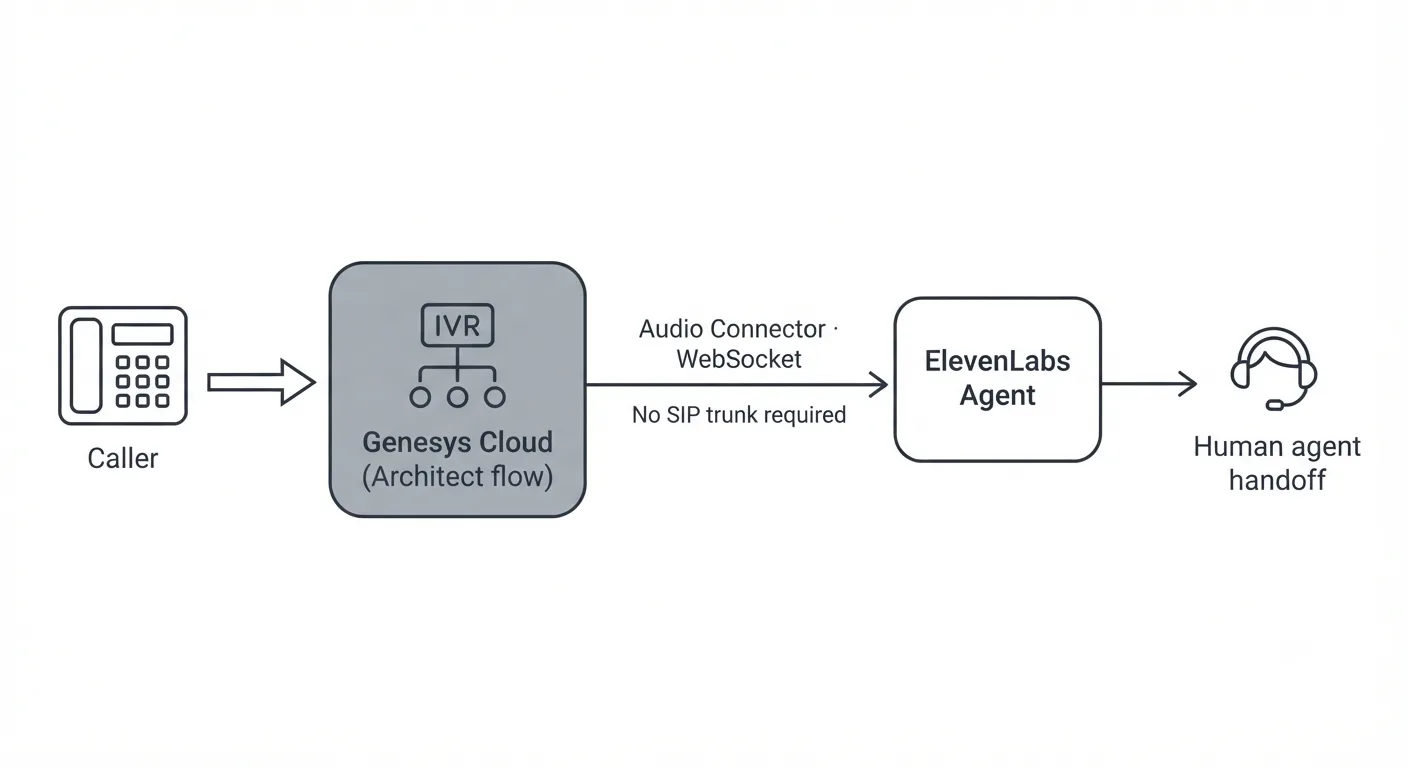
Competitors often describe ElevenLabs as "SIP trunking only." That's out of date. ElevenLabs ships a native Genesys Cloud integration that uses the Genesys Audio Connector over WebSocket, so you don't need a SIP trunk at all and the agent runs inside Genesys Architect flows. It also supports SIP trunking to your existing carrier or PBX, plus Twilio and Telnyx.
Parloa has the broader list of prebuilt contact center connectors: Genesys, Five9, NiCE, plus Salesforce, ServiceNow and SAP on the CRM side. If you run Five9 or NiCE CXone and want a vendor-supported connector rather than a SIP integration your team maintains, that's a real advantage.
Who wins: Tie on Genesys. Parloa for Five9 and NiCE shops that want packaged connectors. ElevenLabs for teams comfortable wiring SIP and APIs.
Testing, governance and change control
This is Parloa's strongest area. Performance Lab runs simulated conversations and compares versions before a change goes live, Lens replays real calls, and version control is part of the product. For a compliance team that wants an audit trail for every prompt change, it arrives in a box.
On ElevenLabs you get the building blocks: agent versions, conversation logs, evaluation criteria and an API for everything. You still have to decide what a release process looks like and wire it into your CI or review workflow. A good team builds something tighter than an off-the-shelf process. A stretched team may never build it.
Who wins: Parloa, unless you have the engineering capacity to own a release process.
Compliance and data residency
Both vendors cover the basics for regulated industries. ElevenLabs offers SOC 2, GDPR and HIPAA, with a Business Associate Agreement on Enterprise. Parloa lists a longer set of certifications, including ISO 27001, ISO/IEC 42001, PCI DSS, DORA and EU AI Act alignment, and its Zones feature pins data to a region.
The longer list matters if you're a European bank under DORA or need PCI DSS for card data on calls. For a US healthcare deployment, a signed BAA from either vendor covers the core requirement. In both cases, ask which subprocessors sit in the call path. Every LLM provider is another company your security team has to review. Our guide to voice AI agents for insurance goes through the questions regulated buyers ask.
Who wins: Parloa for EU financial services. Roughly even elsewhere.
LLM flexibility and control
On ElevenLabs you choose the LLM per agent, including bringing your own model endpoint. If a new model is cheaper or better at tool calling, you switch it and test it yourself.
Parloa takes the opposite approach and picks the model for your use case. That reduces work, but your agent's behavior can change when Parloa changes the model behind it. Ask how much notice you get and whether you can pin a model version.
Who wins: ElevenLabs for control. Parloa if you'd rather not manage model choice at all.
Languages and multilingual calls
Parloa advertises more than 140 languages and variants. ElevenLabs covers dozens of languages across its TTS and STT models, with strong voices in the major European and Asian languages and Indian languages. For most enterprises both lists are long enough. The test that matters is code-switching: a caller who mixes two languages in one sentence. Run that test on your own call recordings with both vendors.
Who wins: Parloa on breadth. Test both on your real language mix.
ElevenLabs pricing vs Parloa pricing
ElevenLabs publishes its agent pricing. Every paid plan prices call minutes at $0.08, whether included in the plan or bought as extra minutes. Plans mainly differ by included minutes and concurrent calls: Business costs $990 a month, includes 12,375 minutes and allows 40 concurrent calls. Calls above your concurrency limit are billed at a $0.16 burst rate. The LLM and telephony are billed separately, and Enterprise contracts negotiate volume, concurrency and terms.
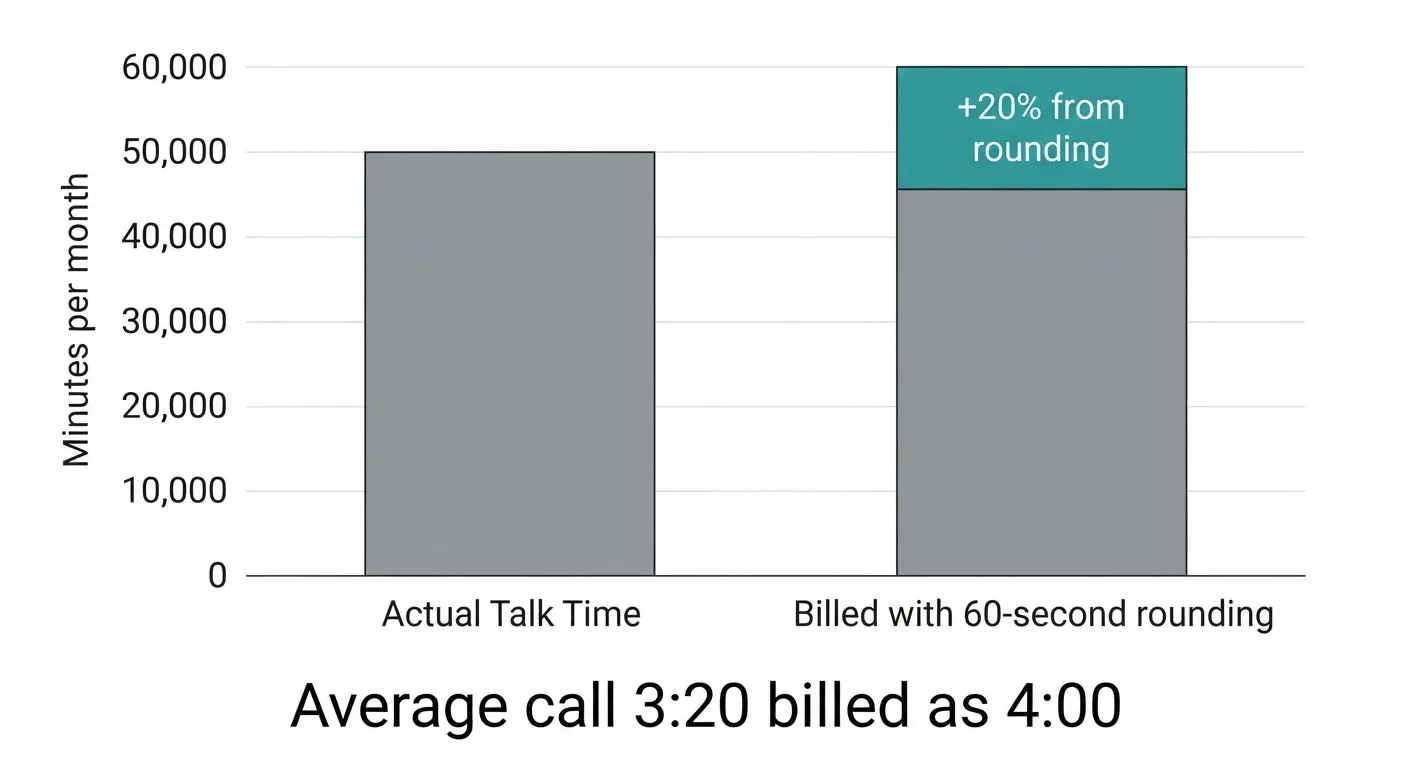
Parloa bills voice per minute and chat per interaction, with rates that depend on how complex each use case is. You commit to a volume package and apply it across use cases. Parloa doesn't publish a rate, and its Fair Use terms round each conversation up to the next 60 seconds. Read that clause carefully in your contract.
Worked example: 50,000 minutes a month
Say you handle 50,000 voice minutes a month with an average call of 3 minutes 20 seconds.
On ElevenLabs: 50,000 minutes × $0.08 = $4,000 in platform charges. On Business, that's $990 for the plan plus 37,625 extra minutes at $0.08 ($3,010). Add LLM costs (which depend on model and prompt size) and carrier minutes. At this volume your peak concurrency will probably exceed 40 calls, which pushes you toward an Enterprise contract or burst charges. You can still budget most of the bill before talking to sales.
On Parloa: with 60-second rounding, a 3:20 call bills as 4 minutes. That's 20% more billable minutes than talk time, so 50,000 real minutes become roughly 60,000 billed minutes. Multiply by whatever rate Parloa quotes. Parloa says it absorbs LLM token costs inside that rate, which removes one variable.
The practical difference: ElevenLabs lets you model cost on day one, while Parloa gives you a single rate that includes the model but that you only see after a sales process. Ask Parloa to price your real call-length distribution, not an average. For the bigger picture against human agents, see our AI call center vs traditional cost comparison.
Total cost of ownership
The platform fee is the smaller part of the bill for either vendor.
With ElevenLabs, the hidden cost is engineering time. Someone has to design prompts, connect tools to your CRM, set up telephony, build an evaluation suite and watch the dashboards after launch. If you don't have that team, you'll pay an implementation partner. Our breakdown of ElevenAgents implementation phases and timelines shows what that work involves.
With Parloa, more of that work is in the product and in the contract. You'll often pay for a partner-led rollout as well, and you trade flexibility for it: changes to the model layer, pricing tier or roadmap depend on Parloa.
A rough rule from our projects: a first ElevenLabs agent typically takes 2–4 weeks from kickoff to go-live, including telephony setup and testing. If you'll run more than three or four distinct agents and expect to change them weekly, that upfront work on your own release process pays back in speed. If you'll run one or two stable agents across many countries, Parloa's managed approach costs less management time.
Team fit: what you need in-house
| Your team | Better fit |
|---|---|
| 2+ engineers who can own APIs, SIP and testing | ElevenLabs |
| Product team that wants to ship and iterate weekly | ElevenLabs |
| CX operations team with little engineering support, large multinational footprint | Parloa |
| Five9 or NiCE CXone shop wanting vendor-supported connectors | Parloa |
| Genesys Cloud shop | Either; ElevenLabs is faster to pilot |
| Need voice quality as a brand asset (premium retail, media, healthcare) | ElevenLabs |
| EU financial services under DORA with a strict vendor-governance process | Parloa |
Pros and cons
ElevenLabs Agents pros
- Best voice quality and the most control over latency
- Published per-minute pricing you can forecast against
- Choose and switch LLMs yourself
- Native Genesys Cloud integration plus SIP, Twilio and Telnyx
- Self-serve, so you can pilot in days
ElevenLabs Agents cons
- Your team owns testing, release process and monitoring
- Fewer packaged CCaaS connectors outside Genesys
- Concurrency limits on self-serve plans push larger deployments to Enterprise
Parloa pros
- Full lifecycle tooling for building, testing and reviewing agents
- Broad CCaaS and CRM connector list
- Long compliance list, including PCI DSS and DORA
- Data residency through Zones
Parloa cons
- No public pricing; per-call rounding inflates billed minutes
- Less control over which LLM runs your agent
- Sales-led buying process and longer time to first agent
- Voice quality may depend on third-party providers, including ElevenLabs
Which should you choose?
Choose ElevenLabs if you have engineers or a partner who can own the agent, you care about how the agent sounds, and you want to see costs before you sign. It's also the faster path on Genesys Cloud.
Choose Parloa if you run a large, multi-country contact center on Five9 or NiCE, your compliance team wants lifecycle governance in the product, and you'd rather pay a vendor to own more of the operation.
Use both in a narrow case: if you're already a Parloa customer and want ElevenLabs voices, ask whether Parloa can run them for your region. You keep Parloa's governance and get ElevenLabs' voice layer.
How to run a fair 2-week proof of concept
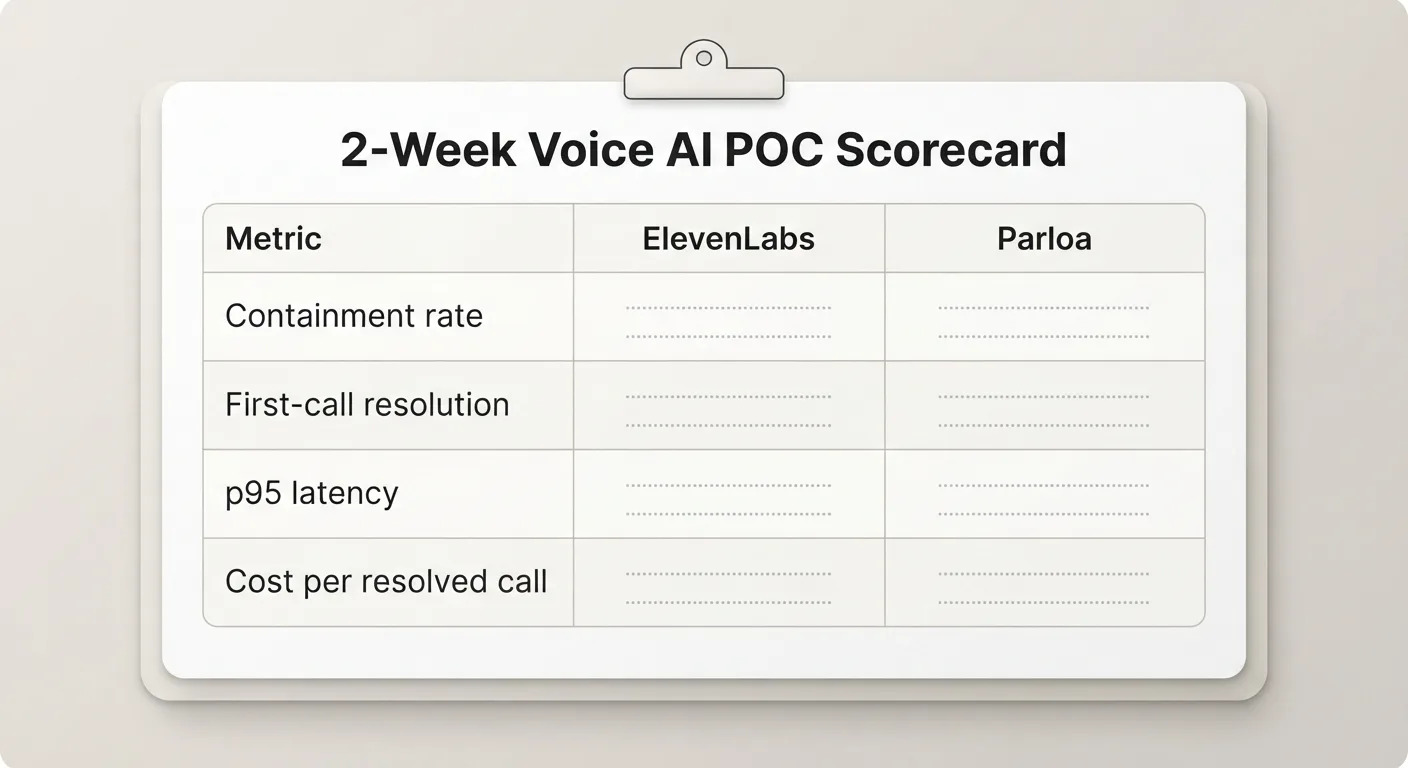
Demos are scripted. A proof of concept on real calls tells you more in two weeks than six sales meetings.
- Pick one call type with clear success criteria, such as order status or appointment rescheduling. Avoid your hardest edge cases in week one.
- Pull 50 real call recordings and write test scripts from them, including interruptions, background noise, accents and callers who change their mind mid-sentence.
- Connect both platforms to the same telephony path. On Genesys, that means the ElevenLabs Audio Connector and Parloa's Genesys connector, so you compare like with like.
- Measure the same four numbers: containment rate, first-call resolution among contained calls, p95 response latency, and cost per resolved call.
- Change something in week two. Update a policy in the knowledge base and time how long it takes to test and ship the change on each platform. This tells you more about month six than anything in week one.
- Ask for written pricing based on your actual call-length mix and peak concurrency.
Parloa alternatives and ElevenLabs alternatives worth a look
If neither vendor fits, the shortlist usually widens in one of two directions. Teams that want a managed, voice-first vendor look at PolyAI or NiCE Cognigy, which NiCE acquired in 2025. We compare the managed approach in ElevenLabs vs PolyAI. Teams that want a developer platform compare ElevenAgents with Vapi, Retell and Bland, which we cover in AI voice agent platforms: ElevenAgents vs Vapi vs Retell vs Bland AI.
How Haass helps
Haass implements ElevenLabs Agents for enterprise support teams. We handle the parts that ElevenLabs leaves to you: telephony and Genesys setup, prompt and guardrail design, CRM tool integrations, evaluation suites and post-launch monitoring. If ElevenLabs looks like the right fit but you don't have the in-house team, that's the gap we fill. See how to choose an ElevenLabs implementation partner for what to look for in any partner.
If you've narrowed the ElevenLabs vs Parloa decision to ElevenLabs, the next step is a scoped proof of concept on one call type. Talk to our ElevenLabs voice AI implementation team and we'll scope it with you.
FAQ
Is ElevenLabs better than Parloa for enterprise contact centers?
It depends on your team. ElevenLabs is better if you have engineers who can own testing and releases and you want the best voice quality, LLM control and published pricing. Parloa is better for large, multi-country contact centers that want lifecycle governance, packaged CCaaS connectors for Five9 or NiCE, and a vendor that manages more of the operation. Run a two-week proof of concept on real calls before deciding.
How much does Parloa cost compared with ElevenLabs Agents?
ElevenLabs Agents costs $0.08 per call minute on paid plans, with LLM and telephony billed separately and Enterprise pricing negotiated. Parloa charges per minute for voice and per interaction for chat but publishes no rate; you get a quote based on volume and use-case complexity. Parloa's terms round each call up to the next minute, so compare billed minutes, not talk time.
Does Parloa use ElevenLabs voices?
In some cases, yes. Parloa's 2026 release notes list ElevenLabs as a subprocessor that customers must accept before enabling EU processing. That means some Parloa deployments already use ElevenLabs technology in the call path. If voice quality drives your decision, ask Parloa which speech providers your region will use and whether you can choose ElevenLabs voices.
Does ElevenLabs integrate with Genesys and other contact centers?
Yes. ElevenLabs Agents has a native Genesys Cloud integration through the Genesys Audio Connector over WebSocket, so no SIP trunk is needed and agents run inside Architect flows. For other contact centers and PBXs, ElevenLabs supports SIP trunking, plus Twilio and Telnyx. Parloa offers more packaged connectors, including Five9 and NiCE.
Is ElevenLabs HIPAA compliant?
Yes. ElevenLabs offers HIPAA-eligible deployments with a Business Associate Agreement on its Enterprise plan, alongside SOC 2 and GDPR compliance. You still need to review the LLM and telephony providers in your call path, since each one handling patient data needs its own coverage. Parloa also supports HIPAA and publishes a template BAA.