TL;DR
- ElevenLabs gives you a voice agent platform. You (or a partner) build the agent, pick the LLM and own every change after launch. Pricing is published, at about $0.08 per call minute plus LLM and telephony.
- PolyAI sells a managed agent. Its team designs, builds and tunes the agent for you. Pricing is quote-only and usually tied to an annual enterprise contract.
- Pick ElevenLabs if you want control, speed and predictable unit costs. Pick PolyAI if you have a large inbound contact centre, a big budget and no appetite to own the build.
- There's a middle path: ElevenLabs plus an implementation partner gives you a managed-style rollout without handing over the keys.
Your board wants 40% of inbound calls automated by next year, and your shortlist has two names on it that look nothing alike. One is a platform your engineers can log into today. The other is a company that wants a discovery call, a statement of work and a contract before anyone hears a demo agent on your own data.
That's the real ElevenLabs vs PolyAI decision. Both can put a natural-sounding AI agent on your phone line. The difference is who builds it, who pays for what, and who controls it once customers start calling. This comparison is written for the product managers, CTOs and AI leads who have to defend that choice, so it skips the feature-list padding and focuses on the trade-offs that show up six months after go-live.
Start with who builds the agent
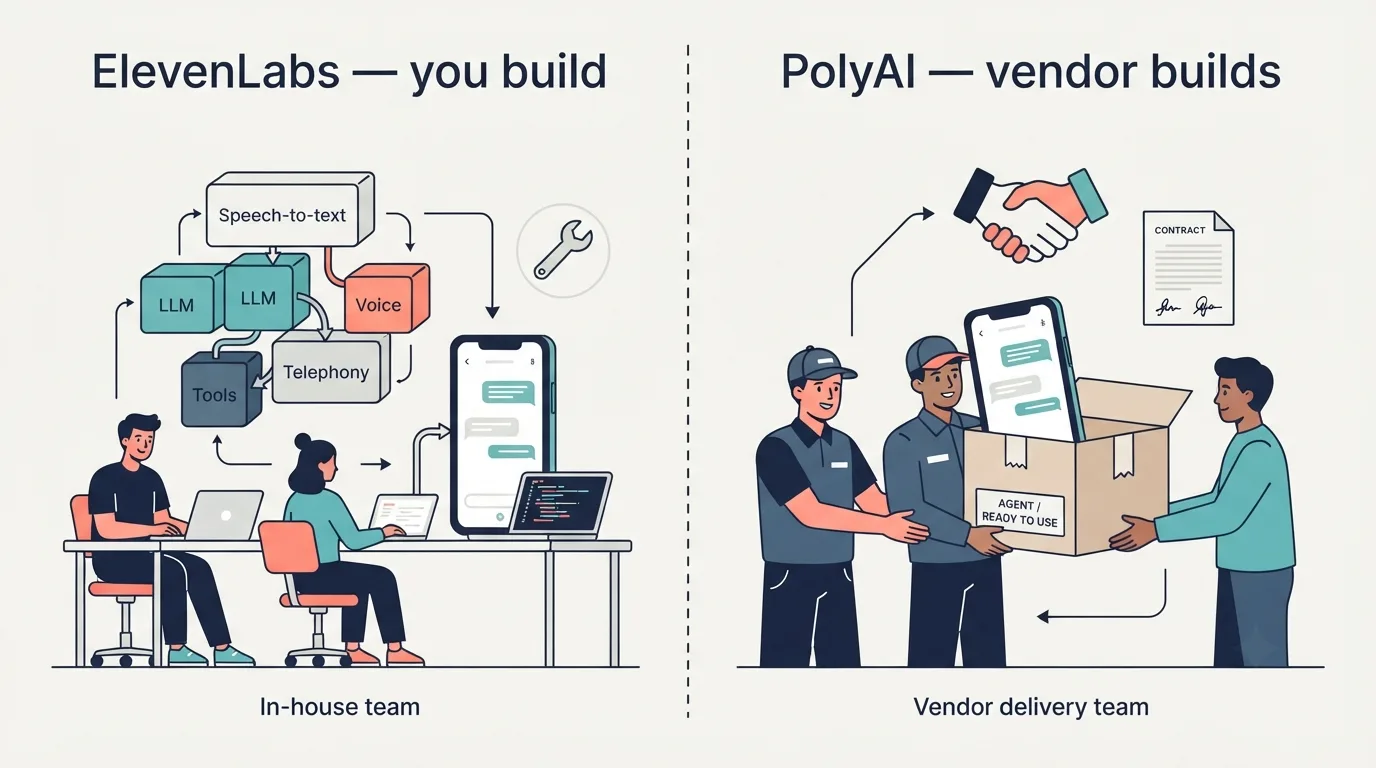
Most comparison pages frame this as "which one sounds better". For a customer-service call, both clear that bar, so the operating model decides it.
ElevenLabs is a platform. Its agent product (ElevenAgents, formerly Conversational AI) gives you the building blocks: speech-to-text, a configurable LLM layer, text-to-speech, a workflow builder, knowledge bases, tools and telephony connectors. Your team, or a partner you hire, designs the conversation, wires up the systems and decides when to ship changes.
PolyAI is a managed service with a platform underneath. PolyAI's own team scopes your call types, builds the agent, connects it to your contact centre and keeps tuning it. You get a finished agent and a vendor relationship. You don't get the same freedom to rebuild a flow on a Tuesday afternoon.
Neither model is better in the abstract. A 2,000-seat insurer with no in-house conversational AI team will find PolyAI's model comforting. A 200-person SaaS company with two ML engineers will find it slow and expensive. Know which one you are before you read any further.
ElevenLabs vs PolyAI at a glance
| Criteria | ElevenLabs | PolyAI |
|---|---|---|
| Build model | Self-serve platform; build in-house or with a partner | Fully managed; PolyAI builds and maintains the agent |
| Pricing | Published plans; about $0.08 per call minute, LLM billed separately | Quote-only; per-minute usage under an enterprise contract |
| Time to first live agent | Days to weeks | 3–8 weeks for typical enterprise deployments, per PolyAI |
| Voice quality | Best-known strength; large voice library and cloning | Natural, call-tuned voices; less choice |
| LLM choice | Pick from several hosted models or bring your own | PolyAI's own Raven model alongside third-party models, chosen by PolyAI |
| Languages | 90+ languages on agents | Multilingual; confirm per-language support in scoping |
| Telephony | SIP trunking plus connectors (Twilio and others); you bring the carrier | Connects to your carrier and major contact-centre platforms |
| Human handoff | Transfer tools you configure | Configured by PolyAI per destination over SIP |
| Changes after launch | Your team edits prompts, flows and tools directly | Usually requested through PolyAI |
| Best fit | Teams that want control and predictable unit costs | Large inbound contact centres buying an outcome, not a tool |
What ElevenLabs is (and isn't)
ElevenLabs started as a text-to-speech company and is still the name most people associate with realistic AI voices. Over the last two years it has built a full agent platform on top of that voice stack. If you want the basics first, our explainer on what ElevenLabs is and how its products fit together covers it.
How the platform works
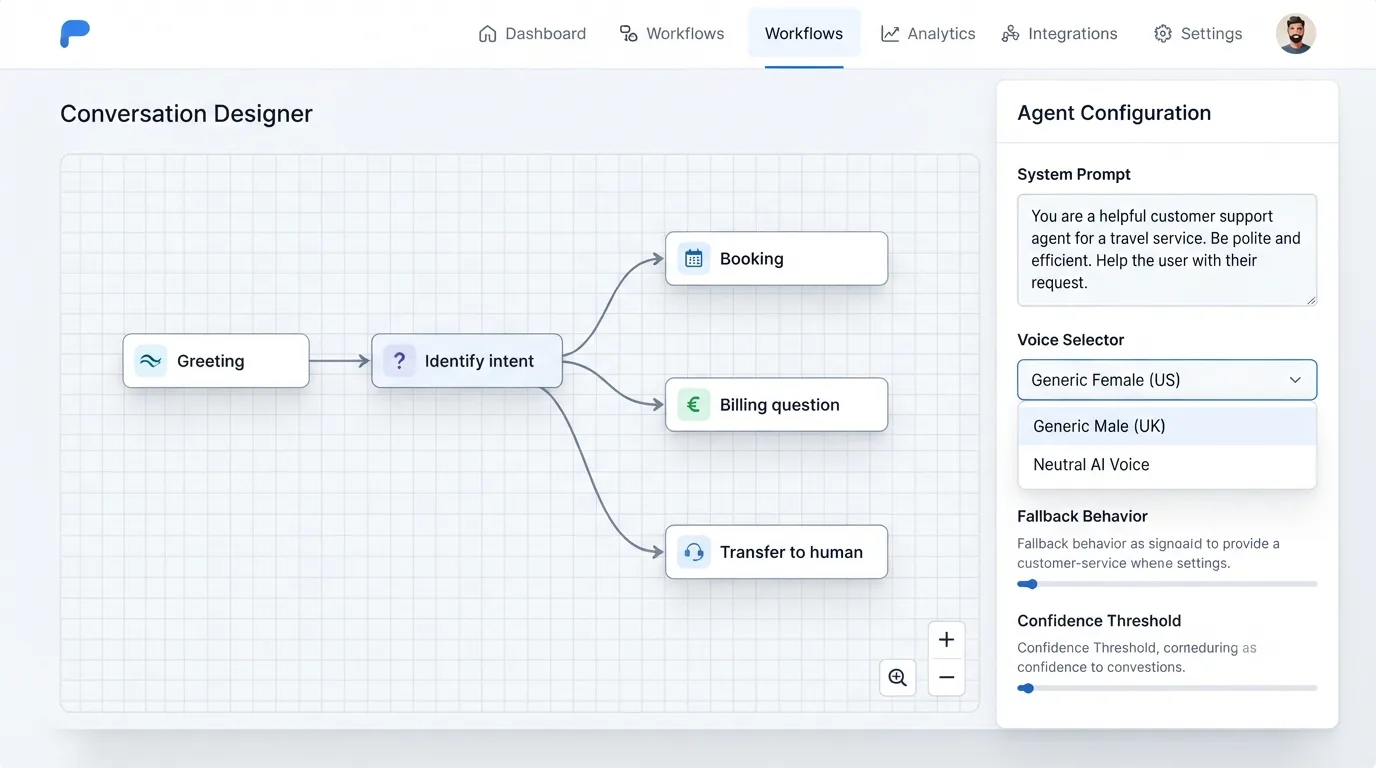
Every call runs through a cascade: the caller's audio is transcribed by ElevenLabs' speech-to-text model, an LLM decides what to say and which tools to call, and the reply is spoken back through ElevenLabs' TTS. You choose the LLM, set the system prompt, attach knowledge bases, and connect tools such as CRM lookups, booking APIs or payment links. The workflow builder lets you split a conversation into nodes with different prompts and transfer rules, so a billing question and a cancellation request don't share one giant prompt.
Telephony comes through SIP trunking or native connectors, which means you keep your existing numbers and carrier. ElevenLabs doesn't sell you a contact centre; it plugs into the one you have.
Where ElevenLabs is strong
Voice is the obvious one. If your brand cares how the agent sounds in the first three seconds, ElevenLabs gives you the widest choice of voices, accents and styles, plus professional voice cloning if you want a consistent brand voice across channels.
Control is the less obvious one, and for most teams it matters more. Your engineers can change a prompt, swap the LLM, add a tool or roll back a version without waiting on a vendor's sprint. That makes iteration cheap, and voice agents need a lot of iteration in their first 90 days.
Pricing is published. You can model your cost before you talk to sales, which procurement teams appreciate. ElevenLabs lists agent minutes on its agents pricing page, with burst pricing above your concurrency limit.
Language coverage is wide. ElevenLabs says its call-centre agents speak 90+ languages, and it has put real investment into Indian languages and accents. More on that in our guide to ElevenLabs for Indian businesses.
Where ElevenLabs is weaker
The platform gives you the parts, not the finished product. Someone still has to design call flows, write guardrails, wire up the CRM, configure transfers and test edge cases like a caller who reads out the wrong account number twice. If you don't have that capability in-house, the "cheap and fast" story falls apart quickly.
The bill also has more than one line. The per-minute rate covers ElevenLabs' speech and transcription, but the LLM is billed on top and your carrier bills telephony separately. None of this is hidden, but it does mean your real cost per minute depends on choices you make.
What PolyAI is (and isn't)
PolyAI is a London-founded company that builds voice assistants for large enterprise contact centres, with a strong presence in hospitality, banking, insurance and utilities. Its pitch is resolution: agents that handle the whole call without escalating, at enterprise volume.
The managed model
PolyAI runs the project for you. A typical engagement starts with scoping your top call types, then PolyAI's team builds the agent in its Agent Studio, connects it to your telephony and back-office systems, and keeps improving it after launch. Under the hood, PolyAI uses its own Raven model alongside third-party LLMs, and it decides how those are combined.
For a large enterprise, this is the appeal. You're buying an outcome from a team that has done this many times, with one throat to choke if containment rates drop.
Where PolyAI is strong
Enterprise contact-centre experience is the big one. PolyAI has spent years on the messy parts of phone calls: noisy lines, callers who change their mind mid-sentence, alphanumeric data capture, and complex transfers into Genesys, Five9 or Salesforce queues. Its agents are designed around containment, so the whole build is tuned to resolve calls rather than just answer them.
It also takes a lot off your plate. Your team doesn't need conversation designers or voice-agent engineers on staff. For procurement, PolyAI lists ISO 27001 certification on its security page and states SOC 2 Type II compliance in its documentation.
Where PolyAI is weaker
Pricing isn't public. You'll get a quote after scoping, usually as per-minute usage under an annual contract, and it's hard to benchmark without running a full sales process. Ask how handle time is billed. Some enterprise voice contracts round each call up to a fixed increment, and on short calls that rounding can add a noticeable share to the bill.
Control is the other trade-off. Because PolyAI builds and maintains the agent, changes go through its team. That works for stable, high-volume call types. It frustrates product teams who want to test a new flow this week. And the engagement size puts PolyAI out of reach for most mid-market companies.
Head-to-head on the criteria that matter
Voice quality and naturalness
ElevenLabs wins on choice and expressiveness. You get thousands of voices, fine control over stability and style, and cloning for a branded voice. PolyAI's voices are tuned for phone audio and sound natural on a call, but you have far less room to shape them. For a hotel booking line, both are fine. For a consumer brand where the voice is part of the product, ElevenLabs has the edge. Our post on choosing the right voice for an ElevenLabs agent covers how to pick one.
Latency and turn-taking
Both platforms are built for real-time calls, and both will feel sluggish if the LLM is slow or the tool calls are heavy. On ElevenLabs you control the levers: model choice, prompt length, tool design and TTS model. That's good news when you have the skills, because you can tune it yourself. We wrote up the specifics in how to reduce ElevenLabs agent latency. On PolyAI, latency tuning is part of the managed service, which is less work for you but less visible.
Conversation design and control after launch
Teams tend to skip this one when scoring vendors. A voice agent is never finished. Call reasons shift, policies change, and you'll find failure patterns in week three that nobody predicted. With ElevenLabs, your team reviews transcripts, edits the prompt or workflow, tests it and ships. With PolyAI, you raise the change and PolyAI's team ships it. If your call mix is stable, that's acceptable. If you're a product-led company that iterates weekly, it will feel like a bottleneck.
Integrations and human handoff
PolyAI comes with years of enterprise contact-centre integration work, including warm transfers into the major CCaaS platforms. Its team configures each handoff destination for you over SIP, passing context in headers or through APIs.
ElevenLabs gives you the tools to do the same: SIP trunking, transfer-to-number and transfer-to-agent tools, webhooks and server-side tools for CRM actions. The capability is there, but the configuration is yours. Both can integrate. Ask who does the integration work and how long it will take.
Multilingual support
ElevenLabs covers more languages and gives you more accent options within them, including regional Indian voices and Hindi–English code-switching support. That matters if you serve markets where callers mix languages mid-sentence. PolyAI supports multiple languages and has deep enterprise experience in its core markets. If you need a less common language, ask for a live demo in that language on your scripts, not a slide.
Security, compliance and data residency
Both vendors sell to regulated industries. ElevenLabs offers HIPAA support with a BAA, a zero-retention mode for sensitive data and data residency options, including an India data residency programme. PolyAI also has a long track record of passing enterprise security reviews. For either one, ask three questions: where LLM inference runs, which sub-processors touch call audio, and what retention defaults apply. If you let ElevenLabs route to a third-party LLM, that provider joins your security review too.
ElevenLabs vs PolyAI pricing: a realistic monthly cost model
List prices don't help much on their own, so here's a worked example for a contact centre handling 50,000 AI-handled minutes a month (roughly 16,000 calls at about three minutes each).
| Cost line | ElevenLabs | PolyAI |
|---|---|---|
| Platform / plan fee | Published plan fee (Business tier or Enterprise) | Included in the per-minute contract rate |
| Voice agent minutes | 50,000 × ~$0.08 ≈ $4,000 | Per-minute rate quoted by sales; covers maintenance, improvements and 24/7 support |
| LLM usage | Varies by model; a fast model like Gemini 2.5 Flash adds well under $0.01/min (about $150 at this volume) | Bundled into the PolyAI rate |
| Telephony | Billed by your carrier | Your carrier or PolyAI's, per contract |
| Build and integration | In-house engineering time or a partner's fixed fee | Included in the contract or charged as professional services |
| Ongoing tuning | Your team or a partner retainer | Included |
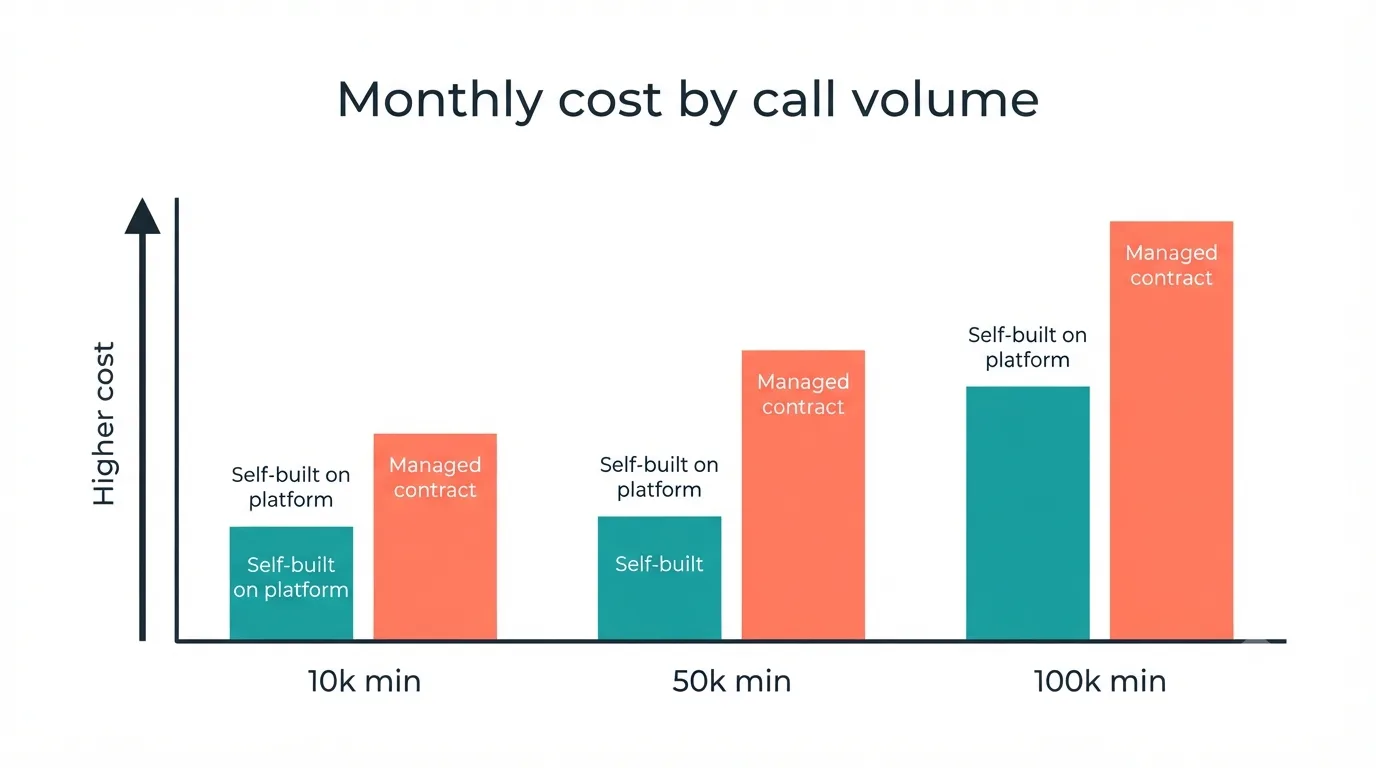
Read the table this way. ElevenLabs' usage costs are low and transparent, so the variable that decides your total is build and maintenance effort. PolyAI's costs are bundled, which makes them easier to budget once signed but hard to compare up front. Push PolyAI for a per-minute rate, a minimum commitment and the billing increment, then compare them like-for-like with your ElevenLabs model.
If you're building the business case against human agents, our AI call centre cost comparison breaks down the agent-side numbers.
Deployment timeline: closer than you'd think
An ElevenLabs agent for one well-scoped call type, such as appointment booking or order status, can be live in two to six weeks with an experienced team. Week one is scoping and prompt design, weeks two and three cover tool integration and telephony, and the rest is testing on real calls with a small share of traffic.
PolyAI says its typical enterprise deployments go live in 3–8 weeks, with some launching in two. The two differ more after launch. PolyAI's clock starts once the contract is signed, and every new call type or flow change goes through its team. On ElevenLabs, your team (or your partner) can ship the next change the same week.
Who should choose ElevenLabs, and who should choose PolyAI
Choose ElevenLabs if:
- You have (or will hire, or will partner for) people who can design and maintain voice agents.
- You want to iterate weekly and own the roadmap.
- Voice quality, brand voice or language breadth is a selling point.
- You need predictable unit costs and want to model them before talking to sales.
- You're mid-market, or an enterprise piloting voice AI before a larger commitment.
Choose PolyAI if:
- You run a large inbound contact centre with stable, high-volume call types.
- You have no internal conversational AI team and don't want one.
- You'd rather buy a containment outcome than a platform.
- You have the budget and timeline for an enterprise engagement.
If you're still weighing whether voice AI fits your support operation at all, start with our guide to voice AI for customer support.
The middle path: ElevenLabs with an implementation partner
What most teams want from a managed service is protection from a slow, messy first build. An implementation partner gives you that on ElevenLabs while you keep ownership of the agent, the data and the roadmap.
At Haass, we design, build and launch ElevenLabs agents for enterprise support teams: call-flow design, guardrails, CRM and telephony integration, human handoff, testing and post-launch tuning. You get managed-style delivery with platform-level pricing and no lock-in. A pilot on one call type typically goes live in a few weeks, tuned on real calls before wider rollout. For a leading US insurance provider, we cut voice bot latency by 75% in four weeks and tripled the call volume it handles with no added headcount. You can see how we approach it in our ElevenAgents implementation guide and our page on what to expect from an ElevenLabs implementation partner.
How to run a fair proof of concept on both
Don't decide from demos. Run both vendors against the same test:
- Pick your top two call types by volume and write 30 real scenarios for each, including awkward ones.
- Use your own knowledge base and at least one live system lookup.
- Test on real phone lines, not a browser widget, including noisy and mobile calls.
- Measure containment, average handle time, transfer quality and caller-reported satisfaction.
- Time how long a mid-test change takes, such as a new policy or a new intent.
- Get a written cost per minute for your projected volume, including LLM, telephony and billing increments.
Step five usually settles it. How long a change takes during the test is roughly how long it will take for the life of the contract.
Other alternatives worth a look
If neither option fits, a few others come up in most enterprise voice AI shortlists. Retell AI and Vapi are developer-first platforms with posted per-minute rates. Bland focuses on high-volume phone automation, and Cognigy suits enterprises with a platform team running their own contact-centre stack. We've compared several of them directly: ElevenLabs vs Retell AI, ElevenLabs vs Vapi, ElevenLabs vs Bland AI, and a four-way ElevenAgents vs Vapi vs Retell vs Bland comparison.
FAQ
Is PolyAI better than ElevenLabs for customer service?
PolyAI is better for large enterprises that want a vendor to build and run a high-containment phone agent for them. ElevenLabs is better for teams that want control over the agent, faster iteration and published pricing. Both can handle customer-service calls well. The deciding factor is whether you want to own the build or buy a managed outcome, not voice quality.
How much does PolyAI cost compared to ElevenLabs?
PolyAI doesn't publish pricing. You get a custom quote, usually per-minute usage under an annual enterprise contract. ElevenLabs publishes its pricing: agent calls cost about $0.08 per minute, with LLM usage and telephony billed separately. For a fair comparison, ask PolyAI for a per-minute rate, its minimum commitment and its billing increment, then model both at your actual call volume.
Can ElevenLabs replace PolyAI in an enterprise call centre?
Yes, if someone owns the build. ElevenLabs supports SIP trunking, warm transfers, tool calls into CRMs and enterprise security controls, so the platform can handle enterprise call volumes. What it doesn't include is PolyAI's done-for-you delivery. Enterprises usually close that gap with an in-house conversational AI team or an implementation partner that designs, integrates and tunes the agent.
Which is faster to deploy, ElevenLabs or PolyAI?
Both can launch a first agent in weeks. A focused ElevenLabs agent for one call type can go live in two to six weeks, and PolyAI says typical enterprise deployments go live in 3–8 weeks. The bigger difference comes after launch: on ElevenLabs your team ships changes directly, while on PolyAI new flows and call types go through PolyAI's team.
What are the best PolyAI alternatives?
The best PolyAI alternatives depend on how much you want to build yourself. ElevenLabs is the strongest choice for voice quality and control. Retell AI and Vapi suit developer teams that want posted rates and flexible stacks. Cognigy and Parloa fit enterprises that want to stay on their current contact-centre platform. Bland focuses on high-volume, phone-first automation.
Verdict
The ElevenLabs vs PolyAI choice comes down to whether you want to own your voice agent or rent a finished one. PolyAI is a solid pick for large contact centres that want a vendor to carry the whole build. For everyone else, and for any team that expects to iterate, ElevenLabs gives you better voices, transparent pricing and full control.
The usual risk with ElevenLabs is the first build, and that's the part we handle. If you want an ElevenLabs agent running on your phone lines without hiring a voice AI team first, talk to Haass about ElevenLabs voice AI implementation.