TL;DR
- Buying model: ElevenLabs is a monthly plan you can start today for $0 to $990, plus $0.08 per extra minute. Synthflow is now sold only as an annual enterprise contract, with no free plan, trial or per-minute rate.
- Voice: ElevenLabs makes the voices. Synthflow agents can run those same voices, so voice quality alone shouldn't decide this.
- ElevenLabs fits developers, product teams, small businesses and anyone who wants to test before committing, especially in India.
- Synthflow fits contact centres on Five9 or Zoom that want vendor engineers to handle the launch, and BPOs that need white-label workspaces.
You've heard both demos, and both sound good. Then you open the pricing pages: ElevenLabs shows six plans and a per-minute rate, while Synthflow shows a "Contact Sales" button. In ElevenLabs vs Synthflow, the bigger decision is how you want to buy, build and run your phone agent. Pick wrong and you either sign a year-long contract you didn't need, or end up building integrations your team has no time for.
We implement ElevenLabs agents for clients, so we have a side in this. We've tried to be straight about where Synthflow is the better choice. Every price and spec below was checked against each vendor's own pages on 17 November 2026.
The short answer
Choose ElevenLabs if you want to start this week, have at least one developer (or a partner), care about voice and language coverage, or need to keep spend low while you prove the use case.
Choose Synthflow if you run a large phone operation on Five9, Zoom Phone or a similar contact-centre stack, want vendor engineers to do the integration, and your procurement team prefers one annual number.
If you're a small business looking for an AI receptionist, Synthflow's enterprise-only sales model mostly rules it out today.
What each platform actually is
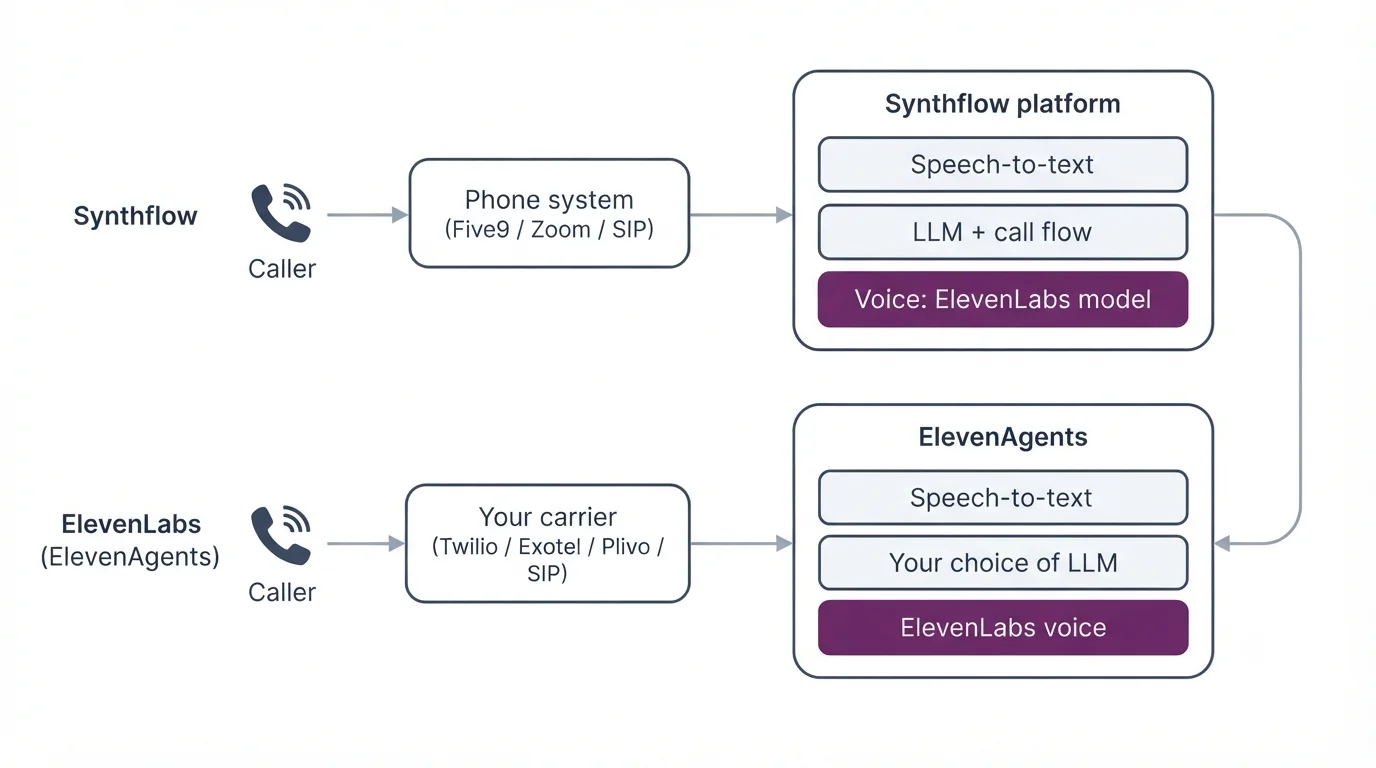
ElevenLabs is a voice AI company. It builds its own text-to-speech and speech-to-text models, and its agent product, ElevenAgents, runs voice and chat agents across phone, web, mobile apps, WhatsApp, SMS and email. You build agents in a visual workflow builder or through APIs and SDKs, and you choose the language model behind them, including your own.
Synthflow is an AI agent platform for phone operations. It runs its own telephony, integrates with contact-centre systems, and positions itself at upper mid-market and enterprise teams. You design calls in its Flow Designer, and where your contract includes it, Synthflow's forward-deployed engineers build and launch the agents with you.
The overlap: Synthflow can use ElevenLabs voices
According to Synthflow's ElevenLabs documentation, Synthflow agents speak with ElevenLabs Flash by default, and you can pick other ElevenLabs models or connect your own ElevenLabs API key to use your custom and cloned voices. Synthflow also has its own TTS engine with around 200 voices.
So if what sold you was an ElevenLabs voice, you can get it on either platform. The real decision is about everything around the voice: pricing, who builds the agent, telephony, limits and compliance.
ElevenLabs vs Synthflow at a glance
| ElevenLabs (ElevenAgents) | Synthflow | |
|---|---|---|
| How you buy | Self-serve monthly plans; Enterprise through sales | Annual enterprise agreement only |
| Free plan or trial | Free plan with 15 call minutes | None |
| Published price | $0 to $990/month, then $0.08/min | Not published; scoped per deal |
| LLM and telephony | Billed separately (LLM via credits, carrier at cost) | Scoped into the contract |
| Voices | 17,000+ voices, 90+ languages, cloning and Voice Design | ~200 Synthflow TTS voices plus ElevenLabs models |
| Build approach | Visual builder, APIs, SDKs (web, iOS, Android, React Native, Unity) | Flow Designer and APIs, with vendor engineers where contracted |
| Telephony | Bring your own: Twilio, Vonage, Telnyx, Plivo, RingCentral, Exotel, Ozonetel or SIP | Native telephony; tested on Zoom Phone, Zoom Contact Center, Five9, RingCentral RingCX, Twilio, Telnyx, Vonage, 8x8; SIP |
| Concurrency | 4 to 40 calls by plan; burst up to 3x | Planned in the contract |
| Compliance | SOC 2 Type 2, ISO 27001, ISO 42001, PCI DSS, GDPR; HIPAA BAA on Enterprise | SOC 2 Type 2, ISO 27001, PCI DSS, GDPR; HIPAA self-attested |
| Data residency | US, EU and India (Enterprise) | US and EU hosting |
| Time to first agent | Hours for a basic agent | Weeks, per Synthflow |
| White-label | Not a core feature | Yes, inside the enterprise agreement |
ElevenLabs vs Synthflow pricing
The two vendors price so differently that a worked example is the only fair way to compare them.
ElevenLabs Agents plans
ElevenLabs' agent pricing page lists these monthly plans:
| Plan | Price/month | Included minutes | Concurrent calls |
|---|---|---|---|
| Free | $0 | 15 | 4 |
| Starter | $6 | 75 | 6 |
| Creator | $22 | 275 | 10 |
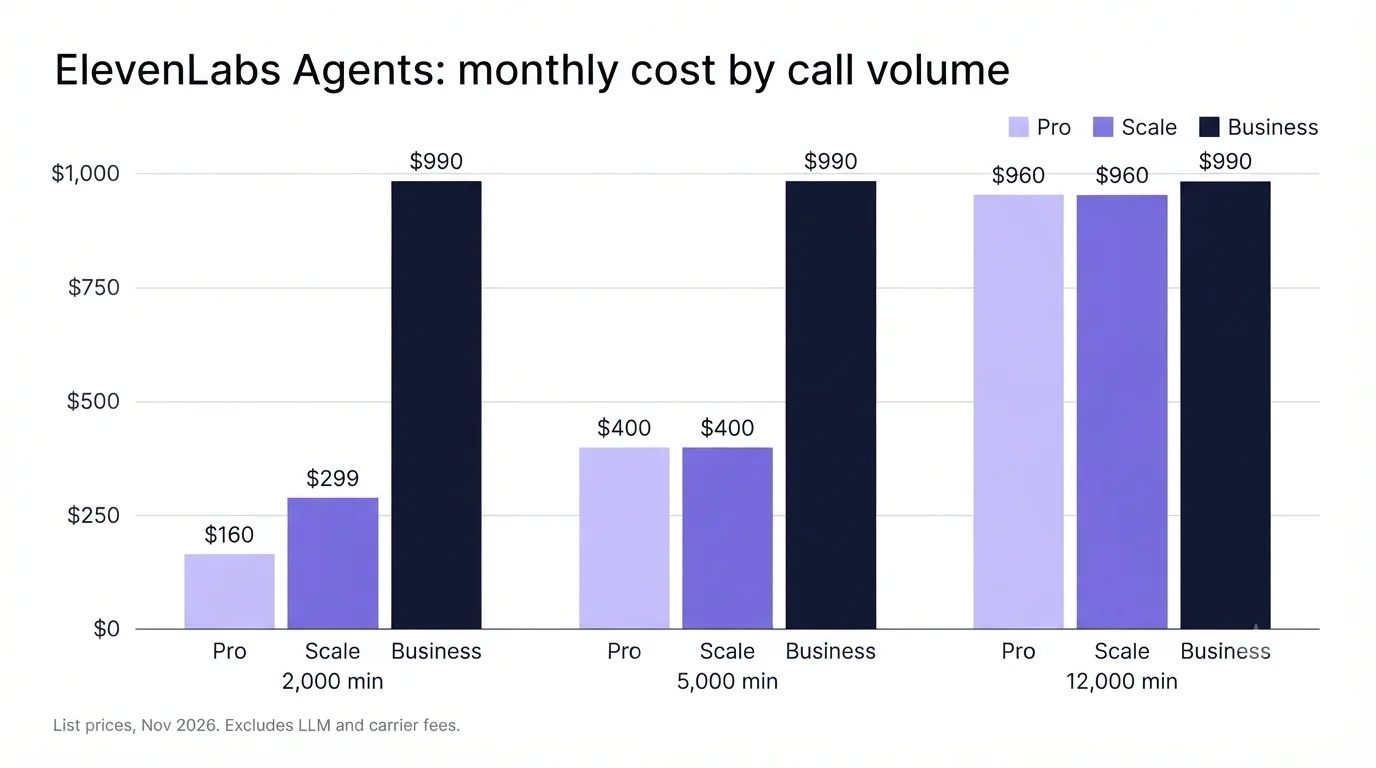
| Pro | $99 | 1,238 | 20 |
| Scale | $299 | 3,738 | 30 |
| Business | $990 | 12,375 | 40 |
| Enterprise | Custom | Custom | Higher limits |
Every plan bills extra minutes at $0.08, text messages at $0.003, and calls above your concurrency limit at $0.16 when burst pricing is on. The language model is charged on top based on the model you pick, and your phone carrier bills you directly. ElevenLabs adds no telephony fee of its own.
Synthflow's move to annual contracts
Synthflow's pricing page now says plainly that it has no free plan, no trial and no per-minute rate. Every new deployment starts on an annual enterprise agreement scoped to call volume, phone system, integrations, security needs and launch support. CRM integrations, transcription, voices and SMS are included in the deal.
If you're reading an older comparison that lists Synthflow plans at $29, $450 or $900 a month, those plans are gone for new customers. That changes the answer for anyone searching for the cheapest AI voice agent platform: Synthflow can't be the cheapest option to start with, because you can't start without a sales cycle.
Worked example: 5,000 minutes a month on ElevenLabs
Say you run an inbound appointment line taking about 5,000 minutes of calls a month.
- Pro plan: $99 + (5,000 − 1,238) × $0.08 = $399.96
- Scale plan: $299 + (5,000 − 3,738) × $0.08 = $399.96
- LLM: with Gemini 2.5 Flash at the $0.0029/min ElevenLabs lists in its calculator, about $14.50
- Telephony: on a US local number through Twilio, inbound calls cost $0.0085/min plus $1.15/month for the number, per Twilio's US voice pricing, so about $43.65
Pro and Scale cost the same at this volume. The difference is concurrency (20 vs 30 calls at once) and workspace seats, so pick the plan that covers your busiest hour. All in, you're looking at roughly $458 a month, or about $0.092 per minute. Carrier rates vary by country and number type, so swap in your own provider's price.
For Synthflow you can't run the same sum, because there's no public rate. Ask sales to price the same 5,000 minutes, and ask what concurrency, integrations and launch support that number includes.
Costs neither pricing page shows you
On ElevenLabs, the work you pay for is engineering: connecting your CRM, setting up the carrier, writing prompts and guardrails, testing, and reviewing calls after launch. On Synthflow, much of that is folded into the contract, and you pay for it whether or not you need it. Our AI call centre cost comparison breaks down where the money goes in a real deployment.
Voice quality and latency
ElevenLabs has the edge on voice, since it trains the models. ElevenAgents gives you more than 17,000 voices in 90+ languages, Instant Voice Cloning from one to five minutes of audio, Professional Voice Cloning from 30 minutes or more, and Voice Design, which creates a voice from a text description.
Synthflow narrows that gap by running ElevenLabs models. You still choose from a smaller menu, and features like Voice Design and cloning happen on the ElevenLabs side.
On latency, ElevenLabs publishes numbers for its own models: Eleven v4 Turbo has a median inference latency of about 100 ms, and Eleven Realtime v1 Max reaches first audio in 570 ms on Artificial Analysis' benchmark. Synthflow doesn't publish a single figure, because its response time depends on the speech, LLM and voice providers each agent uses.
Lab numbers won't match what callers hear. Most phone calls reach the agent as 8 kHz audio, while browser demos run at 16 kHz, so an agent that sounds perfect on your laptop can mishear callers on a real line. Test on a phone number before you sign anything. If you go with ElevenLabs, our guides on cutting ElevenLabs agent latency below one second and choosing between ElevenLabs v4, v3 and Flash cover the settings that matter.
Building the agent: developer control vs no-code
ElevenLabs: built for teams that build
ElevenLabs is the stronger choice for AI voice agents for developers. You get a visual workflow builder for the basics, plus APIs and SDKs for React, iOS, Android, React Native and Unity, an OpenAI-compatible Realtime API, and the freedom to bring your own LLM. The same agent can live in your app, on your website and on a phone line.
The trade-off is ownership. Your team (or your partner) owns every integration, every test and every prompt change. ElevenLabs offers forward-deployed engineers too, but only on Enterprise, and it says complex enterprise deployments typically take two to three months to reach production.
Synthflow: built for teams that don't want to build
Synthflow started as a no-code AI voice agent builder, and the Flow Designer still reflects that. You map the call, attach approved knowledge sources and run simulated calls in its Test Center before going live. On larger deals, Synthflow's engineers map the calls, connect your systems and launch with your team. Synthflow says deployments go live in weeks, and cites Batteries Plus reaching a pilot five weeks after kick-off.
Once your requirements step outside what the flow tool anticipated, workarounds get messy.
Our ElevenAgents implementation guide walks through the phases of a typical build if you want to see what owning it involves.
Telephony and integrations
Synthflow runs its own telephony and has tested integrations with Zoom Phone, Zoom Contact Center, Five9, RingCentral RingCX, Twilio, Telnyx, Vonage and 8x8, plus setup guides for several other platforms and SIP for everything else. If your contact centre already runs on Five9 or Zoom, that's a real advantage, since the agent plugs into what you have.
ElevenLabs uses your carrier instead: Twilio, Vonage, Telnyx, Plivo, RingCentral, Exotel, Ozonetel or a SIP trunk, with Genesys and Amazon Connect integrations. That's more setup work, but you keep your numbers and your carrier pricing.
For Indian businesses, ElevenLabs is the clear pick here. Exotel, Ozonetel and Plivo are the providers most Indian teams already use, and ElevenLabs offers India data residency on Enterprise. Synthflow lists US and EU hosting only. ElevenLabs doesn't issue Indian phone numbers itself, so you still need a carrier with DLT registration. Our guide to ElevenLabs for Indian businesses covers voices, languages and telephony in detail.
Concurrency, burst pricing and outbound calling
If you're buying outbound AI calling software, call limits matter as much as the per-minute price.
ElevenLabs ties concurrency to your plan, from 4 calls at once on Free to 40 on Business. With burst pricing switched on, an agent can handle up to three times its limit, and the extra calls cost $0.16 a minute. You can also turn on call queueing, which holds callers instead of rejecting them and doesn't bill the waiting time.
Synthflow plans concurrency inside the contract. Per Synthflow's concurrency docs, calls over the limit either get an HTTP 429 error or a short queue, depending on your setup. Synthflow also caps how many outbound calls an account can start per second, and transfers count against that cap, so a busy campaign can hit it before it hits concurrency.
For outbound campaigns, ask both vendors what happens at 9:05 on a Monday when every call starts at once. Our AI outbound calling guide covers compliance and setup for these campaigns.
Security, compliance and data residency
Both publish trust centres and list SOC 2 Type 2, ISO 27001, PCI DSS and GDPR.
ElevenLabs' compliance portal also lists ISO 42001 and FedRAMP 20x Class A, and its agents are HIPAA-eligible: ElevenLabs signs a Business Associate Agreement with eligible Enterprise customers who use Zero Retention Mode. Synthflow's Trust Center lists HIPAA as self-attested, with ISO 42001, DORA and the EU AI Act in progress.
If you're in healthcare or finance, request the actual reports from both and have your security team check them against your requirements. Data residency matters too: ElevenLabs offers US, EU and India on Enterprise, and Synthflow offers US and EU.
Agencies and white-label
If you're looking for the best white-label AI voice agent for agencies, Synthflow lets BPOs and software platforms run it under their own brand and domain, with a workspace per client and one analytics dashboard across them. Clients never see Synthflow's name.
The catch is that white-label lives inside the annual enterprise agreement. A small agency that wants to resell voice agents to five local clients would need to commit to a contract before it has any revenue to cover it.
ElevenLabs has no white-label product of the same kind. Agencies on ElevenLabs typically build agents in their own or their client's workspace and own the client relationship directly.
Pros and cons
ElevenLabs
Pros:
- Self-serve plans from $0, cancel any time
- Best-in-class voices, cloning and 90+ languages
- Full API and SDK access, with your choice of LLM
- Wide carrier choice, including Indian providers
- HIPAA BAA and India data residency on Enterprise
Cons:
- LLM and carrier bills sit outside the plan price
- Your team owns integrations and testing
- More than 40 concurrent calls requires Enterprise
- No white-label reseller product
Synthflow
Pros:
- Tested integrations with Five9, Zoom and other contact-centre systems
- Vendor engineers can handle the launch
- One annual budget number for procurement
- White-label workspaces for agencies and BPOs
- Can use ElevenLabs voices
Cons:
- No free plan, trial or published pricing
- Sales cycle before your first call
- HIPAA is self-attested
- No India data residency
Who should choose which
Go with ElevenLabs if:
- You're a startup or small business that wants an AI receptionist live this month
- You have developers, or a partner, and want control over the stack
- You need the agent in an app or website as well as on the phone
- You operate in India or need Indian carriers and data residency
- You want to prove the use case on real calls before committing budget
Go with Synthflow if:
- You run a contact centre on Five9, Zoom or RingCentral and want the agent inside it
- You don't want to hire or contract voice AI engineers
- You're a BPO or platform reselling agents under your own brand
- Procurement wants one contract for the year
ElevenLabs is the wrong pick if nobody on your side can own the integration and you don't want to bring in a partner. In that case, Synthflow's managed launch is worth the contract.
Comparing more than two platforms? See our breakdown of ElevenAgents vs Vapi vs Retell vs Bland AI, or the head-to-heads on ElevenLabs vs Vapi, ElevenLabs vs Retell AI and ElevenLabs vs Bland AI. Our list of the best voice AI agents in 2026 covers the wider market.
Verdict
For most teams comparing ElevenLabs vs Synthflow in 2026, ElevenLabs is the better starting point. You can test it on real calls for a few dollars, you get the best voices directly from the source, and you aren't locked into a year before you know the agent works. Synthflow earns its contract when you're a large phone operation already running on Five9 or Zoom, or a BPO that needs white-label, and you'd rather pay for launch engineers than build that capability yourself.
How Haass helps you deploy ElevenLabs
The biggest reason teams pick Synthflow over ElevenLabs is that they don't want to own the build. Haass designs and implements ElevenLabs agents end to end: prompts and guardrails, carrier and CRM integration (including Exotel, Ozonetel and Plivo in India), testing on real phone lines, and monitoring after launch. You keep ElevenLabs' monthly pricing and get a managed launch.
See our ElevenLabs voice AI implementation service, or read how to choose an ElevenLabs implementation partner before you talk to anyone, including us.
FAQ
Is ElevenLabs cheaper than Synthflow?
Yes, ElevenLabs is cheaper to start, because it has a free plan and monthly plans from $6, while Synthflow is sold only as an annual enterprise agreement. At 5,000 minutes a month, ElevenLabs costs about $400 plus LLM and carrier fees. Synthflow doesn't publish rates, so get a quote for the same volume, including concurrency and launch support, before comparing totals.
Does Synthflow use ElevenLabs voices?
Yes. Synthflow agents use ElevenLabs Flash by default, and you can choose other ElevenLabs models such as v4 and v4 Turbo. If you connect your own ElevenLabs API key, your custom and cloned voices appear in Synthflow's voice selector. Synthflow also offers its own TTS engine with around 200 voices. Check that the model you pick is enabled on your ElevenLabs plan.
Can I try Synthflow for free?
No. Synthflow has no free plan, trial or per-minute rate. You book a demo, agree a scope with sales, and sign an annual agreement covering call volume, telephony, integrations, security and launch support. ElevenLabs, by contrast, offers a free plan with 15 call minutes and four concurrent calls, so you can test an agent on a real phone line before paying anything.
Which is better for agencies and white-label?
Synthflow is better for white-label. Its enterprise agreement lets agencies and BPOs run the platform under their own brand and domain, with a workspace per client and one analytics dashboard. The trade-off is committing to an annual contract up front. ElevenLabs has no equivalent reseller product, so agencies on ElevenLabs usually build in client workspaces and own the relationship directly.
Is ElevenLabs or Synthflow HIPAA compliant?
ElevenLabs agents are HIPAA-eligible: ElevenLabs signs a Business Associate Agreement with eligible Enterprise customers who turn on Zero Retention Mode. Synthflow's Trust Center lists HIPAA as self-attested, and Synthflow signs a BAA with customers using its HIPAA setting. If you handle patient data, request the compliance reports from both vendors and have your security team review them before signing.