TL;DR
- ElevenLabs (ElevenAgents) is a voice-AI company with a full agent platform. You build the agent, choose the LLM and connect your own phone carrier. Pricing is public and starts at $0.
- Thoughtly is an inbound lead-conversion platform for sales and RevOps teams. It packages voice, SMS, email, CRM write-back and booking into one workflow. Pricing is quote-only.
- Pick ElevenLabs for customer support, multilingual or India-based deployments, product-embedded voice, or when you want control over the stack. Pick Thoughtly when the job is calling opted-in leads fast and you have no engineers.
- They aren't fully rivals. Thoughtly's stock voices partly come from ElevenLabs, and its higher plans let you plug in your own ElevenLabs key.
You've shortlisted two voice AI platforms, and every comparison you find was written by one of the vendors or by a company selling a third option. That makes the ElevenLabs vs Thoughtly decision harder than it should be, because the two products overlap less than their marketing suggests.
We implement ElevenLabs agents for clients, so read this with that in mind. We've tried to keep it fair: every price and feature below was checked against each vendor's own pricing page and documentation on 18 November 2026, and where the vendors contradict themselves, we say so.
ElevenLabs vs Thoughtly at a glance
| ElevenLabs (ElevenAgents) | Thoughtly | |
|---|---|---|
| What you're buying | Voice models plus a platform to build agents | A packaged inbound lead-conversion system |
| Typical owner | Developers, product teams, CX/ops with technical help | RevOps, sales ops, growth teams |
| Channels | Phone, web, mobile, WhatsApp, SMS, email, chat | Voice, SMS/iMessage, email, WhatsApp |
| Languages | 70+ (marketing claim) | 34+ |
| LLM choice | Dozens of models from OpenAI, Anthropic, Google and others, or your own | GPT, Claude, Gemini; custom model on Enterprise only |
| Entry price | Free; paid plans from $6/month | Quote-based ("Talk to sales") |
| Concurrency | 4 to 40 calls by plan, more on Enterprise | 10 on Flex, 100+ on Scale |
| Telephony | Bring your carrier (Twilio, SIP); no ElevenLabs phone fee | Bring your carrier (Twilio, Telnyx) |
| HIPAA BAA | Enterprise | Enterprise |
| Best fit | Support, multilingual, India, custom builds | Converting inbound leads in sales teams |
What each platform is
ElevenLabs (ElevenAgents)
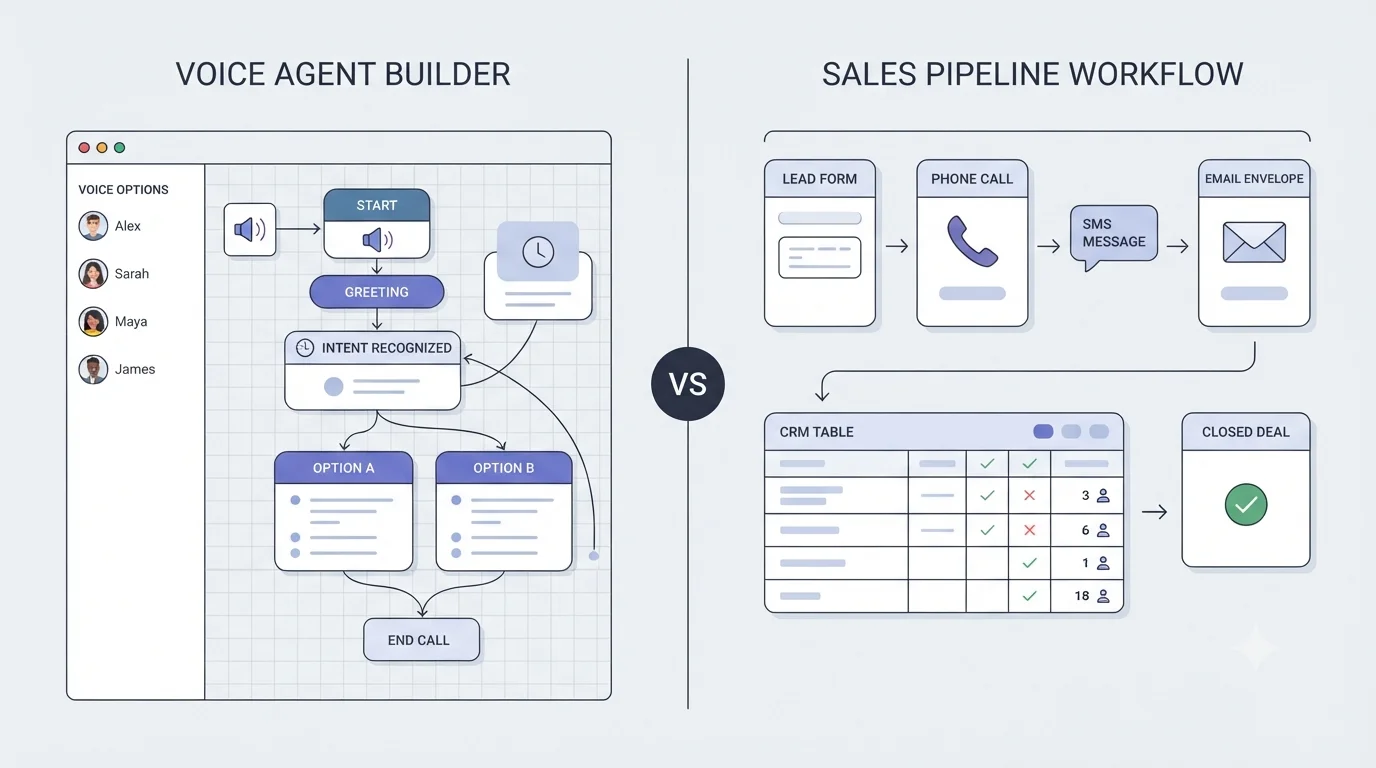
ElevenLabs started as a text-to-speech company and still makes the voice and speech-to-text models it runs on. ElevenAgents sits on top: a visual workflow builder, a knowledge base with RAG, tool calling, testing and analytics, and APIs and SDKs for teams that want to build in code. The ElevenAgents documentation covers deployment over phone, web widget and mobile.
It is a general-purpose platform. You can build a support agent, a booking agent, an outbound reminder campaign or a voice feature inside your own app. Nothing about it assumes you're a sales team, which is both its strength and the reason you'll do more setup yourself. If you're new to the platform, our overview of what ElevenLabs is covers the wider product.
Thoughtly
Thoughtly is built for one job: calling inbound leads quickly, qualifying them, booking or warm-transferring the next step, and writing the result back to your CRM. Its pricing page describes every plan as voice plus SMS plus email plus workflows, with two-way sync to HubSpot, Salesforce and Zoho.
Thoughtly is open about what it won't do. Its comparison pages say it doesn't run cold outbound. Outbound calling exists in the product, but it's meant for leads who have opted in.
Is Thoughtly built on ElevenLabs?
Partly, at the voice layer. Thoughtly's pricing page lists its stock AI voices as coming from the "Cartesia + ElevenLabs catalog." It also offers a "Bring your own ElevenLabs key" option, which is limited on Flex and fully available on Scale and Enterprise. The two companies have worked together since Thoughtly's early days; ElevenLabs published a customer story on Thoughtly building its call agents on ElevenLabs voices.
So when a caller hears a Thoughtly agent, they may be hearing an ElevenLabs voice. What Thoughtly adds is everything around the voice: the lead trigger, qualification logic, follow-up texts and emails, CRM fields and reporting.
Feature-by-feature comparison
Voice quality, voice library and latency
ElevenLabs wins on voice. It makes the models, it has a library of thousands of voices plus professional voice cloning, and its Flash v2.5 model targets around 75ms of text-to-speech latency. Most voice agents sound robotic for reasons that have nothing to do with the model, and we've written up how to make an ElevenLabs agent sound natural if you're testing.
Thoughtly gives you a curated set of Cartesia and ElevenLabs voices plus cloning from a 20-second sample. It claims sub-350ms response latency on its site. That's an end-to-end figure, not just text-to-speech, so don't compare it directly with the 75ms number. End-to-end latency depends heavily on the LLM you pick and how much your agent calls tools mid-conversation. Our guide to reducing ElevenLabs agent latency breaks down where the milliseconds go.
Languages, including Hindi and Indian languages
ElevenLabs markets 70+ languages; Thoughtly lists 34+. If your callers aren't mostly English or Spanish speakers, this alone may settle the decision.
One caveat on ElevenLabs. Its agents page says agents can switch languages mid-conversation, while parts of its language documentation say the language is fixed for a call and point you to a separate language-detection tool. Test the exact behaviour you need, especially Hinglish code-switching, before you commit.
For Indian businesses, ElevenLabs has done more groundwork: Indian-accent voices, data residency in India, and integrations with Indian telephony providers such as Exotel, Ozonetel and Plivo. Thoughtly's compliance tooling is built around US rules (TCPA and state DNC lists) and it doesn't publish India-specific support. We cover the Indian setup in detail in ElevenLabs for Indian businesses.
Building agents: no-code vs API control
Both have visual builders, so the old "no-code vs API" split is too simple. The real difference is how much of the business process ships ready-made.
In Thoughtly, the lead-conversion flow is the default: a form fill or CRM record triggers a call, the agent fills qualification variables, rule-based outcomes decide the next step, and the result writes back to the CRM. Flex plans are self-serve to set up; Scale adds white-glove onboarding.
In ElevenLabs, you design that flow yourself in the workflow builder or in code. You get more freedom (custom tools, webhooks, server-side logic, your own model) and more decisions to make. Our ElevenAgents implementation guide walks through what a production build involves.
LLM choice and customisation
ElevenLabs' pricing calculator lists models from OpenAI, Anthropic, Google and open-weight providers, and you can connect a custom model through a server integration on any plan.
Thoughtly lets you pick GPT, Claude or Gemini on every plan, but bringing your own model is Enterprise-only. Its own developer FAQ also says custom speech-to-text and text-to-speech providers aren't supported. If your security team wants a specific model or a self-hosted one, check which document governs your contract.
CRM, integrations and workflow automation
Thoughtly is stronger out of the box for sales CRMs. Two-way sync, attribution and UTM passthrough are included on every plan. Its pricing page says 200+ native integrations, while its docs introduction says 20+. The gap is probably Zapier-style connectors counted as integrations. Ask for the list that matters to you.
ElevenLabs offers native integrations including Salesforce, HubSpot, Zapier, n8n, Make, Calendly and Cal.com, plus custom tools and post-call webhooks. You'll do more field mapping yourself, but you aren't limited to sales objects. That matters if the agent needs to read an order system or a ticketing tool.
Telephony, outbound calling and warm transfer
Both platforms expect you to bring a carrier. ElevenLabs works with Twilio or any SIP trunk and charges no telephony fee of its own; your carrier bills you directly. Thoughtly supports Twilio and Telnyx.
Both support outbound calls and transfers to humans. ElevenLabs has documented batch calling for outbound lists. Thoughtly supports outbound but limits it to opted-in leads by policy. If you run collections, renewals or appointment reminders at volume, ElevenLabs fits more naturally. Our piece on AI outbound calling covers the compliance side.
Testing, QA and analytics
ElevenLabs includes testing, simulated conversations, evaluation criteria and analytics on its platform. Thoughtly includes auto-QA and evaluations on every conversation, but only from the Scale plan up. On Flex you're reviewing calls more manually.
Security and compliance
ElevenLabs states SOC 2 Type II, ISO 27001 and PCI DSS Level 1 certification, with HIPAA and GDPR compliance, and data residency in the US, EU and India. BAAs for HIPAA are on Enterprise, and HIPAA support requires Zero Retention Mode.
Thoughtly gates most compliance by tier. SOC 2 reports are available on request at Scale. HIPAA with a BAA, PCI scope review, SSO and data residency are Enterprise-only. TCPA and state DNC compliance review starts at Scale.
In regulated industries, plan on the Enterprise tier with either vendor. For insurance teams specifically, see our guide to AI voice agents for insurance.
ElevenLabs vs Thoughtly pricing
How each pricing model works
ElevenLabs publishes everything on its ElevenAgents pricing page:
| Plan | Monthly price | Call minutes included | Concurrent calls |
|---|---|---|---|
| Free | $0 | 15 | 4 |
| Starter | $6 | 75 | 6 |
| Creator | $22 | 275 | 10 |
| Pro | $99 | 1,238 | 20 |
| Scale | $299 | 3,738 | 30 |
| Business | $990 | 12,375 | 40 |
| Enterprise | Custom | Custom | Custom |
Extra minutes cost $0.08. Burst pricing lets you go up to three times your concurrency limit at $0.16 a minute. Text messages cost $0.003 each. LLM usage is billed on top at the model's rate, and your phone carrier bills you separately.
Thoughtly's pricing page has three plans (Flex, Scale and Enterprise) and no prices. Flex says "Talk to sales" and the others say "Get a quote." Earlier in 2026 Flex was listed at $500 a month; that figure is no longer on the page. Plans advertise unlimited voice minutes, SMS and email, yet the same page's FAQ says usage above your plan's monthly allowances is billed in arrears. Thoughtly's docs FAQ has also described per-minute pricing. Get the billing model and any allowances in writing before you sign.
What the same workload costs
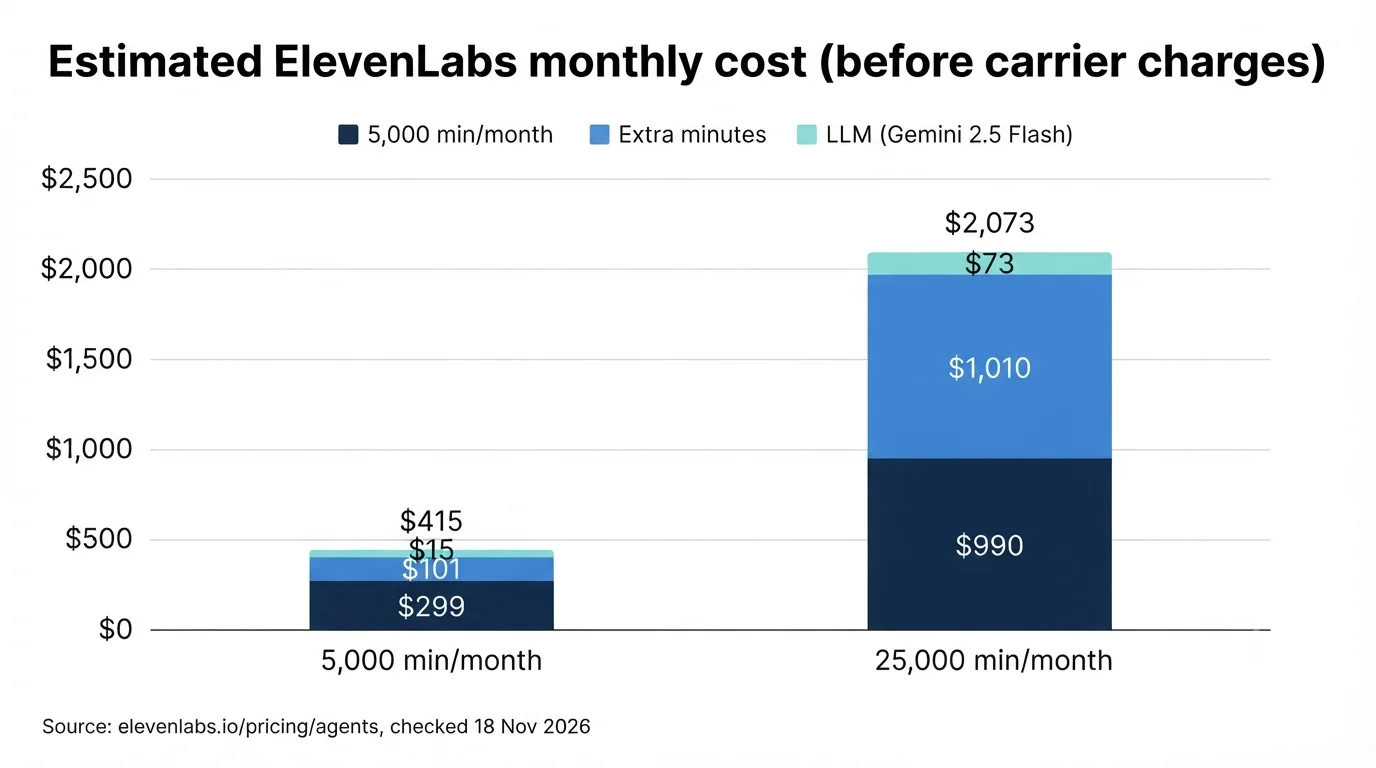
Here's ElevenLabs at two volumes, using the cheapest LLM in its calculator (Gemini 2.5 Flash at $0.0029 a minute):
5,000 minutes a month. Scale plan at $299 covers 3,738 minutes. The other 1,262 minutes cost about $101. LLM usage adds about $15. Total: roughly $415 a month before carrier charges.
25,000 minutes a month. Business plan at $990 covers 12,375 minutes. The other 12,625 minutes cost about $1,010. LLM usage adds about $73. Total: roughly $2,073 a month before carrier charges.
Carrier costs depend on your provider and country. On Twilio's US voice pricing, a local number costs $1.15 a month, receiving calls costs $0.0085 a minute and making calls costs $0.014 a minute (checked 18 November 2026). That adds roughly $43 (inbound) to $70 (outbound) at 5,000 minutes, and $213 to $350 at 25,000 minutes. A larger model such as GPT-5 or Claude Sonnet will raise the LLM line noticeably, so model your real choice in the ElevenLabs calculator.
We can't price Thoughtly the same way because there's no public rate. Ask Thoughtly for a quote at your expected volume, and ask whether it includes the LLM, the ElevenLabs voice cost if you use BYOK, and concurrency above 10.
Costs neither pricing page shows
The subscription is rarely the biggest number in year one. Expect to spend on prompt and workflow design, CRM field mapping, testing edge cases (no answer, wrong number, opt-out, failed transfer), and someone to monitor calls after launch. With Thoughtly, more of that ships ready-made for sales workflows. With ElevenLabs, you or a partner build it. Our AI call center cost comparison puts these numbers next to a human team.
Which platform fits your use case
Inbound lead qualification. Thoughtly has the edge. Speed-to-lead, qualification, booking and CRM write-back are its default flow, and an ops team can run it without engineers.
Customer support and service. ElevenLabs. Thoughtly is built and sold for revenue teams, so ticket lookups, order status, troubleshooting and support handoffs aren't what it's packaged for. ElevenLabs' tools and knowledge base handle these well; see our guide to voice AI for customer support.
Outbound campaigns. ElevenLabs, because it documents batch calling and doesn't restrict outbound by policy. You still own consent and calling-hour rules.
Regulated industries. Either works at Enterprise level. Thoughtly has more ready-made content for mortgage and insurance sales; ElevenLabs has broader certifications and India data residency.
Voice inside your own product. ElevenLabs, clearly. Its SDKs and web and mobile deployment are designed for this.
India and other non-US markets. ElevenLabs, for language coverage, Indian telephony integrations and local data residency.
Pros and cons
ElevenLabs
Pros
- Best-in-class voices, cloning and multilingual coverage from the company that makes the models
- Public, low entry pricing with a free tier
- Wide LLM choice, including your own model
- Works for support, sales, outbound and product use cases
- SOC 2, ISO 27001, PCI DSS, plus US, EU and India data residency
Cons
- You design the business workflow; sales-specific logic isn't pre-built
- Costs are split across plan, overage minutes, LLM and carrier, which makes forecasting harder
- Mid-call language switching needs testing because the docs and marketing disagree
Thoughtly
Pros
- Lead-conversion workflow, CRM write-back and multichannel follow-up ready on day one
- Runnable by an ops team without developers
- Can use ElevenLabs voices, including your own key on Scale and up
- Auto-QA, dedicated CSM and white-glove onboarding on Scale
Cons
- No public pricing
- 34+ languages and US-centric compliance tooling
- Custom LLM, HIPAA, SSO and data residency only on Enterprise
- Narrow by design: not built for support or cold outbound
Can you use ElevenLabs and Thoughtly together?
Yes. Thoughtly's "Bring your own ElevenLabs key" option lets you use your ElevenLabs voices, including custom clones, inside Thoughtly agents, and inherit your ElevenLabs volume discounts. It's limited on Flex.
This makes sense if you already pay for ElevenLabs (for dubbing, content or a support agent) and want the same brand voice on sales calls run by Thoughtly. It also means two vendors, two bills and two places to debug when a call goes wrong. If one platform can handle the whole job, use that one.
Thoughtly alternatives and ElevenLabs alternatives for voice agents
If neither fits, the platforms we see shortlisted most often are Vapi, Retell and Bland. Vapi and Retell are developer platforms where you pick each model and voice provider. Bland builds its own models and focuses on enterprise call volume. We've compared each against ElevenLabs: ElevenLabs vs Vapi, ElevenLabs vs Retell AI, ElevenLabs vs Bland AI, and all four together in ElevenAgents vs Vapi vs Retell vs Bland. For a wider shortlist, see our roundup of the best voice AI agents.
How to choose: five questions
- What starts the conversation? A form fill or CRM record points to Thoughtly. A customer calling about an order, a ticket or an appointment points to ElevenLabs.
- Who will own it after launch? An ops team with no developers will move faster on Thoughtly. A team with engineering help or an implementation partner gets more out of ElevenLabs.
- Which languages and countries? Outside English and Spanish, or in India, start with ElevenLabs.
- What compliance do you need on day one? HIPAA, SSO or data residency puts you on Enterprise with either vendor, so compare enterprise quotes, not entry plans.
- What will it cost at your real volume? Price ElevenLabs in its calculator with your actual model, get a written Thoughtly quote, and add carrier and implementation costs to both.
The fastest way to decide is to build one narrow flow on both: one lead or call source, one qualification path, one transfer and one failure case. Then compare the CRM record each produces.
Verdict
In the ElevenLabs vs Thoughtly decision, choose Thoughtly if you're a US sales team whose problem is reaching opted-in inbound leads fast, and you want that working without engineers. Choose ElevenLabs for customer support, outbound programmes, multilingual or Indian deployments, voice inside your product, or when you want control over the model, data and workflow. ElevenLabs also wins on price transparency: you can see what you'll pay before speaking to anyone.
How Haass can help
The main cost of picking ElevenLabs is the workflow you have to build. That's the work we do: prompt and workflow design, CRM and telephony wiring (including Indian carriers and DLT setup), testing and post-launch monitoring. If you're leaning towards ElevenLabs, see our ElevenLabs voice AI implementation service or read what to expect from an ElevenLabs implementation partner.
FAQ
Is Thoughtly built on ElevenLabs?
Partly. Thoughtly's stock AI voices come from the Cartesia and ElevenLabs catalogs, and its Scale and Enterprise plans let you bring your own ElevenLabs API key and custom voices. Thoughtly builds the rest itself: the lead triggers, qualification logic, SMS and email follow-up, CRM sync and reporting. It's a lead-conversion platform that uses ElevenLabs as one of its voice providers.
Which is cheaper, ElevenLabs or Thoughtly?
ElevenLabs is cheaper to start, with a free tier and paid plans from $6 a month. At 5,000 minutes a month, ElevenLabs comes to about $415 before carrier charges. Thoughtly publishes no prices, so you need a quote to compare. Ask whether that quote includes LLM costs, concurrency above 10 calls and any usage above plan allowances.
Which is better for customer support, ElevenLabs or Thoughtly?
ElevenLabs is the better fit for customer support. Thoughtly is built and sold for inbound sales and lead conversion, so support flows like order lookups, troubleshooting and ticket handoffs aren't part of its package. ElevenLabs agents can call your systems through tools and webhooks, answer from a knowledge base and transfer to humans, which covers most support use cases.
Can I use my own LLM with ElevenLabs or Thoughtly?
ElevenLabs lets you choose from dozens of models or connect your own through a server integration on any plan. Thoughtly lets you choose between GPT, Claude and Gemini on every plan, but a custom or self-hosted model is only available on Enterprise. Thoughtly's docs also say custom speech-to-text and text-to-speech providers aren't supported.
Does ElevenLabs or Thoughtly support Hindi?
ElevenLabs supports Hindi and several other Indian languages, offers Indian-accent voices, and provides data residency in India plus integrations with Indian telephony providers like Exotel and Plivo. Thoughtly lists 34+ languages but doesn't publish India-specific support. If you need Hinglish code-switching, test it on a live call before choosing either platform.