TL;DR
- The best voice agent API for most teams is the one that cuts the work after launch: testing, debugging, cost forecasting and changing providers. Demo latency matters less.
- If you have no platform engineers, pick a managed platform: ElevenLabs Agents if voice quality drives trust, Retell if you want a phone agent live fastest.
- If voice sits inside your own product and you have engineers who can own real-time audio, LiveKit Agents or Pipecat give you the most control. Vapi is the middle ground for teams that want to swap providers without running the infrastructure themselves.
- Run the same agent on two shortlisted platforms for two weeks on real calls before you sign anything. The plan is at the end of this post.
The pilot worked. Now it needs two engineers.
Your voice agent demo went well. Six weeks later, one engineer is chasing a 2-second pause that only happens on mobile calls, another is reconciling four invoices to work out what a minute actually costs, and nobody can say whether last Tuesday's prompt change made things better or worse. Choosing the best voice agent API is mostly a decision about who carries that work after launch.
Most "best voice agent API" lists rank platforms on latency and starting price. Those numbers matter, but they are measured on day one. Developer experience shows up in month three, when you need to test a change, trace a bad call, or explain the bill to finance.
This post scores eight platforms on what makes a voice AI SDK easy or painful to live with. A disclosure up front: Haass is an ElevenLabs implementation partner, so read our ElevenLabs section with that in mind. We have tried to be as blunt about its gaps as about everyone else's, and every price below links to the vendor's own page so you can check it.
What developer experience means for a voice agent API
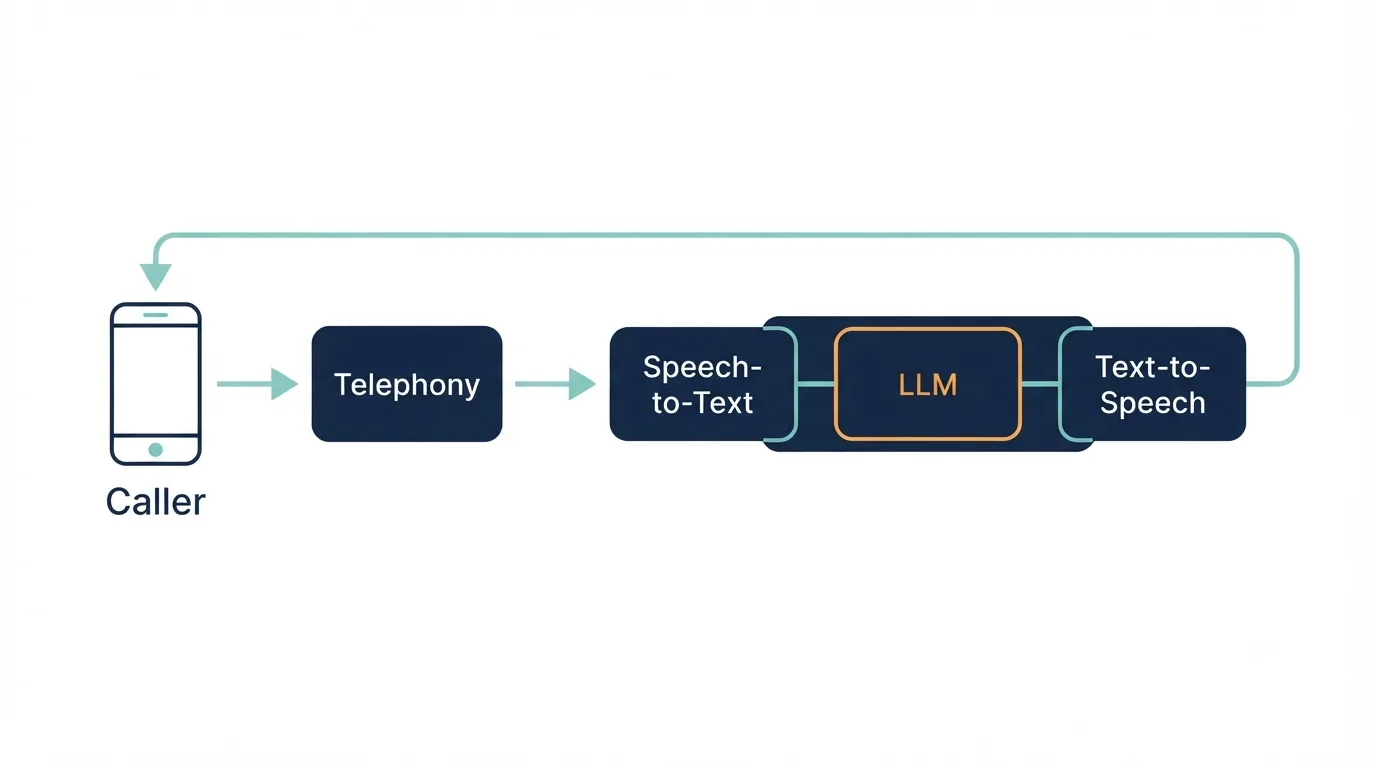
For a voice agent, developer experience is the total effort your team spends getting an agent live and keeping it good. We scored each platform on seven things, because these are where projects stall after the demo.
- Time to first working call. How long it takes to get a real phone or browser call talking to your agent, including telephony.
- SDK and API coverage. Server SDKs, client SDKs for web and mobile, and whether the API covers everything the dashboard does.
- Testing before production. Simulated conversations, test suites you can rerun after every prompt change, and A/B experiments on live traffic.
- Debugging live calls. Transcripts, recordings, per-turn latency broken down by stage, and tool-call logs.
- Agent config as code. Whether you can keep agents in git, deploy them per environment from a CLI, and review changes like any other code.
- Pricing you can forecast. How many separate line items make up one minute, and how easy the bill is to predict at 10x volume.
- Exit cost. How much you rewrite if you change your LLM, voice, carrier or the whole platform.
Latency appears in this list only indirectly. Every serious platform now quotes sub-second response times, and vendors measure different things, so their published numbers don't compare cleanly. What you can compare is how easily each platform lets you find latency when it goes wrong.
The scorecard
These ratings are our assessment from each vendor's public documentation and pricing pages, read in November 2026. They describe how much work each platform leaves with your team, so a "Weak" on control is a fair trade if you get speed in return.
| Platform | Type | First call | Testing | Debugging | Config as code | Cost forecasting | Exit cost |
|---|---|---|---|---|---|---|---|
| ElevenLabs Agents | Managed platform, own speech stack | Fast | Strong | Strong | Good (CLI) | Medium | Medium |
| Retell AI | Managed phone-agent platform | Fastest | Strong | Good | Good | Good | Medium |
| Vapi | Hosted orchestrator, bring your providers | Fast | Good | Good | Good | Weak | Low |
| LiveKit Agents | Open-source framework + cloud | Slow | Build your own | Good (you own it) | Strong | Medium | Lowest |
| Pipecat | Open-source Python framework | Slow | Build your own | You own it | Strong | Medium | Lowest |
| OpenAI Realtime | Speech-to-speech model API | Medium | Build your own | Medium | Code only | Weak | Medium |
| Deepgram Voice Agent API | Speech pipeline over one WebSocket | Medium | Build your own | Good event stream | Code only | Good | Medium |
| Bland / Telnyx | All-in rate, carrier included | Fast | Medium | Medium | Medium | Strong | High |
Two patterns stand out. Managed platforms win on the first three columns and lose some control on the last. Frameworks invert that: you get the lowest exit cost and full ownership, and you pay for it in engineering time to build what the managed platforms ship out of the box.
Same task, eight platforms
To make the scores concrete, picture one agent: it answers a call, books an appointment through your calendar API, and transfers to a human when the caller asks. We did not time a fresh build on every platform for this post. What follows is the setup path each vendor documents for that agent, so you can see where the work sits.
On ElevenLabs Agents and Retell, the agent is a prompt or a visual workflow, the booking is a webhook tool pointed at your API, the transfer is a built-in action, and the number is either bought on the platform or connected over SIP. Most of the work is writing the prompt and the tool schema. On Vapi, the path is the same shape, plus choosing a transcriber, LLM and voice and checking each one's latency together.
On LiveKit Agents or Pipecat, you write the agent in Python (or Node.js for LiveKit), pick provider plugins, implement the tool as a function, and handle the transfer through SIP yourself. You also deploy and monitor the worker. On OpenAI Realtime and Deepgram, the model side is quick, but you bridge the phone audio to their socket, which means a telephony provider and a media server you run.
The gap between "agent talks" and "agent books and transfers correctly on a real phone line" is where the frameworks cost weeks and the managed platforms cost days. If you have numbers from your own builds, that is the single most useful thing to add to an internal version of this comparison.
The eight platforms, scored on developer experience
1. ElevenLabs Agents
What it is. A managed voice agent platform that runs on ElevenLabs' own speech-to-text, text-to-speech and turn-taking model, with your choice of LLM or a custom one.
Example. You define the agent in the dashboard or as config, attach a knowledge base and webhook tools, then use the ElevenAgents CLI to version and deploy it from your terminal. Client SDKs cover React, React Native, Swift, Kotlin and Unity, and telephony connects through Twilio or a SIP trunk.
Benefit. You get one vendor for the whole speech path, so a slow turn has fewer places to hide. Built-in testing and experiments let you rerun scenarios after a prompt change and split live traffic between agent versions. The voices are the main reason teams shortlist it; if your agent sells, books or represents a brand, callers hear the difference. See our guide to picking the best TTS for voice agents.
Limitation. The published rate is $0.08 per call minute with speech included, but LLM usage is billed separately and telephony is billed at carrier cost, so a minute has three parts. HIPAA BAAs are on the Enterprise plan only. You also can't swap in another vendor's speech-to-text or voice, which is the trade for the integrated stack.
Who it fits. Product and CX teams who want a managed platform with real testing tools and the best voice quality available, and who can accept one speech vendor.
2. Retell AI
What it is. A managed platform built around phone agents, with a conversation flow builder, simulation testing and post-call analysis.
Example. You can buy a number, build a node-based flow with a booking function and a transfer node, and take a test call the same afternoon.
Benefit. Retell publishes a price for every layer, at $0.07 to $0.31 per minute depending on LLM and voice, so forecasting is easy. HIPAA and SOC 2 are included without an add-on fee.
Limitation. You work inside Retell's supported model and voice options. Its own docs publish around 600 ms latency, so test endpointing on your real callers before launch.
Who it fits. Teams that want a production phone agent quickly and value predictable billing over provider choice. Our ElevenLabs vs Retell AI comparison goes deeper on the trade-offs.
3. Vapi
What it is. A hosted orchestration layer. You pick the transcriber, LLM, voice and carrier; Vapi runs the real-time loop.
Example. Switching your transcription provider is a config change, so you can A/B two STT vendors on the same agent without touching call handling.
Benefit. Vapi charges $0.05 per minute for hosting and passes provider costs through without markup, or at zero if you bring your own keys. That makes it the cleanest way to compare providers on equal terms.
Limitation. Reliability reflects the stack you assemble, and each provider is one more thing to monitor. The bill has five lines (platform, STT, LLM, TTS, telephony), which makes finance conversations harder. HIPAA is a $2,000 per month add-on, which can cost more than your usage at low volume.
Who it fits. Engineering-led teams that want provider freedom without running the infrastructure. See ElevenLabs vs Vapi.
4. LiveKit Agents
What it is. An open-source framework for Python and Node.js, built on LiveKit's WebRTC server, with an optional managed cloud.
Example. Your agent joins a LiveKit room as a participant, so the same code serves a browser call, a mobile app and a SIP phone call.
Benefit. You own the code, can self-host, and can run any model, including speech-to-speech models. LiveKit Cloud includes 1,000 agent session minutes on its free tier, then $0.01 per minute before model and telephony costs.
Limitation. Testing, monitoring, deployment and on-call are yours. You need engineers comfortable with real-time media.
Who it fits. Product teams building voice into their own app who want no lock-in and have the platform engineers to support it.
5. Pipecat
What it is. An open-source Python framework (BSD-2 licence) that builds voice agents as pipelines of processors, with Pipecat Flows for structured conversations.
Example. You can drop a noise filter or a custom guardrail processor between speech-to-text and the LLM, which no managed platform lets you do.
Benefit. The most granular control over turn-taking, interruptions and provider mixing of anything here.
Limitation. Race conditions in real-time audio pipelines are hard to debug, and there is no visual builder for non-engineers.
Who it fits. Python teams with unusual pipeline needs who are happy to own the runtime.
6. OpenAI Realtime API
What it is. A speech-to-speech model API: audio in, audio out, with tool calls in the same session over WebRTC, WebSocket or SIP.
Example. A team already on OpenAI can have a browser voice demo running in an hour with the Agents SDK.
Benefit. One model removes the hand-offs between separate STT, LLM and TTS calls, and its protocol has become the one other vendors copy, which lowers exit cost later.
Limitation. Pricing is per audio token (gpt-realtime-2.1 lists $32 per million input and $64 per million output), which is hard to turn into a per-minute forecast. There is no voice cloning, and testing and analytics are yours to build.
Who it fits. Teams already standardised on OpenAI who want a speech-to-speech API and will build the surrounding tooling.
7. Deepgram Voice Agent API
What it is. Deepgram's speech-to-text, a managed LLM and text-to-speech over one WebSocket.
Example. You can keep Deepgram for speech recognition and plug in your own LLM and TTS, which drops the rate from $0.075 to $0.050 per minute on its pricing page.
Benefit. A flat per-minute rate and a detailed event stream, including latency reports split by stage.
Limitation. You bring your own telephony and build your own testing.
Who it fits. Teams already using Deepgram for transcription who want a low-latency voice API without another vendor.
8. Bland and Telnyx
What they are. Two platforms that put the carrier and the agent on one bill. Bland bundles telephony, STT, LLM and TTS into one rate ($0.14 per minute on its free plan, $0.12 on the $299 per month Build plan). Telnyx charges $0.05 per minute plus LLM tokens and carrier minutes, on its own network.
Benefit. The easiest bills to forecast here, and one support line when audio degrades.
Limitation. Less model choice, and the highest exit cost because the carrier is part of the platform. Telnyx rounds voice-engine charges to 60-second increments per call, which adds up on short calls.
Who they fit. High-volume outbound teams that care most about a single line item. See our ElevenLabs vs Bland AI comparison.
Head-to-heads developers ask about
Vapi vs LiveKit
Both let you choose your own models. The difference is who runs the real-time loop. Vapi hosts it, so your team writes config and tools and Vapi handles streaming, endpointing and scaling. LiveKit gives you the framework and the media server, so your team writes the agent as code and owns deployment. Pick Vapi if you want provider freedom this quarter with a small team. Pick LiveKit if voice is core to your product and you expect to customise turn-taking or run it in your own cloud.
Retell AI vs Vapi
Retell is the more opinionated product: fewer model choices, a flow builder, simulation testing and compliance included in the price. Vapi is more modular, and its pricing is cheaper on paper but split across more invoices. If your agent is a phone agent and your buyer is a CX leader, Retell is usually faster to defend. If your engineers want to benchmark three voices and two LLMs before committing, Vapi is easier. Our ElevenAgents vs Vapi vs Retell vs Bland breakdown puts all four side by side.
ElevenLabs Agents vs a raw speech-to-speech API
A speech-to-speech API such as OpenAI Realtime gives you the model. ElevenLabs Agents gives you the model layer plus testing, experiments, analytics, telephony integrations and a CLI. If you go the raw API route, budget for building those yourself; most teams underestimate the testing and analytics part. If you only need TTS inside your own pipeline, see our guide to ElevenLabs text-to-speech API integration.
The developer experience costs that don't show on pricing pages
Per-minute rates are the easy part of the budget. The expensive parts are harder to see.
Maintenance headcount. A framework-based agent needs someone on call for the media server, provider outages and audio bugs.
Debugging time. A slow turn in a five-vendor stack means checking five dashboards. A platform that reports latency per stage for each turn shows you which layer is slow without that hunt. Ask every vendor to show you a single bad call traced end to end.
Migration. The OpenAI Realtime protocol is becoming a common interface, and some vendors now document compatibility with it. Building to a widely copied protocol, or keeping prompts and tools in your own repo, makes a later move much cheaper.
Compliance add-ons. HIPAA can be an add-on fee, an Enterprise-only contract, or included. Check this before the pilot, because it can change your shortlist overnight. For a wider view of cost, see our AI call center cost comparison.
A two-week evaluation plan for your shortlist
You can test developer experience directly. Take two finalists and run this plan.
- Days 1–2: write the test. Pick one real use case. Write 20 scenarios, including interruptions, background noise, a caller who spells an email address, and a transfer request. Set pass thresholds before you build anything.
- Days 3–6: build the same agent on both. Same prompt, same tools, same voice where possible. Log how long each step took and where your engineers got stuck.
- Days 7–8: change something. Edit the prompt and swap the LLM. Time how long it takes to retest and redeploy safely. This is the step that shows you month-three life.
- Days 9–12: live traffic. Route a small share of real calls through each. Track dropped calls, failed transfers and slow turns, not only the median latency.
- Days 13–14: trace and price. Take the three worst calls on each platform and trace them to a cause. Then calculate the cost per resolved call, including engineering hours.
If a platform makes step 3 or step 5 painful, that is what your team will live with after launch. Our guide to reducing ElevenLabs agent latency covers what to tune when slow turns show up.
Verdict: the best voice agent API by team type
| Your team | Pick | Runner-up | Why |
|---|---|---|---|
| No platform engineers, customer-facing agent | ElevenLabs Agents | Retell AI | Testing, analytics and voice quality are built in |
| Phone agent live this month, predictable bill | Retell AI | ElevenLabs Agents | Fastest path to a live number, clear per-minute pricing |
| Engineers who want to swap providers | Vapi | LiveKit Agents | Provider freedom without running the media layer |
| Voice is core to your product | LiveKit Agents | Pipecat | Full ownership and the lowest exit cost |
| Already on OpenAI, building in-app voice | OpenAI Realtime | ElevenLabs Agents | One model, familiar SDK |
| High-volume outbound, one line item | Bland | Telnyx | Carrier and agent on one bill |
If you are comparing ElevenLabs with a specialist platform, our ElevenLabs vs PolyAI comparison covers the enterprise contact center case.
FAQ
What is the best voice agent API for developers?
The best voice agent API depends on how much of the stack your team wants to own. For a managed platform with built-in testing and strong voices, ElevenLabs Agents is our pick, with Retell close behind for phone agents. Vapi suits teams that want to swap providers. LiveKit Agents and Pipecat suit teams that want full control and can maintain real-time infrastructure.
How much does a voice agent API cost per minute?
Most voice agent APIs list between $0.05 and $0.14 per minute, but that rarely covers the whole call. Depending on the platform, LLM tokens, telephony and compliance add-ons are billed separately. Compare platforms on cost per resolved call, including the engineering hours each one needs every month, rather than on the headline per-minute rate.
What latency should a voice agent target?
Keep the pause before the agent replies as short as you can, and watch the slowest turns as closely as the median. A PNAS study of conversation across 10 languages found that speakers everywhere avoid overlapping talk and keep the silence between turns to a minimum, so callers notice long gaps quickly. Pick a platform that shows latency per stage for each turn, so you can find which layer is slow.
Should I build on an open-source framework or buy a managed platform?
Buy a managed platform if voice is a channel for your business and you lack engineers who can own real-time audio. Build on LiveKit Agents or Pipecat if voice is core to your product and you need custom turn-taking, self-hosting or zero lock-in. Many teams start managed, then move specific workloads to a framework once volume justifies the engineering cost.
Can I switch voice agent providers later?
Yes, but the cost depends on how you built. Keeping prompts, tool definitions and test scenarios in your own repo makes a move far cheaper. Platforms that support the OpenAI Realtime protocol, or let you bring your own LLM, reduce rewrite work. Telephony is usually the hardest part to move, so own your phone numbers where you can.
Choosing the best voice agent API for your team
The best voice agent API is the one your team can test, debug and change without slowing down. For most customer-facing teams without dedicated platform engineers, that points to ElevenLabs Agents: one speech stack, built-in testing and experiments, and the voice quality callers notice.
If you want help running the two-week evaluation, or getting an ElevenLabs agent into production on real phone lines, talk to Haass about ElevenLabs API implementation. You can also read how we approach an ElevenAgents implementation.